How do Galaxies Accrete Gas and Form Stars?
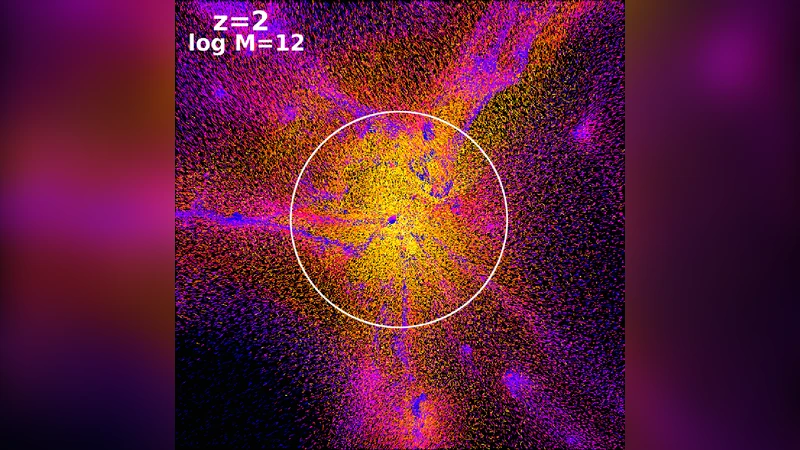
Great strides have been made in the last two decades in determining how galaxies evolve from their initial dark matter seeds to the complex structures we observe at z=0. The role of mergers has been documented through both observations and simulations, numerous satellites that may represent these initial dark matter seeds have been discovered in the Local Group, high redshift galaxies have been revealed with monstrous star formation rates, and the gaseous cosmic web has been mapped through absorption line experiments. Despite these efforts, the dark matter simulations that include baryons are still unable to accurately reproduce galaxies. One of the major problems is our incomplete understanding of how a galaxy accretes its baryons and subsequently forms stars. Galaxy formation simulations have been unable to accurately represent the required gas physics on cosmological timescales, and observations have only just begun to detect the star formation fuel over a range of redshifts and environments. How galaxies obtain gas and subsequently form stars is a major unsolved, yet tractable problem in contemporary extragalactic astrophysics. In this paper we outline how progress can be made in this area in the next decade.
💡 Research Summary
The paper provides a comprehensive review of the current state of knowledge and the outstanding challenges concerning how galaxies acquire gas and convert it into stars. It begins by outlining the hierarchical formation paradigm, where dark‑matter halos provide the gravitational scaffolding for baryonic matter, yet emphasizes that the baryonic physics—cooling, feedback, and star‑formation processes—remain poorly constrained on cosmological scales. The authors distinguish two primary modes of gas accretion: the “cold‑flow” regime, in which filamentary streams of relatively low‑temperature gas penetrate deep into the halo and directly fuel the central galaxy, and the “hot‑mode” regime, where gas is shock‑heated to the virial temperature, forms a quasi‑static halo, and later cools radiatively. Both modes have observational support: high‑redshift (z > 2) galaxies exhibit extreme star‑formation rates that demand a continuous supply of cold gas, while absorption‑line studies of the Lyman‑α forest, quasar sightlines, and 21 cm tomography map the large‑scale cosmic web and reveal the presence of both cold streams and hot halos.
The paper then surveys the most recent observational breakthroughs. Deep integral‑field spectroscopy with instruments such as MUSE and KCWI has resolved extended Lyman‑α nebulae around massive galaxies, directly imaging inflowing gas. The authors highlight the role of high‑velocity clouds (HVCs) and satellite dwarf galaxies in the Local Group as nearby laboratories for studying gas inflow, outflow, and recycling. Large‑area surveys with ALMA, NOEMA, and upcoming facilities like the ngVLA are beginning to detect molecular gas (CO,
Comments & Academic Discussion
Loading comments...
Leave a Comment