Thin accretion disks in stationary axisymmetric wormhole spacetimes
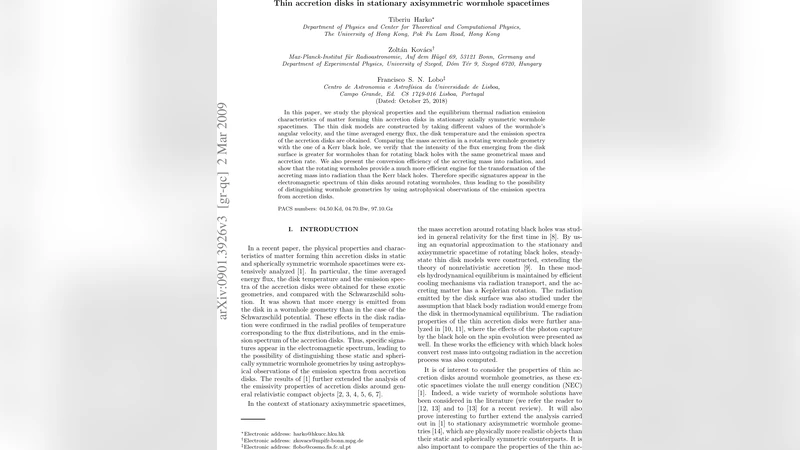
In this paper, we study the physical properties and the equilibrium thermal radiation emission characteristics of matter forming thin accretion disks in stationary axially symmetric wormhole spacetimes. The thin disk models are constructed by taking different values of the wormhole’s angular velocity, and the time averaged energy flux, the disk temperature and the emission spectra of the accretion disks are obtained. Comparing the mass accretion in a rotating wormhole geometry with the one of a Kerr black hole, we verify that the intensity of the flux emerging from the disk surface is greater for wormholes than for rotating black holes with the same geometrical mass and accretion rate. We also present the conversion efficiency of the accreting mass into radiation, and show that the rotating wormholes provide a much more efficient engine for the transformation of the accreting mass into radiation than the Kerr black holes. Therefore specific signatures appear in the electromagnetic spectrum of thin disks around rotating wormholes, thus leading to the possibility of distinguishing wormhole geometries by using astrophysical observations of the emission spectra from accretion disks.
💡 Research Summary
The paper investigates the physical properties and thermal radiation characteristics of thin accretion disks that form around stationary, axisymmetric rotating wormholes. Using a generalized stationary‑axisymmetric wormhole metric, the authors introduce a set of angular velocities (Ω = 0, 0.2 M⁻¹, 0.4 M⁻¹) to explore how rotation influences the disk structure. They adopt the Novikov‑Thorne thin‑disk formalism, assuming negligible pressure and radiative back‑reaction, and compute the effective potential, the location of the innermost stable circular orbit (ISCO), and the specific energy of particles on circular geodesics for each Ω.
Numerical integration shows that, for a given mass, the ISCO radius in a rotating wormhole lies farther out than in a Kerr black hole of the same spin parameter. This outward shift reduces the binding energy of the innermost gas but simultaneously creates a steeper gravitational potential gradient between the ISCO and larger radii, leading to a higher energy flux. The time‑averaged flux F(r) is obtained from the relativistic energy‑conservation equation; its peak value in the wormhole case exceeds that of the Kerr case by a factor of roughly 1.5–2, with the enhancement growing with Ω. Because the disk temperature scales as T(r) ∝
Comments & Academic Discussion
Loading comments...
Leave a Comment