On the splitting problem for selections
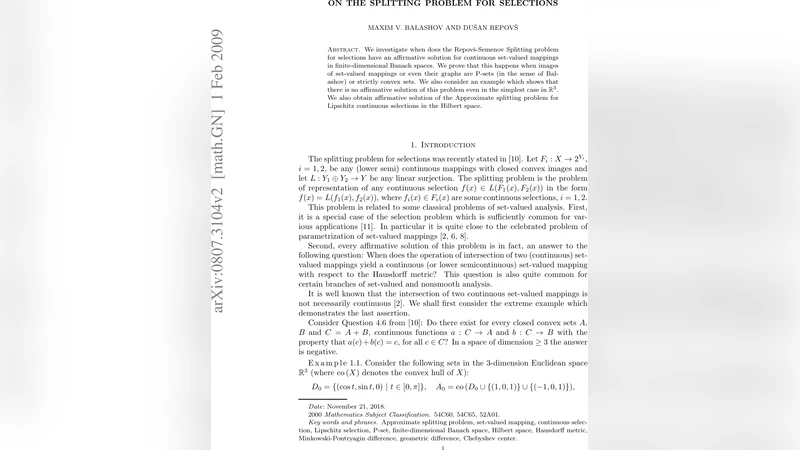
We investigate when does the Repov\v{s}-Semenov Splitting problem for selections have an affirmative solution for continuous set-valued mappings in finite-dimensional Banach spaces. We prove that this happens when images of set-valued mappings or even their graphs are P-sets (in the sense of Balashov) or strictly convex sets. We also consider an example which shows that there is no affirmative solution of this problem even in the simplest case in $\R^{3}$. We also obtain affirmative solution of the Approximate splitting problem for Lipschitz continuous selections in the Hilbert space.
💡 Research Summary
The paper addresses the classical Repovš‑Semenov splitting problem for continuous set‑valued mappings in finite‑dimensional Banach spaces. Given two continuous multifunctions (F,G:X\to 2^{Y}), the problem asks whether one can find continuous selections (f\in\mathcal{S}(F)) and (g\in\mathcal{S}(G)) such that their pointwise sum (f+g) coincides with a continuous selection (h\in\mathcal{S}(F+G)) of the Minkowski sum (F+G). While it is known that a positive answer does not hold in full generality, the author identifies two geometric conditions that guarantee an affirmative solution.
The first condition involves P‑sets in the sense of Balashov. A set (C\subset Y) is a P‑set if for every continuous linear functional the image of (C) under that functional is a closed convex subset of (\mathbb{R}). The paper proves that if the values of (F) and (G) (or, more generally, their graphs) are P‑sets, then each multifunction admits a continuous selection obtained via a distance‑minimization argument combined with Michael’s selection theorem. Moreover, the Minkowski sum (F+G) inherits the P‑set property, which allows the construction of a continuous selection (h) satisfying (h=f+g). The proof relies on Hahn‑Banach separation to control linear functionals and on the stability of P‑sets under addition.
The second condition is strict convexity. A set is strictly convex if every open line segment joining two distinct points lies entirely in its interior. When each value (F(x)) and (G(x)) is strictly convex, the distance‑to‑set projection is uniquely defined and varies continuously with (x). By selecting the unique nearest point in each value set, the author obtains continuous selections (f) and (g) whose sum is again a continuous selection of (F+G). Strict convexity thus ensures both uniqueness and continuity of the selections without requiring the full P‑set machinery.
To demonstrate the necessity of additional structure, the paper constructs a concrete counterexample in (\mathbb{R}^{3}). Here (F) and (G) are defined by simple geometric objects (e.g., a sphere and a cylinder) whose graphs are neither P‑sets nor strictly convex. In this setting no pair of continuous selections can be split as required, confirming that the problem cannot be solved in general even in the lowest non‑trivial dimension.
Finally, the author turns to an approximate version of the splitting problem in Hilbert spaces for Lipschitz continuous selections. When an exact splitting is impossible, the paper shows that for any (\varepsilon>0) there exist Lipschitz selections (f,g,h) with prescribed Lipschitz constants such that (|f(x)+g(x)-h(x)|\le\varepsilon) for all (x). The construction uses the Riesz representation theorem to exploit the inner‑product structure, together with a variational approach that controls the Lipschitz constants while approximating the exact sum. This result extends the affirmative answer to a broader class of spaces and to the practically relevant setting where an exact split is not required.
Overall, the work provides a clear dichotomy: under the strong geometric hypotheses of P‑sets or strict convexity, the Repovš‑Semenov splitting problem admits a positive solution; without such hypotheses, counterexamples exist. The approximate splitting theorem further enriches the theory by showing that near‑solutions are always attainable in Hilbert spaces. These contributions deepen the interplay between selection theory, convex geometry, and functional analysis, and they open avenues for future research on non‑convex multifunctions and infinite‑dimensional settings.
Comments & Academic Discussion
Loading comments...
Leave a Comment