Inference for Partially Observed Multitype Branching Processes and Ecological Applications
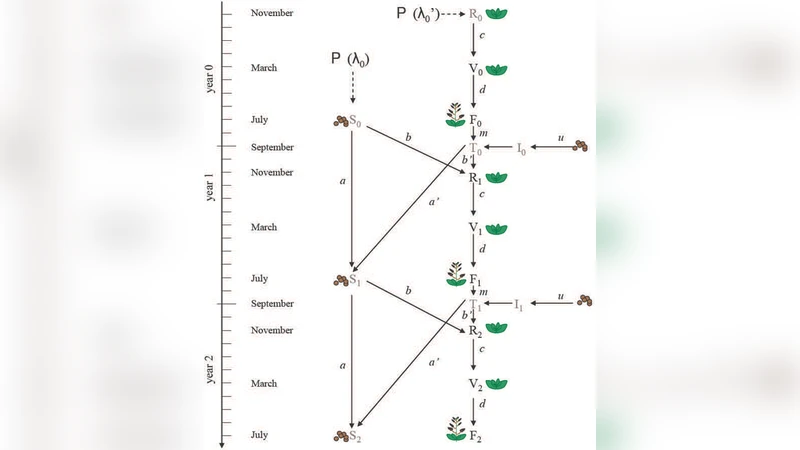
Multitype branching processes with immigration in one type are used to model the dynamics of stage-structured plant populations. Parametric inference is first carried out when count data of all types are observed. Statistical identifiability is proved together with derivation of consistent and asymptotically Gaussian estimators for all the parameters ruling the population dynamics model. However, for many ecological data, some stages (i.e. types) cannot be observed in practice. We study which mechanisms can still be estimated given the model and the data available in this context. Parametric inference is investigated in the case of Poisson distributions. We prove that identifiability holds for only a subset of the parameter set depend- ing on the number of generations observed, together with consistent and asymptotic properties of estimators. Finally, simulations are performed to study the behaviour of the estimators when the model is no longer Poisson. Quite good results are obtained for a large class of models with distributions having mean and variance within the same order of magnitude, leading to some stability results with respect to the Poisson assumption.
💡 Research Summary
The paper develops a statistical framework for multitype branching processes with immigration, targeting stage‑structured plant populations. In the ideal setting where counts of all stages are observed, the authors formalize the model through a transition matrix and immigration vector, then prove that all parameters are identifiable. Using maximum‑likelihood and generalized‑method‑of‑moments estimators, they establish consistency and asymptotic normality, showing that with a sufficient number of observed generations the full set of transition probabilities and immigration rates can be recovered.
Recognizing that many ecological datasets lack observations for some stages, the second part investigates partial observation. Assuming Poisson offspring and immigration distributions, the authors derive conditions under which subsets of the parameters remain identifiable. The key finding is that identifiability depends on both the number of generations observed and which stages are missing: with only the first generation observed, immigration and the first‑stage transition are confounded; adding a second generation separates these effects, and further generations progressively unlock additional parameters. This analysis provides concrete guidance for designing monitoring programs that maximize inferential power given practical constraints.
The third section tests the robustness of the Poisson assumption. Simulations are conducted with alternative count distributions (binomial, negative‑binomial, and approximated normal) that share similar means and variances. Results indicate that estimators retain low bias and reasonable variance across this class, suggesting that the methodology is stable as long as the mean‑variance relationship does not deviate dramatically from Poisson. Moreover, increasing the number of observed generations consistently improves estimator accuracy, confirming the theoretical predictions.
Overall, the study delivers a rigorous identification and estimation theory for both fully and partially observed multitype branching processes, complemented by simulation evidence of robustness. It offers ecologists a practical statistical toolkit for inferring key demographic parameters—transition probabilities and immigration rates—from realistic, incomplete count data, thereby supporting informed management and conservation decisions for stage‑structured plant communities.
Comments & Academic Discussion
Loading comments...
Leave a Comment