Finite Quasihypermetric Spaces
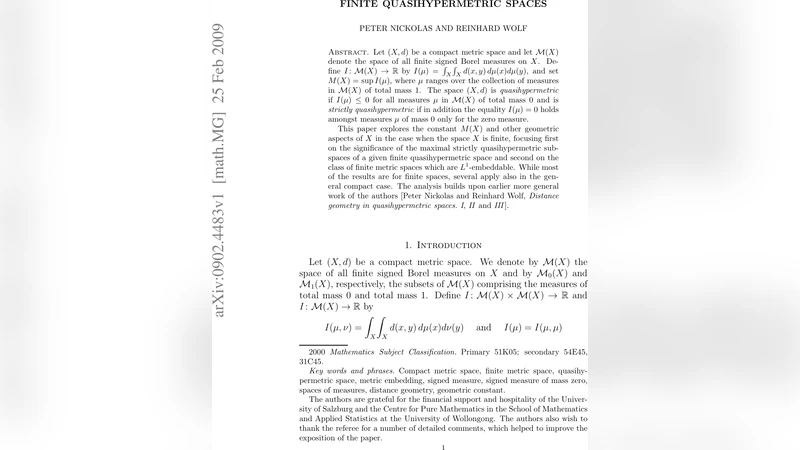
Let $(X, d)$ be a compact metric space and let $\mathcal{M}(X)$ denote the space of all finite signed Borel measures on $X$. Define $I \colon \mathcal{M}(X) \to \R$ by $I(mu) = \int_X \int_X d(x,y) d\mu(x) d\mu(y)$, and set $M(X) = \sup I(mu)$, where $\mu$ ranges over the collection of measures in $\mathcal{M}(X)$ of total mass 1. The space $(X, d)$ is \emph{quasihypermetric} if $I(\mu) \leq 0$ for all measures $\mu$ in $\mathcal{M}(X)$ of total mass 0 and is \emph{strictly quasihypermetric} if in addition the equality $I(\mu) = 0$ holds amongst measures $\mu$ of mass 0 only for the zero measure. This paper explores the constant $M(X)$ and other geometric aspects of $X$ in the case when the space $X$ is finite, focusing first on the significance of the maximal strictly quasihypermetric subspaces of a given finite quasihypermetric space and second on the class of finite metric spaces which are $L^1$-embeddable. While most of the results are for finite spaces, several apply also in the general compact case. The analysis builds upon earlier more general work of the authors [Peter Nickolas and Reinhard Wolf, \emph{Distance geometry in quasihypermetric spaces. I}, \emph{II} and \emph{III}].
💡 Research Summary
The paper investigates a family of compact metric spaces through the lens of a quadratic functional defined on signed Borel measures. For a compact metric space ((X,d)) the authors consider the space (\mathcal M(X)) of all finite signed Borel measures on (X) and define
\
Comments & Academic Discussion
Loading comments...
Leave a Comment