Developments around positive sectional curvature
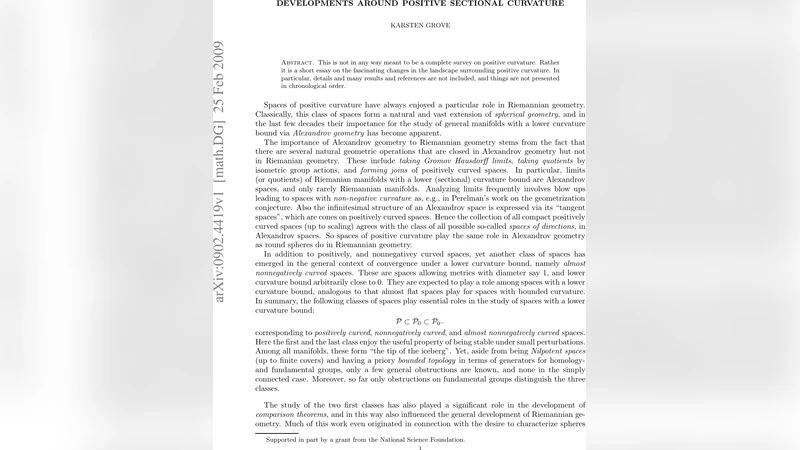
This is not in any way meant to be a complete survey on positive curvature. Rather it is a short essay on the fascinating changes in the landscape surrounding positive curvature. In particular, details and many results and references are not included, and things are not presented in chronological order.
💡 Research Summary
The paper offers a concise yet wide‑ranging essay on the recent transformations in the study of positive sectional curvature (PSC). Rather than attempting a comprehensive historical survey, the author selects a handful of pivotal developments that have reshaped the field over the past two decades and presents them in a non‑chronological, thematic fashion. The first theme revisits the classical examples—spheres, complex projective spaces, and the rank‑one symmetric spaces—and explains why they long dominated the landscape as the only known manifolds with PSC. The narrative then shifts to the breakthrough constructions of the 1990s and 2000s, most notably the Eschenburg spaces in dimension 7 and the Bazaikin spaces in dimension 13. These examples exploit non‑abelian group actions to produce manifolds that are topologically far more intricate (non‑simply‑connected, exotic fundamental groups) while still supporting a metric of positive sectional curvature, thereby disproving the naive belief that PSC forces a very restricted topology.
The second theme concerns symmetry and connectivity principles. The Grove–Searle symmetry‑rank theorem, Wilking’s connectedness principle, and subsequent refinements are described as powerful tools that translate the presence of a large isometry group into topological rigidity: if the symmetry rank exceeds a certain threshold, the manifold must be diffeomorphic to a sphere or a complex projective space. Wilking’s recent “enhanced connectedness” theorem further shows that fixed‑point sets of isometries inherit PSC and force a drop in dimension, tightening the constraints on possible PSC manifolds.
The third theme explores analytic methods, especially Ricci flow. Recent work by Perelman‑type analysts (e.g., Petersen and Vergara) has established a “positive sectional curvature preservation” result: under Ricci flow, an initial PSC metric remains PSC and, in many cases, evolves toward a round metric. This analytic convergence complements the topological rigidity results and opens the possibility of a flow‑based classification in low dimensions.
The paper then enumerates the remaining open problems. In dimensions ≤ 7, a full classification is still missing; the existence of further non‑homogeneous PSC examples beyond the known Eschenburg and Bazaikin families is unknown. The optimal bound for symmetry rank that forces rigidity remains conjectural, as does the precise relationship between PSC and various algebraic invariants such as the Smith index or eigenvalue spectra of the Laplacian.
Finally, the author proposes future research directions. A promising avenue is the synthesis of algebraic‑geometric techniques (e.g., Kähler–Einstein metrics on complex manifolds) with topological invariants to construct new PSC examples. Another is the development of refined symmetry‑rank invariants that capture subtler group actions. The paper also suggests computational experiments: numerical Ricci‑flow simulations combined with machine‑learning pattern detection could reveal hidden structures in the space of PSC metrics. In sum, the essay argues that the field of positive sectional curvature is at a crossroads where classical differential geometry, modern analysis, and emerging computational tools converge, and that this convergence is likely to generate the next generation of breakthroughs.
Comments & Academic Discussion
Loading comments...
Leave a Comment