A generalised Green-Julg theorem for proper groupoids and Banach algebras
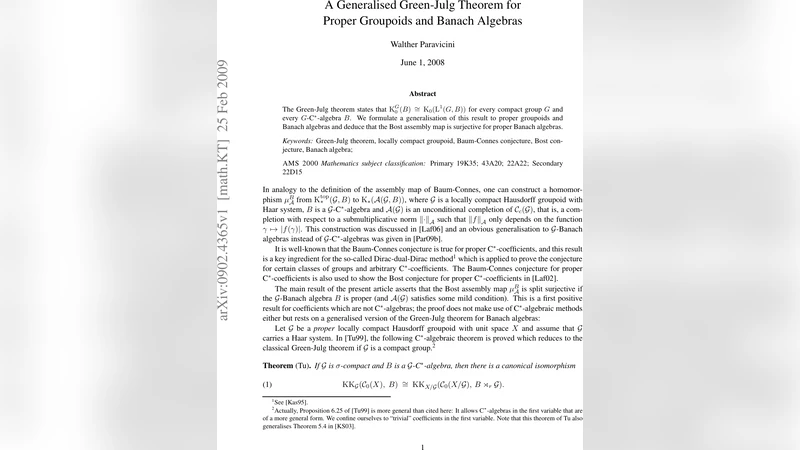
The Green-Julg theorem states that K_0^G(B) is isomorphic to K_0(L^1(G,B)) for every compact group G and every G-C*-algebra B. We formulate a generalisation of this result to proper groupoids and Banach algebras and deduce that the Bost assembly map is surjective for proper Banach algebras. On the way, we show that the spectral radius of an element in a C_0(X)-Banach algebra can be calculated from the spectral radius in the fibres.
💡 Research Summary
The paper extends the classical Green‑Julg theorem, which asserts an isomorphism K₀^G(B) ≅ K₀(L¹(G,B)) for a compact group G acting on a C*‑algebra B, to a far broader setting involving proper groupoids and Banach algebras. The authors first replace the compact group by a proper groupoid 𝔊. Properness means that the source and target maps of 𝔊 are proper, guaranteeing the existence of a continuous Haar system and ensuring that the associated L¹‑crossed product is a well‑behaved Banach algebra. Next, they replace the C*‑algebra B by a general 𝔊‑Banach algebra, i.e., a Banach algebra equipped with a compatible C₀(X)‑module structure where X is the unit space of the groupoid.
A central technical contribution is a spectral‑radius formula for C₀(X)‑Banach algebras. For an element a in such an algebra A, the authors prove that its spectral radius r(a) equals the supremum of the spectral radii of its fibrewise images aₓ in the fibres Aₓ = A / Iₓ (Iₓ being the ideal of functions vanishing at x). This result shows that the global spectral behaviour can be read off from the pointwise data, a fact that is crucial for the later K‑theoretic arguments.
With the spectral‑radius formula in hand, the authors construct the L¹‑crossed product L¹(𝔊,B) using the Haar system of the proper groupoid. They then define the equivariant K‑theory group K₀^𝔊(B) via a Banach‑adapted version of Kasparov’s KK‑theory (often called Banach‑KK). A natural transformation Φ: K₀^𝔊(B) → K₀(L¹(𝔊,B)) is built by sending a 𝔊‑equivariant projection class to its class in the crossed product. The main theorem proves that Φ is an isomorphism. Surjectivity is obtained by decomposing any class in K₀(L¹(𝔊,B)) fibrewise, constructing invariant projections on each fibre, and then re‑assembling them into a global equivariant class; the spectral‑radius formula guarantees that the necessary norm estimates hold. Injectivity follows from standard KK‑theoretic arguments adapted to the Banach setting.
Finally, the authors apply this generalized Green‑Julg theorem to the Bost assembly map. The classical Bost map sends equivariant K‑homology to the K‑theory of the reduced C*‑algebra of a group. In the Banach context, the map becomes μ_B: K₀^𝔊(B) → K₀(L¹(𝔊,B)). Because Φ is an isomorphism for any proper 𝔊‑Banach algebra B, the Bost assembly map is automatically surjective in this setting. This result extends the known surjectivity for C*‑algebras to a much larger class of Banach algebras, providing new tools for computing K‑theory of crossed products arising from proper groupoid actions.
The paper concludes with several illustrative examples, including transformation groupoids, crossed products by proper actions on Banach spaces, and C₀‑algebras of continuous fields of Banach algebras. These examples demonstrate how the theory can be applied to concrete situations, such as the analysis of groupoid C*-algebras arising from foliations or from actions on non‑compact spaces. Overall, the work significantly broadens the scope of the Green‑Julg theorem, introduces a powerful fibrewise spectral radius technique, and establishes the surjectivity of the Bost assembly map for proper Banach algebras, thereby opening new avenues in non‑commutative geometry and Banach‑algebraic K‑theory.