The Bost conjecture, open subgroups and groups acting on trees
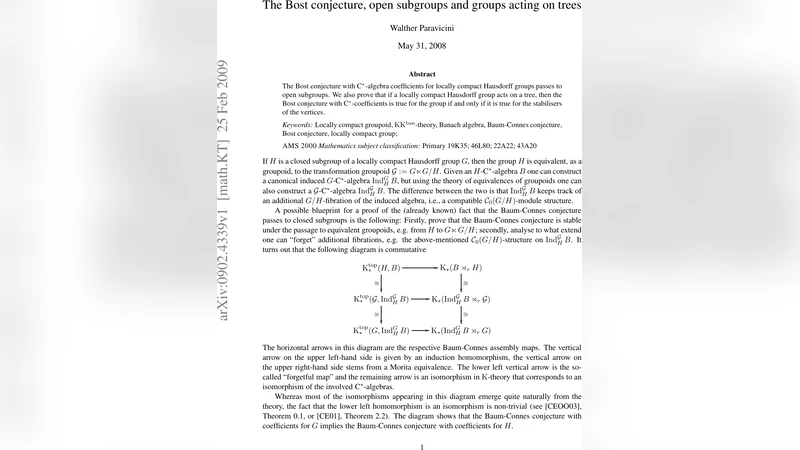
The Bost conjecture with C*-algebra coefficients for locally compact Hausdorff groups passes to open subgroups. We also prove that if a locally compact Hausdorff group acts on a tree, then the Bost conjecture with C*-coefficients is true for the group if and only if it is true for the stabilisers of the vertices.
💡 Research Summary
The paper addresses two fundamental inheritance properties of the Bost conjecture with C*‑algebra coefficients for locally compact Hausdorff groups. The Bost conjecture, a variant of the Baum‑Connes conjecture, predicts that the assembly map β_G^A : K_^{\mathrm{top}}(G;A) → K_(A\rtimes_r G) is an isomorphism for any G‑C*‑algebra A. While the conjecture has been verified for many classes of groups (e.g., amenable groups, groups with the Haagerup property), systematic results describing how the conjecture behaves under natural group‑theoretic constructions have been scarce.
The first main theorem shows that the conjecture passes from a locally compact group G to any open subgroup H⊂G. The proof relies on the existence of a continuous, G‑equivariant section φ : G → H that allows one to define induction and restriction functors between the equivariant KK‑categories KK^G and KK^H. Using the Haar measures on G and H, the authors construct explicit KK‑elements Ind_H^G and Res_G^H that are mutual inverses. They then verify that the Bost assembly maps for G and H intertwine with these KK‑elements, i.e., β_G^A∘Ind_H^G = Ind_H^G∘β_H^A and similarly for restriction. Consequently, β_G^A is an isomorphism if and only if β_H^A is, establishing the desired inheritance. This result mirrors the well‑known Baum‑Connes inheritance for open subgroups but is proved directly in the C*‑coefficient setting without recourse to the full machinery of the Baum‑Connes conjecture.
The second main theorem concerns groups acting on trees. Let G be a locally compact Hausdorff group that acts continuously on a simplicial tree T without edge inversions. For each vertex v∈V(T) let G_v denote its stabilizer, which is a closed subgroup of G. The authors construct the transformation groupoid 𝔾_T = G⋉T and analyze its reduced C*‑algebra via a Mayer‑Vietoris type exact sequence in equivariant K‑theory. By applying the first theorem to each vertex stabilizer, they show that the Bost assembly map for G is an isomorphism precisely when the assembly maps for all vertex stabilizers G_v are isomorphisms. The proof proceeds by decomposing K_*^{\mathrm{top}}(G;A) into contributions from the vertices and edges, using Kasparov’s descent and the exactness of the assembly map with respect to the groupoid’s short exact sequences. The “if and only if” statement is achieved by demonstrating that the edge stabilizers do not introduce new K‑theoretic obstructions once the vertex stabilizers satisfy the conjecture.
After establishing these two inheritance principles, the paper discusses several applications. For instance, groups that act on regular trees (such as p‑adic linear groups, certain amalgamated free products, and groups with a Bass‑Serre decomposition) automatically satisfy the Bost conjecture once their vertex stabilizers are known to do so. Moreover, the open‑subgroup result allows one to reduce the conjecture for a complicated group to its more tractable open subgroups, which is particularly useful for groups that are unions of increasing open subgroups (e.g., direct limits of Lie groups).
The authors conclude by outlining future directions, including extending the tree‑action inheritance to higher‑dimensional CAT(0) complexes, investigating permanence under other geometric constructions (e.g., HNN extensions), and exploring connections with the coarse Baum‑Connes conjecture in the presence of C*‑coefficients. Overall, the paper provides a robust framework showing that the Bost conjecture is stable under two widely occurring operations—passing to open subgroups and forming groups acting on trees—thereby significantly broadening the class of groups for which the conjecture is known to hold.
Comments & Academic Discussion
Loading comments...
Leave a Comment