New Results in the Simultaneous Message Passing Model
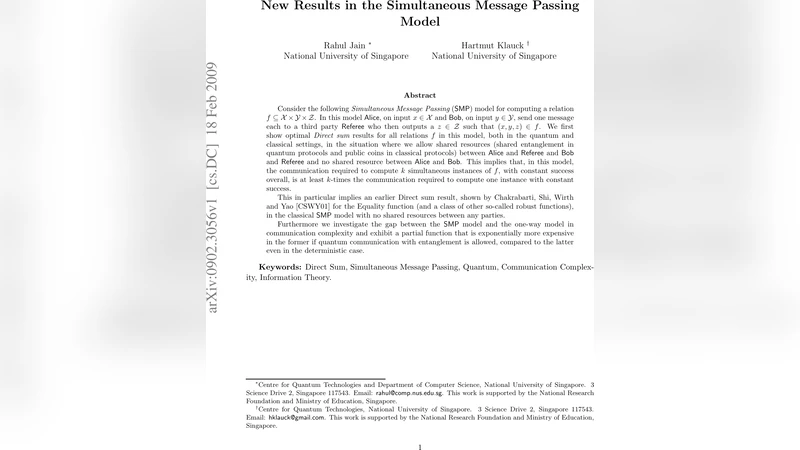
Consider the following Simultaneous Message Passing (SMP) model for computing a relation f subset of X x Y x Z. In this model Alice, on input x in X and Bob, on input y in Y, send one message each to a third party Referee who then outputs a z in Z such that (x,y,z) in f. We first show optimal ‘Direct sum’ results for all relations f in this model, both in the quantum and classical settings, in the situation where we allow shared resources (shared entanglement in quantum protocols and public coins in classical protocols) between Alice and Referee and Bob and Referee and no shared resource between Alice and Bob. This implies that, in this model, the communication required to compute k simultaneous instances of f, with constant success overall, is at least k-times the communication required to compute one instance with constant success. This in particular implies an earlier Direct sum result, shown by Chakrabarti, Shi, Wirth and Yao, 2001, for the Equality function (and a class of other so-called robust functions), in the classical smp model with no shared resources between any parties. Furthermore we investigate the gap between the smp model and the one-way model in communication complexity and exhibit a partial function that is exponentially more expensive in the former if quantum communication with entanglement is allowed, compared to the latter even in the deterministic case.
💡 Research Summary
The paper studies the Simultaneous Message Passing (SMP) model, where two parties, Alice and Bob, each receive private inputs x∈X and y∈Y and send a single message to a third party, the Referee, who must output a value z∈Z such that (x,y,z) belongs to a prescribed relation f⊆X×Y×Z. The authors focus on a setting in which Alice‑Referee and Bob‑Referee may share resources—public randomness in the classical case and shared entanglement in the quantum case—while Alice and Bob themselves have no shared resource.
The first major contribution is an optimal direct‑sum theorem that holds for all relations f in this SMP model, both classical and quantum. Formally, let C(f,ε) denote the minimum total communication (the sum of the lengths of Alice’s and Bob’s messages) required to compute f with error at most ε in a single instance. The theorem states that for any integer k≥1, any protocol that simultaneously solves k independent instances of f with overall success probability at least 1−δ must use at least k·C(f,ε)−O(log k) bits/qubits of communication, where ε and δ are fixed constants (e.g., ε=δ=1/3). In other words, the communication cost scales linearly with the number of instances, and this bound is tight.
The proof combines information‑theoretic compression arguments with a careful analysis of the shared resources. In the classical setting, the authors use Shannon entropy and the subadditivity of mutual information to show that each message must convey essentially the same amount of information as in the single‑instance optimal protocol. In the quantum setting, they employ von Neumann entropy, the quantum substate theorem, and Schumacher compression to argue that shared entanglement cannot be leveraged to compress the total quantum message beyond the single‑instance bound. A “block‑wise” reduction then aggregates the k instances, preserving the linear lower bound.
As a corollary, the paper recovers and strengthens the earlier direct‑sum result of Chakrabarti, Shi, Wirth, and Yao (2001) for the Equality function and a broader class of “robust” functions. That earlier work considered the SMP model without any shared resources; the present theorem shows that even when public coins (classical) or shared entanglement (quantum) are allowed, the same linear scaling holds.
The second major contribution is an exponential separation between the SMP model and the one‑way communication model, even when quantum communication with entanglement is permitted in SMP. The authors construct a partial function g that can be computed deterministically in the one‑way model with O(n) bits of communication, yet any quantum SMP protocol with shared entanglement that computes g with constant success probability requires Ω(2ⁿ) qubits of total communication. The construction exploits the fact that, in SMP, the Referee must simultaneously decode information that is “distributed” across two entangled messages; without direct interaction between Alice and Bob, the Referee essentially needs to reconstruct an exponentially large quantum state. In contrast, the one‑way model allows Alice to send the entire relevant information directly to the Referee, avoiding the exponential blow‑up.
The paper concludes with a discussion of implications and open problems. The optimal direct‑sum theorem confirms that parallelizing SMP tasks does not yield any hidden communication savings, which is valuable for designing distributed protocols where bandwidth is a premium. The exponential gap highlights that the choice of communication model can dramatically affect complexity, especially when quantum resources are involved. Future directions suggested include (i) tightening the dependence on error parameters, (ii) extending the direct‑sum result to settings with limited shared entanglement or multi‑referee architectures, and (iii) identifying broader classes of functions that exhibit exponential SMP‑to‑one‑way separations.
Comments & Academic Discussion
Loading comments...
Leave a Comment