Reciprocal transformations and flat metrics on Hurwitz spaces
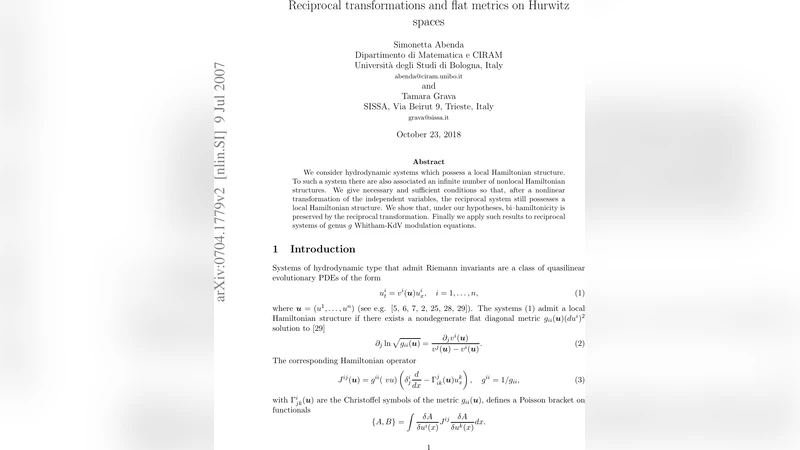
We consider hydrodynamic systems which possess a local Hamiltonian structure of Dubrovin-Novikov type. To such a system there are also associated an infinite number of nonlocal Hamiltonian structures. We give necessary and sufficient conditions so that, after a nonlinear transformation of the independent variables, the reciprocal system still possesses a local Hamiltonian structure of Dubrovin-Novikov type. We show that, under our hypotheses, bi-hamiltonicity is preserved by the reciprocal transformation. Finally we apply such results to reciprocal systems of genus g Whitham-KdV modulation equations.
💡 Research Summary
The paper investigates hydrodynamic‑type systems that admit a local Hamiltonian structure of Dubrovin‑Novikov (DN) type, i.e. a Poisson bracket of the form
(P^{ij}=g^{ij}(u)\partial_x+\Gamma^{ij}_k(u)u^k_x)
with a flat metric (g^{ij}). It is well known that such systems possess infinitely many non‑local Hamiltonian structures generated by conserved densities and their associated fluxes. The central question addressed is: under what conditions does a reciprocal (or nonlinear change of independent variables) transformation preserve the DN‑type local Hamiltonian structure?
A reciprocal transformation is defined by two conserved densities (\rho(u),\sigma(u)) and their fluxes (J^\rho(u),J^\sigma(u)):
(d\tilde x=\rho,dx+J^\rho,dt,\qquad d\tilde t=\sigma,dx+J^\sigma,dt.)
The Jacobian of this map must be non‑zero, guaranteeing a diffeomorphism of the ((x,t)) plane. The authors derive necessary and sufficient conditions for the transformed system to retain a DN bracket. The first condition requires that the pair ((\rho,J^\rho)) (and similarly ((\sigma,J^\sigma))) be compatible with a second non‑local Poisson structure of the original system; in other words, the densities must lie in the kernel of the associated recursion operator. The second condition is a flatness preservation requirement: the transformed metric (\tilde g^{ij}) must remain flat, which translates into the symmetry equation
(\partial_k(\rho,g^{ij})-\partial_j(\rho,g^{ik})=0.)
Geometrically this means that (\rho) acts as a scalar factor preserving the Levi‑Civita connection of the original metric.
When these conditions hold, the transformed system inherits a DN bracket with metric (\tilde g^{ij}=\rho^{-1}g^{ij}) (up to a constant factor) and connection coefficients that satisfy the same flatness relations. Moreover, if the original system is bi‑Hamiltonian—i.e. it possesses two compatible DN brackets—then the reciprocal transformation preserves bi‑Hamiltonicity. The proof relies on showing that the two transformed Poisson operators continue to commute and that the associated recursion operator remains hereditary after the change of variables.
The theoretical framework is then applied to the Whitham modulation equations for the Korteweg‑de Vries (KdV) hierarchy on a genus‑(g) Hurwitz space. Hurwitz spaces parametrize branched coverings of the Riemann sphere and serve as natural phase‑space manifolds for the averaged dynamics of finite‑gap solutions. The Whitham‑KdV system is already known to be bi‑Hamiltonian with two DN structures: one derived from the averaged conservation of mass, the other from the averaged conservation of energy. By selecting appropriate conserved densities (e.g., the averaged action variables) and constructing the corresponding reciprocal transformation, the authors verify that the flatness condition is satisfied. Consequently, the reciprocal Whitham‑KdV system retains both DN brackets, confirming that the bi‑Hamiltonian property is invariant under the transformation.
In summary, the paper provides a complete set of algebraic‑geometric criteria guaranteeing that a reciprocal transformation maps a DN‑type Hamiltonian hydrodynamic system to another DN‑type system, and that bi‑Hamiltonian integrability is preserved. The results extend the toolbox for studying integrable hierarchies on high‑dimensional moduli spaces, offering a rigorous justification for employing non‑linear changes of independent variables without destroying the underlying Hamiltonian geometry.
Comments & Academic Discussion
Loading comments...
Leave a Comment