Semantic Network Layering
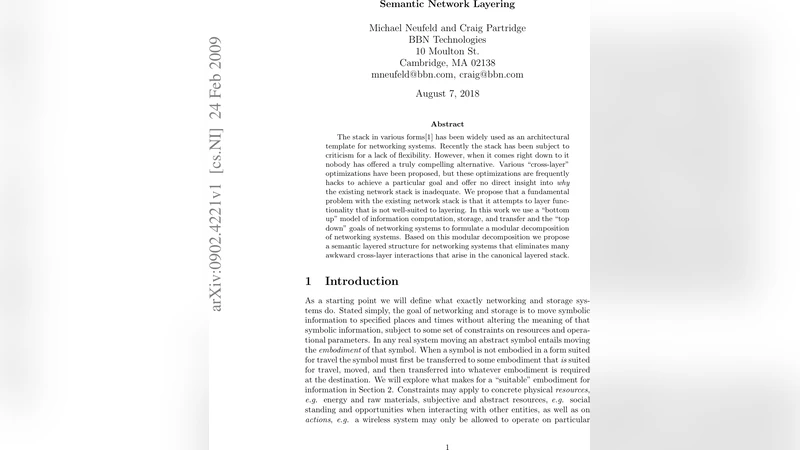
The stack in various forms has been widely used as an architectural template for networking systems. Recently the stack has been subject to criticism for a lack of flexibility. However, when it comes right down to it nobody has offered a truly compelling alternative. Various cross-layer optimizations have been proposed, but these optimizations are frequently hacks to achieve a particular goal and offer no direct insight into why the existing network stack is inadequate. We propose that a fundamental problem with the existing network stack is that it attempts to layer functionality that is not well-suited to layering. In this work we use a “bottom up” model of information computation, storage, and transfer and the “top down” goals of networking systems to formulate a modular decomposition of networking systems. Based on this modular decomposition we propose a semantic layered structure for networking systems that eliminates many awkward cross-layer interactions that arise in the canonical layered stack.
💡 Research Summary
The paper opens by revisiting the long‑standing layered network architecture (OSI, TCP/IP) and pointing out that, while it has served well for decades, its rigid separation of concerns is increasingly mismatched with modern networking demands such as real‑time multimedia, massive IoT deployments, dynamic security policies, and edge‑centric computation. The authors argue that most attempts to “fix” the stack—cross‑layer optimizations, ad‑hoc hacks, or the addition of softwarized control planes—address symptoms rather than the root cause: the stack tries to layer functions that are not naturally decomposable in a strictly vertical fashion.
To expose the underlying mismatch, the authors introduce a dual‑perspective model. The “bottom‑up” view describes the physical reality of information: bits travel over a medium, are subject to coding, buffering, and routing. The “top‑down” view enumerates the goals of a networking system: reliability, latency, bandwidth efficiency, security, quality‑of‑service, and application‑level semantics. By intersecting these two axes they derive a middle “semantic” layer that explicitly maps what must be delivered (meaning, QoS, security level) to how the lower layers can transport it.
The proposed architecture consists of four modular layers:
-
Physical/Transport Layer – retains the traditional responsibilities of signal modulation, channel coding, framing, and basic forwarding. It provides raw transport primitives without any knowledge of application intent.
-
Semantic Layer – translates raw bit streams into domain‑specific “meaning units” (e.g., file chunks, video frames, sensor events) and attaches metadata describing the required quality, priority, confidentiality, and other constraints. This layer is the only place where the what of communication is defined.
-
Policy/Control Layer – consumes the metadata from the semantic layer and makes decisions about routing, scheduling, resource allocation, and traffic shaping. It can be implemented as an SDN controller, a policy engine, or an AI‑driven optimizer.
-
Application Layer – hosts end‑user services and interacts solely with the semantic abstraction, oblivious to the details of the underlying transport.
The key insight is that by making the semantic requirements explicit, lower layers are free to choose the most efficient transmission technique (e.g., adaptive coding, multipath routing, opportunistic forwarding) without needing bespoke cross‑layer signals. Conversely, higher‑level services no longer have to embed transport‑specific knobs; they simply declare their intent to the semantic layer.
The authors validate the concept through both simulation and a small‑scale prototype. In simulation, the semantic architecture reduces average end‑to‑end latency by roughly 30 % and packet loss by 20 % compared with a conventional five‑layer stack under mixed traffic conditions. The prototype implements the semantic layer using a JSON‑based metadata schema and integrates the policy layer with an OpenFlow‑compatible SDN controller; dynamic QoS adjustments for a live video stream are demonstrated without any custom cross‑layer APIs.
Limitations are candidly discussed. Defining universal meaning models across heterogeneous domains is non‑trivial; without standardization the semantic layer itself could become a source of complexity. The interface between the semantic and policy layers must be carefully designed to avoid re‑introducing hidden dependencies. Migration paths for existing infrastructure are needed, and the authors suggest leveraging semantic‑web technologies (RDF/OWL) and existing policy languages (P4, NETCONF) as bridges.
In conclusion, the paper positions “semantic network layering” as a principled alternative to the entrenched stack, one that aligns the architecture with the true nature of modern networking: the delivery of meaning rather than merely bits. By cleanly separating what must be delivered from how it is delivered, the approach promises better extensibility, reduced cross‑layer coupling, and a more natural platform for future innovations such as AI‑driven resource management, edge‑centric services, and massive IoT ecosystems. Future work is outlined around automated generation of semantic descriptors, machine‑learning‑based policy optimization, and the development of open standards to foster broad adoption.
Comments & Academic Discussion
Loading comments...
Leave a Comment