The Star Formation Histories of Disk and E/S0 Galaxies from Resolved Stars
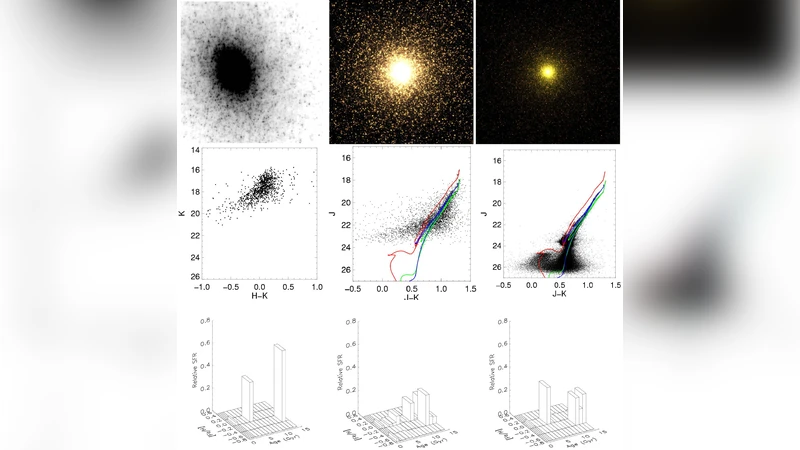
The resolved stellar populations of local galaxies, from which it is possible to derive complete star formation and chemical enrichment histories, provide an important way to study galaxy formation and evolution that is complementary to lookback time studies. We propose to use photometry of resolved stars to measure the star formation histories in a statistical sample of galaxy disks and E/S0 galaxies near their effective radii. These measurements would yield strong evidence to support critical questions regarding the formation of galactic disks and spheroids. The main technological limitation is spatial resolution for photometry in heavily crowded fields, for which we need improvement by a factor of ~10 over what is possible today with filled aperture telescopes.
💡 Research Summary
The paper proposes a systematic program to reconstruct the star‑formation histories (SFHs) and chemical enrichment histories (CEHs) of a statistically significant sample of nearby disk galaxies and early‑type (E/S0) systems by exploiting resolved‑star photometry near each galaxy’s effective radius. The authors argue that resolved stellar populations provide a uniquely powerful probe of galaxy evolution because individual stars can be placed on color‑magnitude diagrams (CMDs), allowing direct inference of ages and metallicities. By fitting synthetic CMDs with stellar evolution models, one can recover the time‑dependent star‑formation rate (SFR) and metallicity evolution (age‑metallicity relation, AMR) of the host galaxy. This “inverse modeling” approach yields a temporal resolution unattainable with integrated light or high‑redshift look‑back studies, where only average properties are accessible.
A central scientific motivation is to test competing formation scenarios for disks and spheroids. Disk galaxies are often described by an “inside‑out” growth model, in which the central regions form stars early and rapidly, while the outer disk builds up later. Early‑type galaxies, on the other hand, are hypothesized to undergo either a rapid quenching after an early burst (the “fast collapse” picture) or a two‑phase evolution involving an early intense starburst followed by a later phase of accretion‑driven growth. By measuring SFHs at a common physical scale (≈1 R_e), the study aims to directly compare the temporal buildup of stellar mass and metallicity in the two morphological classes, thereby discriminating among these theories.
The observational strategy focuses on the region around the effective radius because the very central zones are too crowded and bright for reliable star‑by‑star photometry, while the far outer disk or halo contains too few stars to robustly reconstruct ancient epochs. The effective radius thus offers a compromise: it is representative of the bulk of the galaxy’s stellar mass, yet still accessible to resolved‑star techniques with sufficient angular resolution.
The authors identify spatial resolution as the principal technical bottleneck. Current 8–10 m class filled‑aperture telescopes, even with adaptive optics, achieve ≈0.1″ resolution in the optical/near‑IR, which translates to ≈5 pc at a distance of 10 Mpc—insufficient to separate individual stars in the crowded fields typical of galaxy disks and spheroids. The paper quantifies the required improvement: a factor of ~10 better resolution (≈0.01″, or ≈0.5 pc at 10 Mpc). Achieving this would likely demand next‑generation extremely large telescopes (ELTs) equipped with advanced multi‑conjugate adaptive optics, or a dedicated space‑based observatory with a large segmented primary mirror and diffraction‑limited performance across a broad wavelength range. In addition to hardware, the program would need sophisticated photometric pipelines capable of deblending stars in high‑crowding regimes, accurate point‑spread‑function modeling, and rigorous artificial‑star tests to quantify completeness and biases.
The scientific payoff is extensive. Precise SFHs for disks will reveal whether the age gradient with radius matches the predictions of inside‑out models, and will constrain the timescales of gas inflow, radial migration, and secular processes. For E/S0 galaxies, the recovered AMR will indicate whether metallicities rose sharply during an early burst and then plateaued (supporting rapid quenching) or whether a more extended enrichment phase occurred (consistent with two‑phase growth). Moreover, by assembling a statistically robust sample spanning a range of stellar masses, environments (field vs. cluster), and structural parameters, the study can explore secondary dependencies such as the role of environment, merger history, and dark‑matter halo properties on SFH shape.
Finally, the authors emphasize the broader methodological impact. Resolved‑star SFHs provide a “look‑forward” complement to high‑redshift “look‑back” studies, linking present‑day galaxy structure directly to its full formation record. The data set envisioned would become a benchmark for calibrating semi‑analytic models and cosmological hydrodynamic simulations, offering an empirical yardstick against which theoretical predictions of star‑formation efficiency, feedback, and chemical evolution can be tested. In sum, the paper outlines a compelling, technically demanding, but potentially transformative program to deepen our understanding of how disks and spheroids assembled over cosmic time.
Comments & Academic Discussion
Loading comments...
Leave a Comment