Parametrized post-post-Newtonian analytical solution for light propagation
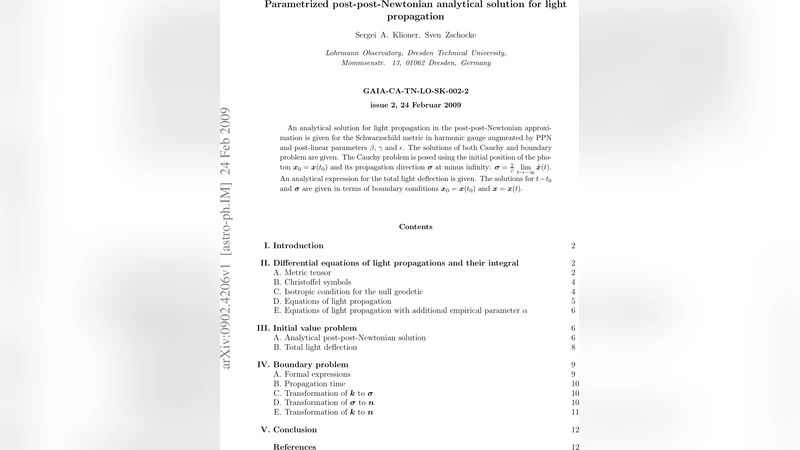
An analytical solution for light propagation in the post-post-Newtonian approximation is given for the Schwarzschild metric in harmonic gauge augmented by PPN and post-linear parameters $\beta$, $\gamma$ and $\epsilon$. The solutions of both Cauchy and boundary problem are given. The Cauchy problem is posed using the initial position of the photon $\ve{x}0 = \ve{x}(t_0)$ and its propagation direction \ve{\sigma} at minus infinity: $\ve{\sigma} = {1\over c} \lim\limits{t \to -\infty}\dot{\ve{x}}(t)$. An analytical expression for the total light deflection is given. The solutions for $t - t_0$ and $\ve{\sigma}$ are given in terms of boundary conditions $\ve{x}_0 = \ve{x} (t_0)$ and $\ve{x} = \ve{x}(t)$.
💡 Research Summary
The paper presents a fully analytical solution for light propagation in the post‑post‑Newtonian (2PN) approximation of general relativity, extending the standard parametrized post‑Newtonian (PPN) framework to include a second‑order non‑linear parameter ε in addition to the familiar β and γ. The authors work in harmonic gauge, where the Schwarzschild metric is expressed as a perturbation series in powers of 1/c, and they retain all terms up to order c⁻⁴. By doing so they capture not only the linear (1PN) curvature effects that give the classic light‑deflection formula, but also the quadratic curvature contributions that become relevant for micro‑arcsecond astrometry.
Two complementary boundary‑value formulations are derived. The first is a Cauchy problem: the photon’s initial position x₀ = x(t₀) and its asymptotic propagation direction σ (defined as the limit of the velocity divided by c as t → –∞) are prescribed, and the trajectory x(t) is obtained as a series expansion in the impact parameter b and the PPN parameters. The second formulation solves the boundary problem where the positions at two finite times, x₀ = x(t₀) and x = x(t), are given; from these the elapsed coordinate time Δt = t – t₀ and the direction σ are reconstructed. Both solutions involve elementary functions (logarithms, arctangents) and display explicitly how β, γ, and ε enter each term.
A central result is the closed‑form expression for the total light‑deflection angle α: \
Comments & Academic Discussion
Loading comments...
Leave a Comment