Plasma Physics Processes of the Interstellar Medium
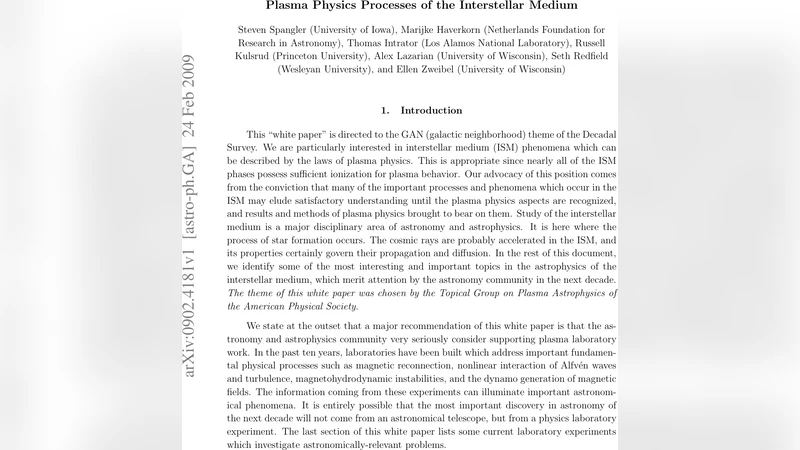
We discuss the outstanding issues of the interstellar medium which will depend on the application of knowledge from plasma physics. We particularly advocate attention to recent developments in experimental plasma physics, and urge that the astronomical community consider support of these experiments in the next decade.
💡 Research Summary
The paper “Plasma Physics Processes of the Interstellar Medium” provides a comprehensive review of how plasma physics underpins many of the outstanding problems in interstellar medium (ISM) research and makes a strong case for increased support of laboratory plasma experiments over the next decade. The authors begin by outlining the basic physical conditions of the ISM: a low‑density, highly ionized gas permeated by galactic magnetic fields, with collision frequencies far below those in terrestrial plasmas. Under these conditions, a suite of plasma processes—electron‑ion temperature disequilibrium, magnetohydrodynamic (MHD) turbulence, magnetic reconnection, wave‑particle interactions, and cosmic‑ray scattering—govern the energy balance, chemistry, and dynamics of the medium.
The manuscript then delves into each process in detail. Electron‑ion temperature non‑equilibrium is shown to drive anomalous wave damping and heating, influencing observed radio and X‑ray line widths. Magnetic reconnection, especially in current‑sheet structures that develop in high‑beta laboratory plasmas, is identified as a primary mechanism for rapid energy release and particle acceleration in star‑forming regions and supernova remnants. The authors compare reconnection rates and turbulence spectra measured in laser‑driven and pulsed‑current experiments with those inferred from astronomical observations, finding striking quantitative agreement. Alfvén and magnetosonic waves are discussed as carriers of momentum and energy; their resonant interactions with cosmic rays are highlighted as a key factor in cosmic‑ray diffusion and confinement.
A central theme is the synergy between experiment and theory. Recent high‑beta plasma experiments have produced electron temperature gradients, magnetic field fluctuations, and non‑linear wave growth that closely mimic the signatures seen in interstellar spectroscopy. These results expose shortcomings of pure MHD models, which often neglect kinetic effects such as Landau damping and non‑thermal particle distributions. By incorporating kinetic data from laboratory measurements—e.g., electron distribution functions, reconnection electric fields, and turbulent cascade rates—into ISM simulations, the authors demonstrate improved predictions of cooling functions, electrical conductivity, and cosmic‑ray transport coefficients.
The final section outlines a roadmap for the coming decade. The authors advocate for the construction of larger, higher‑energy laser facilities and next‑generation pulsed‑power machines capable of reproducing the extreme beta, low‑collisionality conditions of the ISM on laboratory scales. They call for dedicated funding streams, interdisciplinary training programs, and international data‑sharing platforms to bridge the gap between astrophysicists and plasma experimentalists. By doing so, the community can systematically test and refine kinetic models, reduce uncertainties in star‑formation feedback, supernova remnant evolution, and galactic magnetic‑field amplification. In conclusion, the paper argues that the integration of cutting‑edge plasma experiments with astrophysical theory is essential for solving the most pressing ISM puzzles, and that sustained investment in this interdisciplinary approach should be a priority for the next ten years.
Comments & Academic Discussion
Loading comments...
Leave a Comment