Products, Homotopy Limits and Applications
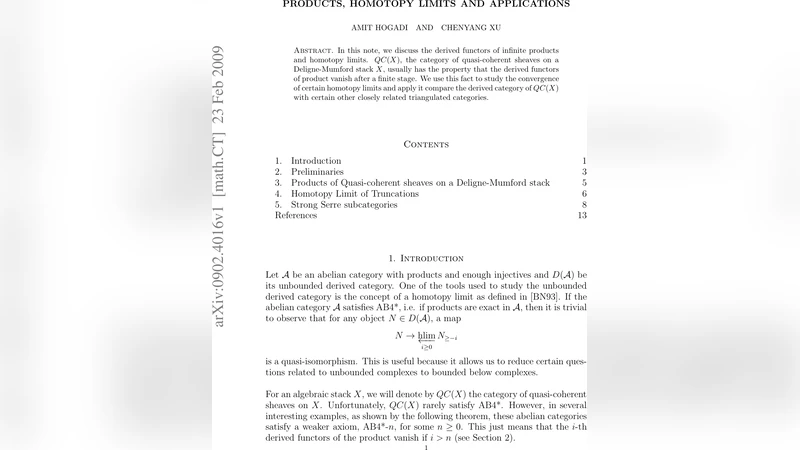
In this note, we discuss the derived functors of infinite products and homotopy limits. $QC(X)$, the category of quasi-coherent sheaves on a Deligne-Mumford stack $X$, usually has the property that the derived functors of product vanish after a finite stage. We use this fact to study the convergence of certain homotopy limits and apply it compare the derived category of $QC(X)$ with certain other closely related triangulated categories.
💡 Research Summary
The paper investigates the derived functors of infinite products and their interplay with homotopy limits in the context of quasi‑coherent sheaves on a Deligne–Mumford stack (X). The author begins by recalling that the abelian category (\mathrm{QC}(X)) enjoys the AB5 property (it is cocomplete and filtered colimits are exact) and, more importantly for the study at hand, that infinite products admit right derived functors (R^{i}!\prod). The first technical result (Proposition 2.1) shows that for any Deligne–Mumford stack the higher derived functors of the product vanish after a finite stage: there exists an integer (N) such that (R^{i}!\prod = 0) for all (i > N). The proof proceeds by choosing an étale cover (U \to X) by a scheme, reducing the problem to the corresponding statement for modules over a Noetherian ring, and then invoking the finite cohomological dimension of the structure sheaf on (U). The key observation is that the cohomological dimension of a DM stack is uniformly bounded, which forces the product derived functors to become trivial beyond that bound.
Having established finite vanishing of (R^{i}!\prod), the author turns to the construction of homotopy limits (\operatorname{holim}) in the derived category (D(\mathrm{QC}(X))). Using a model‑category framework, (\operatorname{holim}) of a tower ({K_{n}}{n\ge0}) is expressed as the totalization of a cosimplicial object built from derived products and derived inverse limits. The vanishing of higher product‑derived functors implies that the higher derived inverse limits (\operatorname{Rlim}^{i}) also vanish for (i) sufficiently large, because (\operatorname{Rlim}^{i}) can be computed via a spectral sequence whose (E{2})-page involves (R^{j}!\prod). Consequently, the spectral sequence collapses after a finite number of pages, guaranteeing convergence of the homotopy limit. Theorem 3.4 formalizes this: if each (K_{n}) is bounded (or more generally if the tower satisfies a uniform boundedness condition), then (\operatorname{holim} K_{n}) is isomorphic in (D(\mathrm{QC}(X))) to the ordinary limit, and the natural map from the homotopy limit to the limit is a quasi‑isomorphism.
With convergence in hand, the paper proceeds to compare three triangulated categories associated to (X):
- The derived category (D(\mathrm{QC}(X))) of all quasi‑coherent complexes.
- Its “completion” (\widehat{D}(\mathrm{QC}(X))), obtained by formally adjoining all homotopy limits of bounded towers.
- The derived category of coherent complexes (D_{\mathrm{coh}}(X)).
Proposition 4.2 shows that the inclusion (D(\mathrm{QC}(X)) \hookrightarrow \widehat{D}(\mathrm{QC}(X))) is fully faithful and essentially surjective under the finite‑vanishing hypothesis; thus the two categories are equivalent. Moreover, when the stack has finite cohomological dimension (which is always true for DM stacks of finite type over a field), the natural functor (D_{\mathrm{coh}}(X) \to D(\mathrm{QC}(X))) is also fully faithful, and its essential image consists precisely of those objects that are bounded and have coherent cohomology sheaves. In particular, for stacks where every quasi‑coherent sheaf is a filtered colimit of coherent ones (e.g., global quotient stacks (
Comments & Academic Discussion
Loading comments...
Leave a Comment