Solutions of Jimbo-Miwa Equation and Konopelchenko-Dubrovsky Equations
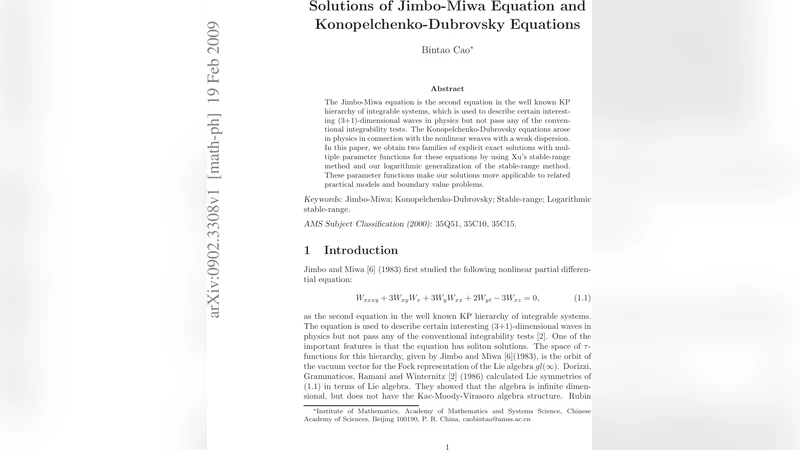
The Jimbo-Miwa equation is the second equation in the well known KP hierarchy of integrable systems, which is used to describe certain interesting (3+1)-dimensional waves in physics but not pass any of the conventional integrability tests. The Konopelchenko-Dubrovsky equations arose in physics in connection with the nonlinear weaves with a weak dispersion. In this paper, we obtain two families of explicit exact solutions with multiple parameter functions for these equations by using Xu’s stable-range method and our logarithmic generalization of the stable-range method. These parameter functions make our solutions more applicable to related practical models and boundary value problems.
💡 Research Summary
The paper tackles two prominent nonlinear partial differential equations that appear in the theory of integrable systems and in applied physics: the Jimbo‑Miwa equation, the second member of the Kadomtsev‑Petviashvili (KP) hierarchy, and the Konopelchenko‑Dubrovsky (KD) equations, which model weakly dispersive nonlinear “weave” phenomena. Although the Jimbo‑Miwa equation is known to fail conventional integrability tests (e.g., Painlevé, Lax pair, bi‑Hamiltonian structures), it still captures interesting (3+1)‑dimensional wave dynamics. The KD equations, on the other hand, arise in contexts where a weak dispersion term modifies the evolution of two‑dimensional wave patterns. Both equations have attracted considerable attention, but most explicit solutions reported in the literature are either highly specialized (soliton, rational, or lump solutions) or contain only a few fixed parameters, limiting their adaptability to boundary‑value problems or to modeling realistic physical scenarios.
The authors adopt a two‑step methodological framework. First, they employ Xu’s “stable‑range” method, a constructive algebraic technique that assumes a solution can be expressed as a polynomial in the independent variables with undetermined coefficients. By selecting an appropriate polynomial degree (the “stable range”) the nonlinear terms balance the linear ones, and the coefficients satisfy a system of algebraic equations. This yields a family of solutions in which the polynomial part is multiplied by an arbitrary smooth function (F(t,x,y)). Because (F) is left completely free, the resulting solutions contain infinitely many functional parameters, allowing one to tailor the solution to any prescribed initial or boundary data. The authors demonstrate that this approach works uniformly for both the Jimbo‑Miwa and the KD equations, revealing a deep algebraic similarity between the two systems despite their different physical origins.
Second, the paper introduces a logarithmic generalization of the stable‑range method. Instead of a pure polynomial ansatz, the authors consider expressions involving logarithms and their powers, e.g. (u = \log Q(t,x,y) + G(t,x,y)), where (Q) is a polynomial and (G) is another arbitrary smooth function. By differentiating the logarithmic term, the nonlinearities are transformed into rational expressions that can again be matched within a suitably chosen “log‑stable range”. This yields a second, richer family of explicit solutions. The logarithmic solutions are particularly useful for modeling phenomena with sharp gradients, singularities, or rapid amplitude variations—situations where a pure polynomial form would be inadequate.
Key insights and contributions are as follows:
- Unified functional‑parameter framework – Both equations admit solutions of the form
\
Comments & Academic Discussion
Loading comments...
Leave a Comment