Random Quantum Operations
We define a natural ensemble of trace preserving, completely positive quantum maps and present algorithms to generate them at random. Spectral properties of the superoperator Phi associated with a given quantum map are investigated and a quantum anal…
Authors: Wojciech Bruzda, Valerio Cappellini, Hans-J"urgen Sommers
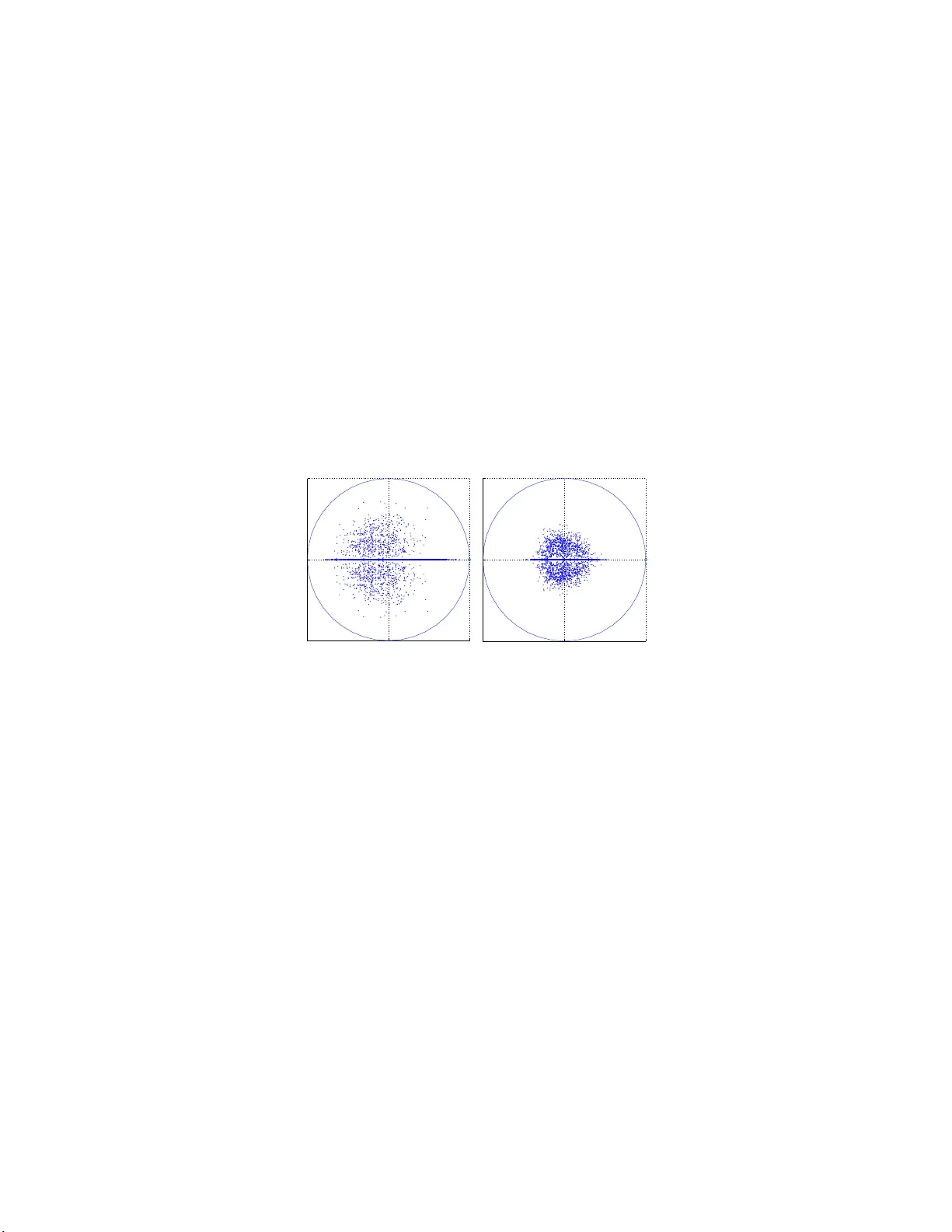
Random Quan tum Op erations W o jciech Bruzda 1 , V alerio Capp ellini 1 , Hans-J ¨ urgen Sommers 2 , and Karo l ˙ Zyczko wsk i 1 , 3 1 Mark Kac Complex Systems R ese ar ch Centr e, Inst itute of Physics, Jagiel lonian Un iversity, ul. R eymonta 4, 30-059 Kr ak´ ow, Poland 2 F achb er eich Physik, Universit¨ at Duisbur g-Essen, Ca m pus Duisbur g, 47 048 Duisbur g, Germany 3 Centrum Fizyki T e or etycznej, Polska Akademia Nauk, A l. L otnik´ ow 3 2/44, 02-668 Warszawa, Poland (Dated: October 13, 2008) W e define a natural ensemble of trace preserving, completely p ositive quantum maps and present algorithms to generate them at random. Sp ectral p roperties of the sup erop erator Φ associated with a given qu antum map are inv estigated and a qu antum analogue of t he F rob enius–Perron theorem is proved. W e derive a general form ula for the density of eigen v alues of Φ and sho w the conn ection with the Ginibre ensemble of real non- symmetric random matrices. Numerical inv estigations of th e sp ectral gap imply that a generic state of the system iterated several t imes by a fixed generic map conv erges ex p onential ly to an inv arian t state. Random dynamical systems are sub ject of a considerable scientific int er est. Certain statistical proper ties of classical deterministic sy stems which exhibit chaotic b ehavior can b e describ ed by random pr o cesses. A simila r link ex ists als o in the quantum theory , since q uantum a nalogues of classica lly ch a otic dy namical systems display sp ectral pr op erties characteristic of ensembles o f ra ndom matrices [1]. In the case of an isolated quantum system the dynamics is represented b y a u nitar y ev olution opera tor which acts on the space of pure quantum states. T o characterize such evolution op erators for p erio dic ally driven, quantum chaotic systems the Dyson circula r ensembles of rando m unitary matrices a re o ften used. The symmetry proper ties of the system determine which univ er sality clas s should b e used [2]. In a more genera l case of a quantum system coupled with an en vir onment one needs to work with densit y op er ators. In suc h a case any d is crete dynamics is gov erned by a quantum op er ation [3] whic h maps the set of all density opera tors of size N into itself. Investigations o f the set S N of all quantum oper ations play the key role in the field of quantum information pr o cessing [4], since a ny physical tra nsformation of a state carr ying q uantum infor mation has to b e describ ed by an element of this set. T o pro cess quant um information one needs to transform a giv en quan tum state in a con tro lled w ay . Wh en des igning a sequence of quantum opera tions, which constitutes a quan tum algorithm, it is imp or tant to understand the prop erties of ea ch op era tion and to estimate the influence o f any impe rfection in realization of an op er ation on the final result. In order to des crib e a n effect of ex ternal noise a cting on a qua n tum sy stem one often uses certain mo dels of ra ndom quantum ope rations. On the other hand, random opera tions are purpos ely applied to obtain pseudo–rando m q uantum circuits [5, 6]. These p ossible applications pr ovide mo tiv ation for rese arch on r andom quantum op erations. The main aim of this work is to constr uct a general c lass of ra ndom quantum op erations and to analyze their prop erties. Mo re for mally , we in tr o duce a natural probability measure whic h co vers the en tire set S N of q uantum op erations and present an efficient algorithm to gener ate them ra ndomly . W e inv es tigate sp ectral pr op erties o f sup erop erato rs asso ciated with qua n tum op erations and infer conclusions ab out the convergence of a ny initial s tate sub jected to the re pea ted action of a given random op eration to its inv ariant state. It is w o rth to empha size that the sp ectral prop erties o f super op erator s are alr eady acce ssible ex per imentally , as demonstrated b y W einstein et a l. [7] in a study of a three-qubit nuclear magnetic r esonance quantum information pro ces sor. W e star t reviewing the classical pr oblem, in which classical informatio n is encoded in to a probabilit y vector ~ p of length N . The s et of all cla ssical states of size N for ms the pro bability simplex ∆ N − 1 . A discrete dynamics in this set is given by a trans formation p ′ i = S ij p j , where S is a rea l square matrix of siz e N , which is sto chastic , i.e.: a) S ij ≥ 0 for i, j = 1 , . . . , N ; b) P N i =1 S ij = 1 for all j = 1 , . . . , N . If a r eal matrix S satisfies assumptions (a ) and (b) then i) the sp ectrum { z i } N i =1 of S belongs to the unit disk, | z i | ≤ 1 , and the lea ding eigenv alue equals unity , z 1 = 1 ; ii) the eigenspa ce asso c iated with z 1 contains (at least) a real eigenstate ~ p inv , which describ es the inv a riant measure of S . If additionally c) P N j =1 S ij = 1 for all i = 1 , . . . , N then the matrix S is called bisto chastic (doubly sto chastic) and iii) the maximally mixed state is inv ar iant, ~ p inv = (1 / N , . . . , 1 / N ) . 2 This is a form of the well-known F rob eni us–P erron (FP) theorem and its pro of may be found e.g. in [8, 9]. T o g enerate a ra ndom sto chastic matr ix it is c onv enient to s tart with a squar e matrix X fro m the complex Ginibre ensemble, all elements of which are indep endent complex ra ndom Gaussian v ariables. Then the ra ndom matrix S ij := | X ij | 2 / N X m =1 | X mj | 2 , (1) is stochastic [10], and eac h of its columns forms an independent random vector distr ibuted uniformly in the probability simplex ∆ N − 1 . Let us now discuss the quantum case, in which any state can b e descr ib ed by means of a p ositive, no rmalized op erator , ρ ≥ 0, T r ρ = 1. Let M N denote the set of all nor malized states which act on a N -dimensional Hilb ert space H N . A q uantum a nalogue of a sto chastic matrix is given by a linear quantum map Φ : M N → M N which preserves the trace, and is completely p ositive (i.e. the ex tended ma p, Φ ⊗ 1 K , is po sitive for a ny size K of the e xtension 1 K ). Such a transformation is ca lled quantu m op er ation or sto chastic map , and ca n be describ ed by a matrix Φ of size N 2 , ρ ′ = Φ ρ or ρ mµ ′ = Φ mµ nν ρ nν . (2) It is co nv enient to r eorder elements of this matrix [3 , 11] defining the so-called dynamic al matrix D , D (Φ) ≡ Φ R so that D mn µν = Φ mµ nν , (3) since the ma trix D is Hermitian if the map Φ pres erves Hermiticity . Note that the ab ov e eq uation ca n be interpreted as a definition of the op eration o f r eshuffling (realignment) of a matrix X , denoted by X R . This definitio n is representation dep endent, and co rresp onds to ex changing the p o sition of s ome element s o f a matr ix. Obviously reshuffling is an inv olution: D R = Φ. Due to the theo rem of Choi [12], a map Φ is completely p ositive (CP) if and only if the corr esp onding dynamical matrix D is p os itive, D ≥ 0. Hence D can b e interpreted as a p ositive op erator acting on a co mpo sed Hilb ert s pace H := H A ⊗ H B . Any completely po sitive ma p can also b e written in the Kr aus form [13], ρ → ρ ′ = X i A i ρA † i . (4) The set o f Kr aus op erator s A i allows one to wr ite down the linear sup er op erator a s Φ = X i A i ⊗ ¯ A i , (5) where ¯ A i is the co mplex conjugate of A i , while A † i denotes the adjoint op er ator: A † i = ¯ A T i . The map Φ is tr ac e pr eserving , T r ρ ′ = T r ρ = 1 , if P i A † i A i = 1 N . This condition is equiv alent to a partial trace condition imp osed on the dynamical matr ix, T r A D (Φ) = 1 N , (6) which implies T r D = N . Since the dy namical map of an o pe ration Φ is p os itive and normalized, the r escaled matrix D / N ma y b e co nsidered as a state in an extended Hilb ert space H A ⊗ H B of size N 2 . Sto chastic maps and states on the extended space H A ⊗ H B are r elated b y the so–c alled Jamio lkowski isomor phism [3, 14] . Making use o f the maximally en tangled bipartite state | ψ + i = 1 √ N P N i =1 | i, i i , this ca n b e expr essed as D (Φ) / N = (Φ ⊗ 1 ) | ψ + ih ψ + | . F or completeness w e sketc h here a compact pr o of of the latter fact. Pro of . The pro jector | ψ + ih ψ + | can b e recasted in the for m 1 N P N i,j =1 | i ih j | A ⊗ | i ih j | B , in which the ma trix element s on H A and H B are explicit. Then, (Φ A ⊗ 1 B ) | ψ + ih ψ + | = 1 N P N i,j =1 Φ ( | i ih j | ) A ⊗ ( | i ih j | ) B , which in turn c an b e expressed in co ordinates as 1 N P N i,j,µ,ν =1 Φ µν ij | µi ih ν j | . Thus the result fo llows fr om definition (3 ) . A qua nt um map is ca lled unital if it leav es the maximally mixed state inv a riant. It is so if the Kraus op er ators satisfy P i A i A † i = 1 N . The unitality condition may also b e written in a form T r B D = 1 N , dual to (6) . A CP quantum map which is trace pre serving and unital is calle d bisto chastic . Spec tral proper ties of p ositive operato rs were studied in the m a thematical literature [15, 16] for a general fr amework of C ∗ -algebra s. Here w e analyze spec tral proper ties of t he op era tor Φ corres po nding to a stochastic map and form ulate a quan tum analogue of the F rob e nius–Perr on theo rem . 3 Let Φ be a complex s quare matr ix of size N 2 , s o that it repr esents an o per ator acting in a comp osite Hilb ert spa ce H N 2 = H A ⊗ H B . L e t us or der its co mplex eig env alues accor ding to their mo duli, | z 1 | ≥ | z 2 | ≥ · · · ≥ | z N 2 | ≥ 0 . Assume that Φ repr e sents a sto chastic quantum map, i.e. it s atisfies a ′ ) Φ R ≥ 0 ; b ′ ) P k Φ kk ij = δ ij so that T r A Φ R = 1 , where the reshuffling oper ation, denoted by R , is defined in eq. (3) . Then i ′ ) the sp ectrum { z i } N 2 i =1 of Φ b elo ngs to the unit disk, | z i | ≤ 1 , and the leading eig e nv alue e q uals unity , z 1 = 1 , ii ′ ) one o f the cor resp onding eigenstates for ms a matrix ω of size N which is p ositive, normalized ( T r ω = 1 ) a nd is inv ariant under the action of the ma p, Φ( ω ) = ω . If additionally c ′ ) T r B Φ R = 1 , then the map is c alled bisto chastic and iii ′ ) the maximally mixed state is inv ar iant, ω = 1 / N . Pro of . Assumption (a ′ ) implies that the quantum map is co mpletely p ositive while (b ′ ) implies the tr ace prese rving prop erty . Hence Φ is a linea r ma p which sends the convex compact set M N of mixed states into itself. Due to the Schauder fixed–p oint theor em [17] s uch a tra nsformation has a fixed p oint—an inv ar iant s tate ω ≥ 0 such that Φ ω = ω . Thus z 1 = 1 and a ll eigenv a lues fulfil | z i | ≤ 1, since otherwise the ass umption that Φ ma ps the co mpact set M N int o itself would b e violated. The spectr al prop erties of sto chastic maps ar e similar to those of classical sto chastic matrices discus sed in [1 8]. As noted in [19, 20] the spectrum of the sup ero p erator is symmetric with respect to the real axis – see Fig. 1. Such sp ectra for a quantum map cor resp onding to a class ically chaotic irr eversible s ystem where studied in [2 1]. −1 0 1 −1 0 1 Re(z) Im(z) b) N = 3 −1 0 1 −1 0 1 Re(z) Im(z) a) N = 2 FIG. 1: Sp ectra of an ensemble of random sup erop erators Φ: a) 800 op erations for N = 2 and b ) 300 operations for N = 3. Let us a nalyze briefly some par ticular case s of quan tum op er ations. F or an y unitar y rotation, Φ( ρ ) = U ρU † the Kraus form (4) consists of a sing le operato r only , A 1 = U . Thus accor ding to (5) the sup erop era tor is giv en b y a unitary matrix Φ = U ⊗ ¯ U of size N 2 . Denote the eigenphases of U by α i where i = 1 , . . . N . Then the sp ectrum of Φ consis ts of N 2 phases given by α i − α j for i , j = 1 , . . . , N . All diago nal phases for i = j are equa l to zero, hence the leading eigenv alue of the sup er op erator Φ , z 1 = 1 , exhibits multiplicit y not smaller than N . Consider now a quantum map for which Φ R is diagonal. This sp ecia l c ase ca n be treated as classic al , since then Φ describ es a clas sical dy namics in ∆ N − 1 , while the ge neralized quantum version of the FP theo rem r educes to its standard version. Resha ping a diag onal dynamica l matrix of size N 2 one o btains then a matrix S of size N , where S ij = Φ ij ij , (no summation performed!). Then assumption (a ′ ) (all diagonal elements o f Φ R are p o sitive) gives (a), while the trace preser ving condition (b ′ ) implies the pro bability preser ving condition (b) . Similarly , the additional condition (c ′ ) for quantum unitalit y gives condition (c) which impo ses that the unifor m vector is inv a riant under m ultiplica tion b y a bistochastic matrix S . Similarly , c onclusions (i ′ ), (ii ′ ) and (iii ′ ) of the quantum version of the theorem imply conclusions (i–iii) of the standar d (classical) F ro benius –Perron theo rem. W e are in ter ested in defining an ensem ble of r andom o p erations [3]. A simple choice o f r andom ex ternal fields [22], defined as a convex combination of an a rbitrary num b er k of unitary tr ansformations , ρ ′ = P k i =1 p i V i ρV † i , pro duces bisto chastic oper ations only . Let us then co nsider fir st a metho d of constructing r andom s tates by N × M rectangular r andom co mplex matric es of the Ginibre ensemble [23]. T aking ρ := X X † / T r X X † , (7) 4 we get a p ositive normalized sta te ρ . F or M = 1 we obtain a recip e to generate r andom pur e states , w hile fo r M = N the measure induced b y the Ginibre ensemb le coincides with the Hilbert–Schmidt measure in M N [24] and the a verage purity , h T r ρ 2 i HS , scales a s 1 / N [3, 10]. Here we prop ose an analogo us algorithm of c onstructing a ra ndom op era tion: 1) fix M ≥ 1 a nd take a N 2 × M r andom complex Ginibre matrix X ; 2) find the p ositive matrix Y := T r A X X † and its square ro o t √ Y ; 3) write the dynamica l matrix ( Choi matrix ) D = 1 N ⊗ 1 √ Y X X † 1 N ⊗ 1 √ Y ; (8) 4) reshuffle the Cho i matrix according to (3) to obtain the s uper op erator Φ = D R , and use it a s in (2 ) to pro duce a random map. It is no t difficult to chec k that the r elation (6) ho lds due to (8) , so the r andom map preserves the trace. Such a renor malization to obtain the Choi matrix was independently used in [25]. This metho d is simple to apply for nu mer ical simulations, and exemplar y sp ectra obtaine d in the cas e M = N 2 are shown in Fig .1. F or la rger N , the subleading eigenv alue mo dulus r = | z 2 | is smaller, so the con vergence rate of any initial ρ 0 to the inv ariant sta te ω o ccurs faster. T o demonstrate this effect we studied the decrea se of an av er age tra ce distance in time, L ( t ) = h T r | Φ t ( ρ 0 ) − ω |i ψ , where the av era ge is p erfo rmed ov er an ensemble of initially pure r andom states, ρ 0 = | ψ ih ψ | . Numerical re sults confir m a n exp onential conv er gence, L ( t ) ∼ exp( − αt ). The mean conv er gence rate h α i Φ , av er aged ov er an ense m ble o f r andom op eratio ns, increases with the dimension N like log N , with slope very close to unity – s ee Fig. 2. FIG. 2: a) Average trace distance of random pure states to the inv arian t sta t e of Φ as a function of time for N = 4( • ) , 6( ) , 8( ⋆ ); b) mean con vergence rate h α i Φ as a function of the system size N , plotted in log scale. T o expla in these findings we need to analyze sp ectral properties of an ensemble o f r andom op eratio ns. Consider first a random Choi matrix D o btained b y the ab ove algor ithm fr om a Ginibre matrix X , genera ted a ccording to the distribution ∝ exp( − T r X X † ). Then D is of the Wishar t t yp e and has the distr ibution P ( D ) ∝ Z dX exp( − T r X X † ) δ ( D − W X X † W † ) , (9) where W := 1 ⊗ (T r A X X † ) − 1 / 2 . This integral ca n b e rewritten with help o f another Delta function, P ( D ) ∝ Z d Y Z dX exp( − T r Y ) δ ( D − W X X † W † ) δ ( Y − T r A X X † ) . (10) Using the Delta function prop erty and taking the Jaco bians in to account w e a rrive a t P ( D ) ∝ det( D M − N 2 ) δ (T r A D − 1 ) , (11) which sho ws that ther e ar e no o ther constraints on the distribution of the Choi ma trix, b esides the partial tra ce condition and po sitivity . This is equiv alent to saying that the M Kra us matr ices A i , which for m a map Φ, constitute a ( M N ) × N truncated par t of a unitary matrix U of size N M . A natura l assumption is that the matr ix U is distributed according to the Haar measure. Unitarity cons traints b ecome w eak for la rge N , so the non–Hermitian N × N tr uncations A i are describ ed b y the complex Ginibre ensemble [2 3]: Their sp ectra cov er uniformly the disk of radius 1 / √ N in the co mplex plane [26]. 5 Therefore we ar e in po sition to prese nt a n alter native a lgorithm o f gener ating the same e nsemble of rando m op er- ations, which has a simple physical int er pretation: (1 ′ ) Cho os e a ra ndom unitary ma trix U according to the Haar measure on U ( N M ); (2 ′ ) Constr uct a rando m map defined by ρ ′ = T r M [ U ( ρ ⊗ | ν ih ν | ) U † ] . (12) Hence this random op eration corresp onds to an int er action with an M –dimensional en vir onment, initially in a random pure sta te | ν i . Of a sp ecial impo rtance is the ca se M = N 2 , f o r which the ter m with the determinant in (11) disapp ear s, so the matr ices D ar e gener ated a ccording to the meas ure ana logous to the Hilb ert-Schmidt mea sure. This ca se provides thus gener ic dynamical matrices of a full ra nk and can b e reco mmended for n umer ical implemen ta tion. T o analy ze sp ectral prop erties of a sup erop er ator Φ let us use the Blo ch representation of a s tate ρ , ρ = N 2 − 1 X i =0 τ i λ i , (13) where λ i are generators o f SU(N) such that tr λ i λ j = δ ij and λ 0 = 1 / √ N . Since ρ = ρ † , the generalized Blo ch vector − → τ = [ τ 0 , . . . , τ N 2 − 1 ] , als o called c oher enc e ve ctor , is real. Thus the actio n of the ma p Φ ca n b e represe nt ed as τ ′ = Φ( τ ) = C τ + κ, (14) where C is a real asymmetric con tra ction matrix o f size N 2 − 1 while ~ κ is a transla tion vector, which v anishes for bisto chastic maps. Their elements can b e expressed in terms of the Kraus o pe rators , e .g. C ij = T r P k λ i A k λ j A † k , while κ i = T r λ i λ 0 P k τ k A † k . Thus there exists a r eal representation of the sup erop era tor Φ = 1 0 κ C . (15) Eigenv a lues of C , deno ted by { Λ i } N 2 − 1 i =1 , a re a lso eigenv alues of Φ. W e are go ing to study the case M = N 2 , fo r which the dis tribution (11) simplifies. Like for the real Ginibre ens emb le [27, 28] one may derive in this case the meas ure in the space of eigenv a lues Λ i of C dµ (Λ) = | Y i d Λ i | Y k 0) f ( C ) . (18) The doma in of integration is given by the conditions for complete p os itivity , D ≥ 0, which is not e asy to work with, even for N = 2 . F or larg e N we can exp ect that these conditions do not play an imp ortant role, so the dep endence G (Λ) is weak, and the mea sure for C can b e describ ed by the real Ginibre ensemble of non- symmetric Gaussia n matrices. The spectrum o f such r andom matrices co nsists of a compo nent on the real axis, the probabilit y density of which is given asymptotically by the step function P ( x ) = 1 2 Θ(1 − | x | ) [29, 3 0], while remaining eigenv alues cov er uniformly the unit cir cle acco rding to the Girko distribution [1]. T o analyze the spectra of ra ndom op erator s Φ one needs to set the sca le. The mean purity of a random sta te σ of size N 2 behaves as N − 2 [10] and D = N σ , th us the a verage T r D 2 = T rΦΦ † is of the order of unity . Hence, the rescaled matrix Φ ′ := N Φ of size K = N 2 has the normaliza tion T rΦ ′ (Φ ′ ) † ≈ K , which ass ures tha t the radius of the circle is eq ual to unit y . Thu s we arrive at the following conjecture: for large N the statistica l prope rties of a rescale d random sup erop era tor N Φ are descr ib ed by the real Ginibre e nsemble. W e confir med this conjecture by a detailed numerical inv estiga tion. Fig. 3 shows the density of complex eigenv alues o f r andom sup er op erator s for N = 10 with M = N 2 and the 6 FIG. 3: a) Distribution of complex eigenv alues of 10 4 rescaled random op erators Φ ′ already for N = 10 can b e approximated by the circl e la w. b) D istribution of real eigen v alues P ( x ) of Φ ′ plotted fo r N = 2 , 3 , 7 and 14 tends to the step function, chara cteristic of real Ginibre ensemble. distribution P ( x ) of the r eal eigenv alues. As the sp ectrum o f the res caled op era tor Φ ′ = N Φ tends to b e lo calized in the unit cir cle, we infer tha t the siz e of the sublea ding eige n v alue r = | z 2 | of Φ b ehaves as 1 / N , hence the conv ergence rate α scales a s ln N . Numerical studies were also p er formed for r andom maps a cting o n states of a fixed dimension N . In this ca se the subleading e igenv alue of a random map (12) decrea ses with the v arying s ize of the environment M as r ∼ 1 / √ M . Similar inv estigations w ere also p erfor med under a co nstraint that t he dynamical matrix D is diagonal. In this case the assumption M = 1 allows to obtain a random sto chastic matrix S of size N , suc h that each of its columns is generated independently with resp ect to the fla t measure in the ( N − 1) dimensio nal simplex o f pro bability distributions. Analyzing the av er age trace of S S T we infer that in this cas e the complex sp ectr um can b e describ ed by the Girko distribution, whic h cov ers uniformly the disk o f radius r ∼ 1 / √ N . Thes e sp ectral proper ties of random sto chastic matrices, co nfirmed by o ur numerical results, were rigo rously analyzed in a recent paper of Horv at [31]. In this work we analy zed s upe rop erato rs asso c iated with quantum s to chastic maps and their sp ectral proper ties and formulated a quantum analogue of the F rob enius–Perron theorem. W e defined an ensemble of random oper ations, presented a n explicit a lgorithm to generate them, and show ed an exponential c onv ergence of a generic sta te of the system to the inv a riant state under s ubsequent ac tion of a fixed map. W e demons trated that for a large dimensio n of the Hilb ert spa ce, used to describ e qua n tum dynamics, the sp ectral prop erties of a g eneric s uper op erator can b e describ ed by the Ginibr e ensemble of real random matrices. It is a pleas ure to thank M.D. Choi, W. S lomczy ´ nski and J. Zakr zewski for helpful rema rks. W e acknowledge financial s uppo rt by the SFB T ra nsregio -12 pro ject, the E urop ean grant COCOS, a nd a gr ant n umber N20 2 09 9 31/07 46 of Polish Minis try o f Science a nd Education. [1] M. L. Meh ta R andom M atric es , I I I ed. (Academic, New Y ork, 2004). [2] F. Haake Quantum Signatur es of Chaos , I I ed. (S pringer, Berlin, 2006) [3] I. Bengtsson and K. ˙ Zyczko wski, Ge ometry of Q uantum States , (Cam bridge Universit y Press, Cam bridge, 2006). [4] M. A. Nielsen and I . L. Ch u ang, Q uantum Computation and Quantum Information , (Cambridge Universit y Press, Cam- bridge, 2000). [5] J. Emerson, E. Livine, and S. Lloyd, Phys. Rev . A 72, 060302(R) (2005); [6] W. G. Bro wn Y. S. W einstein, and L. V iola, prep rint arX iv:0802.2 675 [7] Y.S. W einstein, T.F. H a vel, J. Emerson, N. Boulan t, M. Saraceno M, S. Llo yd and D.G. Cory J. Chem. Phys. 121 , 6117 (2004) [8] A. W. Marshall and I. Olkin, The The ory of Majorizations and Its Applic ations ( Academic Press, New Y ork, 1979) [9] D. S. Be rn stein, Matrix mathematics: the ory, fact s, and formulas with appli c ation to line ar systems t he ory , Princeton Universit y Press, Princeton, 2005. [10] K. ˙ Zyczko wski and H.-J. Sommers, J. Phys. A: Math. Gen. 34(35) , 7111– 7125 (2001). [11] E. C. G. Sudarshan, P .M Mathews, and J. Rau, Phys. R ev. 121 , 920 (1961). [12] M.-D. Choi, Li ne ar Alg. Appl. 10 , 285 (1975). [13] K. Kraus, A nn. Phys. 64 , 311 (1971). [14] A. Jamio lk owski, R ep. Math. Phys. 3 , 275 (1972). [15] D. Ev ans and R. Høegh-Krohn, J . London Math. So c. 17 345 (1978). [16] U. Groh, Li ne ar Algebr a Appl. 42 213 (1982). [17] J. Schauder, Studia Math. 2 , 171–180 (1930). [18] K. ˙ Zyczko wski, M. Ku´ s, W. S lomczy ´ nski and H.-J. Sommers, J. Phys. A 36 , 3425-3450 (2003). 7 [19] P . Pep lo wski and F. H aak e, J. Phys. A 26 , 2473 (1993) [20] B. M. T erhal and D. DiVincenzo, Phys. R ev. A61 , 22301 (2000). [21] A. Lozi ´ nski, P . Pak o ´ nski and K. ˙ Zyczko wski, Phys. R ev. E 66 , 065201(R4) (2002). [22] R. Alic k i an d K. Lendi, Quantum Dynamic al Semi gr oups and Their Applic ations , (Springer, Berlin, 1987) [23] J. Ginibre, J. Math. Phys. 6 , 440 (1965). [24] H.–J. Sommers and K. ˙ Zyczko wski, J. Phys. A 37 , 8457 (2004). [25] K. M.R. A udenaert and S. Scheel, N. J. Phys. 10 , 023011 (2008). [26] K. ˙ Zyczko wski and H.-J. Sommers, J. Phys. A 33 , 2045 (2000). [27] N. Lehmann an d H.-J. Sommers, Phys. R ev. Le tt. 67 , 941 (1991). [28] H.-J. Sommers and W. Wieczorek, J. Phys. A 41 40500 3 (2008). [29] H.-J. Sommers J. Phys. A 40 , F671 (2007); [30] P .J. F orrester and T. N agao, Phys. R ev. Le tt. 99 , 050603 (2007). [31] M. Horv at, prep rint, Lubliana 2008.
Original Paper
Loading high-quality paper...
Comments & Academic Discussion
Loading comments...
Leave a Comment