Using integration by parts on Gaussian space we construct a Stein Unbiased Risk Estimator (SURE) for the drift of Gaussian processes using their local and occupation times. By almost-sure minimization of the SURE risk of shrinkage estimators we derive an estimation and de-noising procedure for an input signal perturbed by a continuous-time Gaussian noise.
Deep Dive into SURE shrinkage of Gaussian paths and signal identification.
Using integration by parts on Gaussian space we construct a Stein Unbiased Risk Estimator (SURE) for the drift of Gaussian processes using their local and occupation times. By almost-sure minimization of the SURE risk of shrinkage estimators we derive an estimation and de-noising procedure for an input signal perturbed by a continuous-time Gaussian noise.
SURE shrinkage of Gaussian paths and
signal identification
Nicolas Privault∗
Department of Mathematics
City University of Hong Kong
Tat Chee Avenue
Kowloon Tong
Hong Kong
Anthony R´eveillac†
Institut f¨ur Mathematik
Humboldt-Universit¨at zu Berlin
Unter den Linden 6
10099 Berlin
Germany
October 29, 2018
Abstract
Using integration by parts on Gaussian space we construct a Stein Unbiased
Risk Estimator (SURE) for the drift of Gaussian processes using their local and
occupation times. By almost-sure minimization of the SURE risk of shrinkage
estimators we derive an estimation and de-noising procedure for an input signal
perturbed by a continuous-time Gaussian noise.
Key words: Estimation, SURE shrinkage, thresholding, denoising, Gaussian processes,
Malliavin calculus.
Mathematics Subject Classification: 93E10, 93E14, 60G35, 60H07.
1
Introduction
Let X be a Gaussian random vector on Rd with unknown mean m and known covari-
ance matrix σ2Id under a probability measure Pm.
It is well-known [13] that given g : Rd →Rd a sufficiently smooth function, the mean
square risk ∥X + g(X) −m∥2
Rd of X + g(X) to m can be estimated unbiasedly by
SURE := σ2d +
d
X
i=1
gi(X)2 + 2
d
X
i=1
∇ig(X),
(1.1)
∗nprivaul@cityu.edu.hk
†anthony.reveillac@univ-lr.fr
1
arXiv:0809.1516v2 [math.ST] 23 Feb 2009
from the identity
IEm
∥X + g(X) −m∥2
Rd
= σ2d + IEm
"
d
X
i=1
gi(X)2 + 2
d
X
i=1
∇ig(X)
#
(1.2)
which is obtained by Gaussian integration by parts under Pm. The estimator (1.1),
which is independent of m, is called the Stein Unbiased Risk Estimate (SURE).
When (gλ)λ∈Λ is a family of functions it makes sense to almost surely minimize the
Stein Unbiased Risk Estimate (1.1) of gλ with respect to the parameter λ. This point
of view has been developed by Donoho and Johnstone [4] for the design of spatially
adaptive estimators by shrinkage of wavelet coefficients of noisy data via
X + gλ(X) = λη(X/λ),
where η(x) is a threshold function.
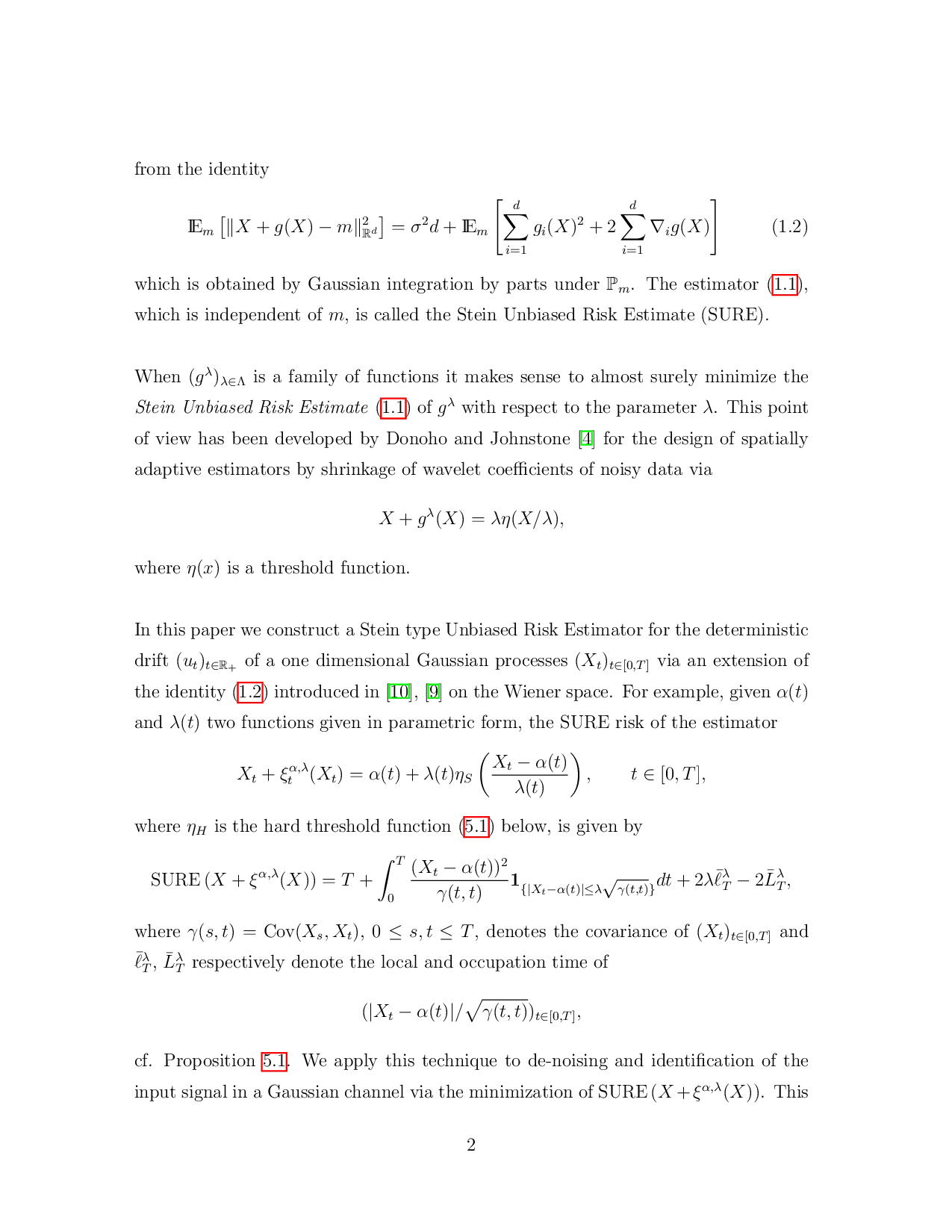
In this paper we construct a Stein type Unbiased Risk Estimator for the deterministic
drift (ut)t∈R+ of a one dimensional Gaussian processes (Xt)t∈[0,T] via an extension of
the identity (1.2) introduced in [10], [9] on the Wiener space. For example, given α(t)
and λ(t) two functions given in parametric form, the SURE risk of the estimator
Xt + ξα,λ
t
(Xt) = α(t) + λ(t)ηS
Xt −α(t)
λ(t)
,
t ∈[0, T],
where ηH is the hard threshold function (5.1) below, is given by
SURE (X + ξα,λ(X)) = T +
Z T
0
(Xt −α(t))2
γ(t, t)
1{|Xt−α(t)|≤λ√
γ(t,t)}dt + 2λ¯ℓλ
T −2¯Lλ
T,
where γ(s, t) = Cov(Xs, Xt), 0 ≤s, t ≤T, denotes the covariance of (Xt)t∈[0,T] and
¯ℓλ
T, ¯Lλ
T respectively denote the local and occupation time of
(|Xt −α(t)|/
p
γ(t, t))t∈[0,T],
cf. Proposition 5.1. We apply this technique to de-noising and identification of the
input signal in a Gaussian channel via the minimization of SURE (X +ξα,λ(X)). This
2
yields in particular an estimator of the drift of Xt from the estimation of α(t), and
an optimal noise removal threshold from the estimation of λ. This approach differs
from classical signal detection techniques which usually rely on likelihood ratio tests,
cf e.g. [8], Chapter VI. It also requires an a priori hypothesis on the parametric form
of α(t).
We proceed as follows. In Section 2 we recall our framework of functional estimation
of drift trajectories. In Section 3 we derive Stein’s unbiased risk estimate for the
estimation of the drift of Gaussian processes. In Section 4 we discuss its application
to soft thresholding for Gaussian processes using the local time and obtain an upper
bound for the risk of such estimators.
We also show the existence of an optimal
parameter and the smoothness of the risk function. In Section 5 we consider the case
of hard thresholding. In Section 6 we consider several numerical examples where α(t)
is given in parametric form. In Section 7 we recall some elements of stochastic analysis
of Gaussian processes.
2
Functional drift estimation
In this section we recall the setting of functional drift estimation to be used in this pa-
per. Given T > 0 we consider a real-valued centered Gaussian process X = (Xt)t∈[0,T]
with non-vanishing covariance function
γ(s, t) = IE[XsXt],
s, t ∈[0, T],
on a probability space (Ω, F, P), where (F)t∈[0,T] is the filtration generated by (Xt)t∈[0,T].
Assume that under a probability measure Pu we observe the paths of (Xt)t∈[0,T] de-
composed as
Xt = ut + Xu
t ,
t ∈[0, T],
where u = (ut)t∈[0,T] is a square integrable F-adapted process and (Xu
t )t∈[0,T] is a
centered Gaussian process with covariance
γ(s, t) = IEu[Xu
s , Xu
t ],
0 ≤s, t ≤T,
3
where IEu denotes the expectation under Pu. Given a continuous time observation of
the process (Xt)t∈[0,T] we will propose estimators of the unknown drift function u.
Definition 2.1. The risk of an estimator ξ := (ξt)t∈[0,T] to u is defined as
R(γ, µ, ξ) := IEu
Z T
0
|ξt −ut|2µ(dt)
where µ is a positive measure on [0, T].
Examples of risk measures µ include the Lebesgue measure and
µ(dt) =
n
X
i=1
aiδti(dt),
a1, . . . ,
…(Full text truncated)…
This content is AI-processed based on ArXiv data.