Magnetic Fields in Stellar Astrophysics
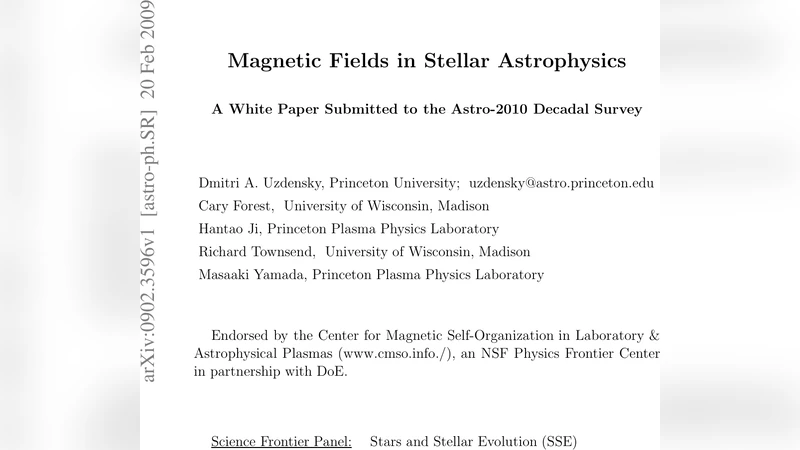
This is a white paper submitted to the Stars and Stellar Evolution (SSE) Science Frontier Panel (SFP) of the NRC’s 2010 Astronomy and Astrophysics Decadal Survey. The white paper is endorsed by the NSF Physics Frontier Center for Magnetic Self-Organization in Laboratory and Astrophysical Plasmas (CMSO).
💡 Research Summary
The white paper “Magnetic Fields in Stellar Astrophysics,” submitted to the Stars and Stellar Evolution Science Frontier Panel of the 2010 NRC Decadal Survey and endorsed by the NSF Physics Frontier Center for Magnetic Self‑Organization in Laboratory and Astrophysical Plasmas (CMSO), presents a comprehensive research roadmap aimed at unraveling the multifaceted role of magnetic fields throughout the life cycle of stars. The authors begin by emphasizing that magnetic fields influence virtually every stage of stellar evolution—from the collapse of magnetized molecular clouds that seed protostellar cores, through the main‑sequence dynamo that regulates angular momentum loss, to the magnetically driven winds and jets that shape the late‑stage mass‑loss episodes of massive stars and the formation of planetary nebulae. Despite their importance, current observational constraints are sparse, theoretical models remain fragmented, and laboratory analogues have yet to be fully integrated.
The paper is organized around four interlocking pillars.
-
Observational Advances – The authors advocate for a coordinated, multi‑wavelength polarimetric campaign that couples next‑generation radio interferometers (e.g., ngVLA), optical/infrared spectropolarimeters, and X‑ray polarimetry missions (e.g., IXPE successors). By measuring Zeeman splitting, Faraday rotation, and synchrotron polarization in protostellar disks, stellar coronae, and magnetically collimated jets, researchers can construct three‑dimensional magnetic field maps across a broad range of spatial scales and evolutionary phases. The paper stresses the need for standardized data products and open archives to enable cross‑comparison with models.
-
Theoretical and Numerical Frameworks – Recognizing that stellar magnetic phenomena span many orders of magnitude in both space and time, the authors call for high‑resolution, adaptive‑mesh magnetohydrodynamic (MHD) simulations that incorporate realistic microphysics (e.g., anisotropic viscosity, Hall effect, radiative transfer). They propose a “virtual observatory” pipeline that converts simulation outputs into synthetic polarimetric observables, allowing direct validation against the data described above. Emphasis is placed on capturing both large‑scale dynamo action and small‑scale turbulent reconnection, thereby bridging the gap between mean‑field theory and fully nonlinear plasma dynamics.
-
Laboratory Plasma Experiments – Leveraging CMSO’s expertise, the paper outlines a program of scaled laboratory experiments that reproduce key dimensionless parameters (magnetic Reynolds number, Lundquist number) of stellar interiors and winds. Facilities such as large‑scale spheromaks, reversed‑field pinches, and laser‑driven plasma jets can emulate dynamo amplification, magnetic buoyancy, and reconnection events under controlled conditions. Experimental diagnostics (e.g., proton radiography, Thomson scattering) will provide quantitative benchmarks for the numerical models, while the experiments themselves will explore regimes (e.g., high‑beta, strong‑guide‑field reconnection) that are difficult to access observationally.
-
Human Capital and Collaborative Infrastructure – The authors argue that progress hinges on training a new generation of “stellar plasma scientists” fluent in astrophysics, laboratory plasma physics, and high‑performance computing. They propose interdisciplinary graduate programs, joint post‑doctoral fellowships, and annual workshops that rotate among observatories, supercomputing centers, and laboratory facilities. A shared data repository, governed by community standards, will facilitate seamless exchange of observational, simulation, and experimental datasets.
In the concluding policy recommendations, the paper urges sustained federal investment in three critical assets: (i) a next‑generation polarimetric observatory suite, (ii) a dedicated exascale computing allocation for stellar MHD, and (iii) the continued operation and expansion of high‑energy density plasma laboratories. By aligning these resources under a unified, cross‑disciplinary framework, the authors contend that the astrophysics community can finally achieve a predictive, quantitative understanding of how magnetic fields shape stellar birth, life, and death, with far‑reaching implications for galactic magnetism, cosmic ray acceleration, and the habitability of exoplanetary systems.
Comments & Academic Discussion
Loading comments...
Leave a Comment