Energy-Efficient Shortest Path Algorithms for Convergecast in Sensor Networks
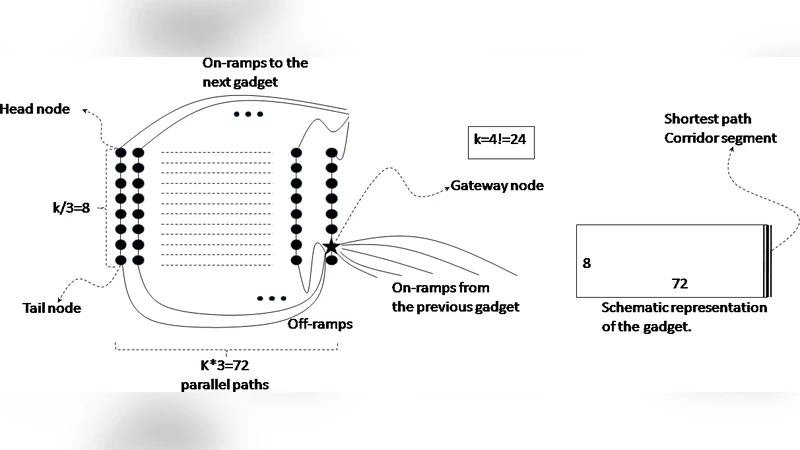
We introduce a variant of the capacitated vehicle routing problem that is encountered in sensor networks for scientific data collection. Consider an undirected graph $G=(V \cup {\mathbf{sink}},E)$. Each vertex $v \in V$ holds a constant-sized reading normalized to 1 byte that needs to be communicated to the $\mathbf{sink}$. The communication protocol is defined such that readings travel in packets. The packets have a capacity of $k$ bytes. We define a {\em packet hop} to be the communication of a packet from a vertex to its neighbor. Each packet hop drains one unit of energy and therefore, we need to communicate the readings to the $\mathbf{sink}$ with the fewest number of hops. We show this problem to be NP-hard and counter it with a simple distributed $(2-\frac{3}{2k})$-approximation algorithm called {\tt SPT} that uses the shortest path tree rooted at the $\mathbf{sink}$. We also show that {\tt SPT} is absolutely optimal when $G$ is a tree and asymptotically optimal when $G$ is a grid. Furthermore, {\tt SPT} has two nice properties. Firstly, the readings always travel along a shortest path toward the $\mathbf{sink}$, which makes it an appealing solution to the convergecast problem as it fits the natural intuition. Secondly, each node employs a very elementary packing strategy. Given all the readings that enter into the node, it sends out as many fully packed packets as possible followed by at most 1 partial packet. We show that any solution that has either one of the two properties cannot be a $(2-\epsilon)$-approximation, for any fixed $\epsilon > 0$. This makes \spt optimal for the class of algorithms that obey either one of those properties.
💡 Research Summary
The paper tackles the converge‑cast problem in wireless sensor networks from an energy‑efficiency perspective. Each sensor node holds a unit‑size reading (1 byte) that must be delivered to a designated sink. Communication proceeds in packets of capacity k bytes, and each transmission of a packet over a single edge (a “packet hop”) consumes one unit of energy. Consequently, minimizing total energy consumption is equivalent to minimizing the total number of packet hops required to gather all readings at the sink.
The authors first formalize this task as a variant of the capacitated vehicle routing problem (CVRP) on an undirected graph (G=(V\cup{\text{sink}},E)). They prove that the decision version—whether a schedule exists using at most H packet hops—is NP‑hard by a polynomial‑time reduction from the classic CVRP. This hardness result justifies the search for approximation algorithms rather than exact polynomial‑time solutions.
The core contribution is a simple, fully distributed algorithm called Shortest Path Tree (SPT). SPT proceeds in two stages: (1) construct a breadth‑first search tree rooted at the sink, thereby assigning each node a unique shortest‑path route to the sink; (2) each node aggregates all readings arriving from its children together with its own reading, then packs them into as many full packets (size k) as possible, followed by at most one partially‑filled packet. The node forwards all created packets to its parent in the tree. This “full‑first, at‑most‑one‑partial” packing rule is extremely lightweight: a node only needs to count incoming packets and its own byte, without any global coordination.
The analysis of SPT yields a provable approximation ratio of
\
Comments & Academic Discussion
Loading comments...
Leave a Comment