Dwarf Galaxies in 2010: Revealing Galaxy Formations Threshold and Testing the Nature of Dark Matter
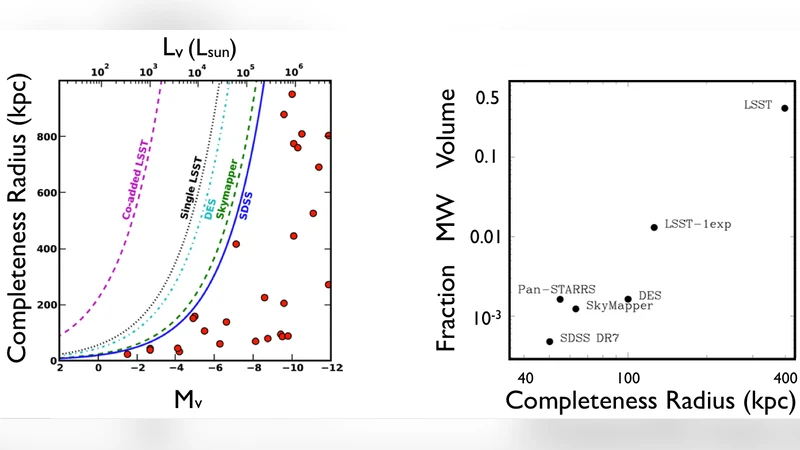
Over the past five years, searches in Sloan Digital Sky Survey data have more than doubled the number of known dwarf satellite galaxies of the Milky Way, and have revealed a population of ultra-faint galaxies with luminosities smaller than typical globular clusters, L ~ 1000 Lsun. These systems are the faintest, most dark matter dominated, and most metal poor galaxies in the universe. Completeness corrections suggest that we are poised on the edge of a vast discovery space in galaxy phenomenology, with hundreds more of these extreme galaxies to be discovered as future instruments hunt for the low-luminosity threshold of galaxy formation. Dark matter dominated dwarfs of this kind probe the small-scale power-spectrum, provide the most stringent limits on the phase-space packing of dark matter, and offer a particularly useful target for dark matter indirect detection experiments. Full use of dwarfs as dark matter laboratories will require synergy between deep, large-area photometric searches; spectroscopic and astrometric follow-up with next-generation optical telescopes; and subsequent observations with gamma-ray telescopes for dark matter indirect detection.
💡 Research Summary
Over the past half‑decade, systematic searches of the Sloan Digital Sky Survey (SDSS) have more than doubled the known population of Milky Way satellite galaxies, revealing a new class of ultra‑faint dwarf galaxies (UFDs) with luminosities as low as L ≈ 10³ L☉. These objects are fainter than most globular clusters, yet their stellar velocity dispersions imply dynamical mass‑to‑light ratios of M/L ≈ 10³–10⁴ M☉/L☉, indicating that they are overwhelmingly dominated by dark matter. Spectroscopic metallicity measurements show extremely low iron abundances (
Comments & Academic Discussion
Loading comments...
Leave a Comment