No Planet Left Behind: Investigating Planetary Diversity and Architecture with SIM Lite
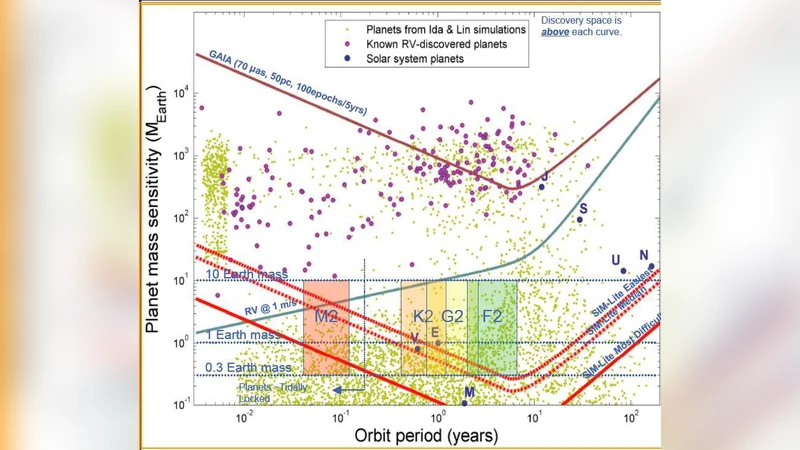
The evidence is mounting that star formation necessarily involves planet formation. We clearly have a vested interest in finding other Earths but a true understanding of planet formation requires completing the census and mapping planetary architecture in all its grandeur and diversity. Here, we show that a 2000-star survey undertaken with SIM Lite will uniquely probe planets around B-A-F stars, bright and binary stars and white dwarfs. In addition, we show that the high precision of SIM Lite allows us to gain unique insights into planet formation via accurate measurements of mutual inclinations.
💡 Research Summary
The paper “No Planet Left Behind: Investigating Planetary Diversity and Architecture with SIM Lite” proposes a comprehensive astrometric survey of 2,000 stars using the Space Interferometry Mission (SIM) Lite, a next‑generation interferometer capable of sub‑micro‑arcsecond positional precision. The authors argue that while the discovery of exoplanets around Sun‑like (G‑K) stars has progressed rapidly, our understanding of planet formation remains incomplete because the current census is heavily biased toward a narrow range of stellar hosts. To address this gap, the proposed SIM Lite program deliberately targets three under‑explored stellar populations: (1) massive early‑type stars (spectral types B, A, and F), (2) bright and close binary systems, and (3) white dwarfs, each of which presents unique observational challenges for radial‑velocity or transit techniques but can be probed effectively through high‑precision astrometry.
The methodology involves repeated astrometric measurements over a baseline of five to ten years. By fitting the time‑dependent stellar wobble to Keplerian models, the survey will recover full three‑dimensional orbital elements, including inclination, longitude of ascending node, and mutual inclination between planets in multi‑planet systems. Because SIM Lite’s positional accuracy is largely independent of stellar brightness or spectral type, it can detect the reflex motion induced by planets as small as a few Earth masses at orbital radii of several astronomical units around bright early‑type stars, where Doppler amplitudes are suppressed by rapid rotation and broad spectral lines. In binary systems, the instrument can simultaneously track the positions of both components, allowing the disentanglement of planetary signals from the binary orbital motion and enabling a direct assessment of how stellar multiplicity influences planet occurrence, orbital stability, and dynamical evolution. For white dwarfs, the high mass‑to‑radius ratio amplifies the astrometric signature of any surviving planetary companion, making it possible to detect planets that have survived the host star’s red‑giant phase or that have formed from fallback material.
A key scientific payoff of the survey is the measurement of mutual inclinations in multi‑planet systems. Current detection methods provide only line‑of‑sight information (mass sin i) and, in rare cases, transit geometry, leaving the three‑dimensional architecture largely unconstrained. SIM Lite’s astrometric data will yield precise orbital planes for each planet, enabling statistical studies of coplanarity versus misalignment across different host‑star categories. Such measurements directly test competing formation scenarios: in‑situ core accretion predicts near‑coplanar, low‑eccentricity configurations, whereas migration driven by disk turbulence, planet‑planet scattering, or Kozai‑Lidov cycles induced by a distant companion should produce a broader distribution of inclinations and eccentricities. By correlating mutual inclination distributions with stellar mass, binarity, and evolutionary state, the survey will illuminate how initial disk conditions and subsequent dynamical processes sculpt planetary systems.
The authors present quantitative forecasts based on simulated astrometric signals. For early‑type stars, they anticipate detecting planets with masses ≥ 30 M⊕ at orbital distances of 5–30 AU, implying a detection efficiency of roughly 5 % for such massive companions, consistent with the expectation that massive disks around high‑mass stars can form giant planets more readily. In binary systems, the survey should uncover planets in dynamically stable zones (e.g., circumprimary, circumsecondary, or circumbinary orbits) with a detection probability that depends on binary separation and mass ratio; the authors predict a modest but non‑negligible occurrence rate, offering the first robust statistical test of planet formation in binary environments. For white dwarfs, the survey aims to identify remnants of planetary systems that survived stellar evolution, potentially revealing a population of planets at tens of AU that have migrated inward due to mass loss or that are part of debris disks observed in infrared surveys.
Beyond detection, the SIM Lite dataset will serve as a legacy resource for follow‑up studies. Precise orbital parameters will enable targeted direct‑imaging campaigns with future ground‑based ELTs and space‑based coronagraphs, atmospheric characterization with JWST‑type facilities, and dynamical modeling of long‑term stability. Moreover, the astrometric catalog will refine stellar mass estimates, improve Galactic dynamics models, and provide benchmarks for testing general relativistic effects in strong‑field regimes.
In conclusion, the proposed SIM Lite 2,000‑star astrometric survey represents a strategic expansion of exoplanet science beyond the traditional G‑type host sample. By leveraging micro‑arcsecond precision to probe massive early‑type stars, bright binaries, and white dwarfs, and by delivering full three‑dimensional orbital architectures—including mutual inclinations—the program promises to fill critical gaps in our empirical understanding of planetary diversity and formation pathways. The resulting comprehensive census will not only test theoretical models across a broad range of stellar environments but also lay the groundwork for the next generation of exoplanet characterization missions.
Comments & Academic Discussion
Loading comments...
Leave a Comment