Likelihood-based inference for max-stable processes
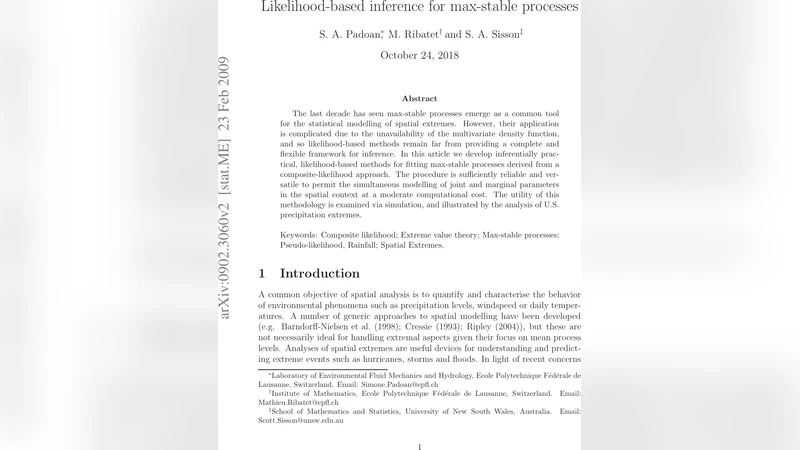
The last decade has seen max-stable processes emerge as a common tool for the statistical modeling of spatial extremes. However, their application is complicated due to the unavailability of the multivariate density function, and so likelihood-based methods remain far from providing a complete and flexible framework for inference. In this article we develop inferentially practical, likelihood-based methods for fitting max-stable processes derived from a composite-likelihood approach. The procedure is sufficiently reliable and versatile to permit the simultaneous modeling of marginal and dependence parameters in the spatial context at a moderate computational cost. The utility of this methodology is examined via simulation, and illustrated by the analysis of U.S. precipitation extremes.
💡 Research Summary
The paper addresses a central challenge in spatial extremes modeling: the lack of a tractable multivariate density for max‑stable processes, which hampers the use of full likelihood‑based inference. To overcome this, the authors develop a composite‑likelihood framework that builds on pairwise (or more generally, low‑dimensional) marginal densities. By constructing a pairwise likelihood that sums the log‑densities of all possible observation pairs, they are able to estimate both marginal GEV parameters (location, scale, shape) and dependence parameters governing the spatial structure (range, smoothness, tail dependence) simultaneously. The authors provide theoretical justification, proving consistency and asymptotic normality of the estimators, and they compute standard errors using the Godambe information matrix. To keep computation feasible, they introduce distance‑based weighting schemes that give higher weight to nearby pairs and discard distant pairs, thereby reducing the effective number of terms in the composite likelihood without sacrificing essential dependence information.
A comprehensive simulation study evaluates the performance of the proposed method under various spatial configurations and sample sizes. Results show that the composite‑likelihood estimators have lower bias and mean‑square error compared to a two‑step approach that first fits marginal GEV models and then estimates dependence parameters. The method also yields reliable standard‑error estimates and enables the use of information criteria (AIC, BIC) for model selection among competing max‑stable families.
The methodology is illustrated with an analysis of extreme precipitation in the United States. Annual maximum daily precipitation records from a network of stations are modeled using two popular max‑stable constructions: the Schlather model and the Brown‑Resnick model. Composite‑likelihood fitting reveals that both models capture the spatial variability of extreme rainfall, but the Brown‑Resnick model achieves a lower AIC, indicating a better fit. Diagnostic checks, including residual analysis and out‑of‑sample predictive validation, confirm that the composite‑likelihood approach provides realistic uncertainty quantification and improves predictive performance relative to simpler methods.
In summary, the authors deliver a practical, computationally efficient, and statistically sound framework for likelihood‑based inference on max‑stable processes. By leveraging composite likelihoods, they enable joint estimation of marginal and dependence parameters, facilitate model comparison, and open the door to more sophisticated extensions such as non‑stationary dependence structures or Bayesian implementations. This work substantially broadens the applicability of max‑stable models in environmental sciences and other fields where spatial extremes are of interest.
Comments & Academic Discussion
Loading comments...
Leave a Comment