The simplicial interpretation of bigroupoid 2-torsors
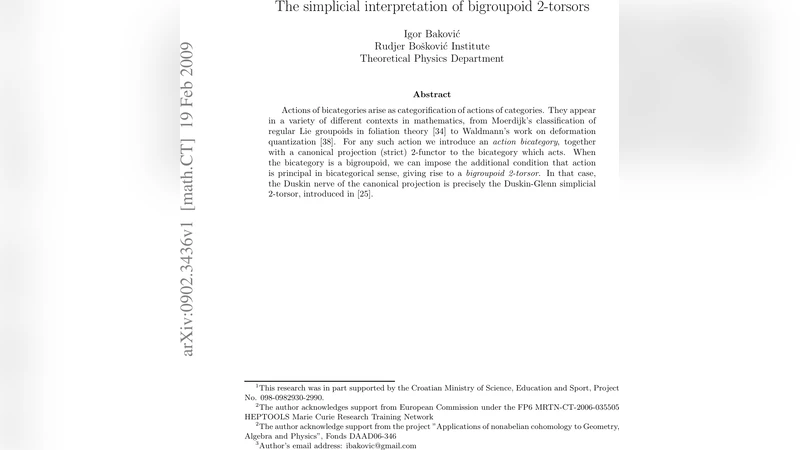
Actions of bicategories arise as categorification of actions of categories. They appear in a variety of different contexts in mathematics, from Moerdijk’s classification of regular Lie groupoids in foliation theory, to Waldmann’s work on deformation quantization. For any such action we introduce an action bicategory, together with a canonical projection (strict) 2-functor to the bicategory which acts. When the bicategory is a bigroupoid, we can impose the additional condition that action is principal in bicategorical sense, giving rise to a bigroupoid 2-torsor. In that case, the Duskin nerve of the canonical projection is precisely the Duskin-Glenn simplicial 2-torsor.
💡 Research Summary
The paper develops a systematic framework for actions of bicategories and shows how, when the acting bicategory is a bigroupoid, such actions give rise to a notion of a “bigroupoid 2‑torsor” that is precisely captured by the Duskin‑Glenn simplicial 2‑torsor. The authors begin by defining a bicategory action: a bicategory 𝔅 acting on another bicategory 𝔄 consists of a functor on objects, a family of 1‑cell morphisms, and a family of 2‑cell modifications, all satisfying the usual coherence axioms (associativity, unit laws). From this data they construct the “action bicategory” 𝔄⋉𝔅. Its objects are pairs (a, x) with a∈Obj(𝔄) and x∈Obj(𝔅); its 1‑cells are pairs (f : a→a′, u : F(a)→x′) where F is the object‑level part of the action; its 2‑cells are pairs of 2‑morphisms in 𝔄 and 𝔅 that respect the action. The canonical projection P : 𝔄⋉𝔅 → 𝔅 simply forgets the 𝔄‑component, sending (a, x)↦x, (f, u)↦u, and (σ, τ)↦τ. This projection is a strict 2‑functor.
When 𝔅 is a bigroupoid (all 1‑cells and 2‑cells are invertible), the authors impose a “principal” condition on the action. Principality requires that P be essentially surjective on objects and locally fully faithful, i.e. each hom‑category of 𝔅 is recovered up to equivalence from the corresponding hom‑category of 𝔄⋉𝔅 via P. Under these hypotheses the pair (𝔄, 𝔅) together with the action is called a bigroupoid 2‑torsor, a 2‑dimensional analogue of a principal homogeneous space.
The central technical result uses the Duskin nerve N_D, a functor that turns any bicategory into a simplicial set by encoding objects, 1‑cells, 2‑cells, and higher coherence data as simplices. The authors prove that the nerve of the canonical projection, N_D(P) : N_D(𝔄⋉𝔅) → N_D(𝔅), satisfies exactly the axioms of a Duskin‑Glenn simplicial 2‑torsor. In particular, N_D(𝔄⋉𝔅) is a Kan complex, the map N_D(P) is a free and transitive action of the simplicial 2‑groupoid N_D(𝔅) on the total space, and the horn‑filling conditions required for a simplicial torsor follow from the invertibility of 1‑ and 2‑cells in the bigroupoid together with the local full faithfulness of P. The paper gives explicit constructions of the required liftings for 2‑ and 3‑horns, showing how associators and unitors provide the necessary coherence.
To illustrate the theory, the authors discuss three concrete contexts. First, they revisit Moerdijk’s classification of regular Lie groupoids, showing that the holonomy groupoid naturally forms a bigroupoid 2‑torsor over the leaf space. Second, they connect Waldmann’s deformation quantization framework, where star‑product algebras carry a 2‑groupoid symmetry, to the present notion of a principal action. Third, they point out that crossed modules and 2‑bundles in higher gauge theory can be modeled as bigroupoid 2‑torsors, thereby linking the abstract categorical construction to familiar geometric objects.
In the concluding section the authors emphasize that their work unifies several disparate appearances of 2‑torsors under a single simplicial perspective. By showing that the Duskin nerve of a principal bicategory action yields a Duskin‑Glenn simplicial torsor, they provide a bridge between bicategorical algebra, simplicial homotopy theory, and applications in foliation theory, quantization, and higher gauge theory. They suggest future extensions to actions of tricategories and to “weak” torsors where the acting bicategory is not a bigroupoid, opening the door to even richer higher‑categorical structures.
Comments & Academic Discussion
Loading comments...
Leave a Comment