Local section of Serre fibrations with 3-manifold fibers
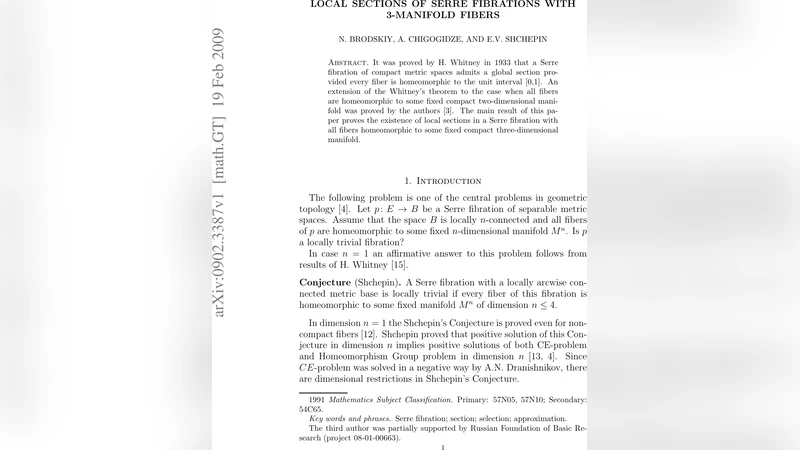
It was proved by H. Whitney in 1933 that a Serre fibration of compact metric spaces admits a global section provided every fiber is homeomorphic to the unit interval [0,1]. An extension of the Whitney’s theorem to the case when all fibers are homeomorphic to some fixed compact two-dimensional manifold was proved by the authors \cite{BCS}. The main result of this paper proves the existence of local sections in a Serre fibration with all fibers homeomorphic to some fixed compact three-dimensional manifold.
💡 Research Summary
The paper addresses a long‑standing gap in the theory of Serre fibrations: while Whitney’s classical theorem (1933) guarantees a global continuous section for a Serre fibration whose fibers are all homeomorphic to the unit interval, and subsequent work by Bessaga‑Cernavskiĭ‑Sakai (referred to as BCS) extended this result to the case where every fiber is a fixed compact two‑dimensional manifold, no analogous statement was known for three‑dimensional fibers. The authors fill this void by proving that any Serre fibration (p\colon E\to B) between complete metric spaces, whose fibers are all homeomorphic to a fixed compact 3‑manifold (M), admits a local continuous section around every point of the base space. In other words, for each (b\in B) there exists an open neighbourhood (U\subset B) and a continuous map (s\colon U\to E) such that (p\circ s = \operatorname{id}_U).
The proof proceeds through several sophisticated topological constructions that together overcome the intrinsic complexity of three‑dimensional manifolds. First, the authors recall that a Serre fibration is a Hurewicz fibration with the homotopy lifting property for all CW‑complexes; this property ensures a certain “regularity” of the map, which they formalize as a topologically regular map: small perturbations of a base point induce homeomorphic fibers in a controlled way. Because every fiber is homeomorphic to the same compact 3‑manifold (M), Moise’s theorem guarantees that (M) admits a triangulation, and consequently the homeomorphism group (\operatorname{Homeo}(M)) is a locally contractible Polish group (a result due to Anderson and Henderson). This local contractibility is the cornerstone of the argument.
The authors then construct, for a sufficiently small neighbourhood (U) of a given base point, a cell‑like approximation of the preimage (p^{-1}(U)). Using Chapman’s cell‑like mapping theory, they produce a cell‑like map (f_U\colon p^{-1}(U)\to M\times U) that is a near‑homeomorphism: it collapses only “cellular” subsets and is arbitrarily close to a genuine homeomorphism. The next step is to refine this approximation by exploiting the local contractibility of (\operatorname{Homeo}(M)). For each (x\in U) they select a homeomorphism (h_x\in\operatorname{Homeo}(M)) that adjusts the fiber over (x) so that the restriction of (f_U) becomes exactly the identity on the (M) factor. The map (x\mapsto h_x) can be chosen to vary continuously because of the local contractibility, yielding a continuous family of adjustments.
Having obtained a continuous family of fiberwise homeomorphisms, the authors invoke microbundle theory. The pair ((p^{-1}(U), f_U)) together with the family ({h_x}) defines a microbundle over (U) whose total space is homeomorphic to the product bundle (M\times U). Classical results of Milnor and Kister guarantee that a microbundle over a paracompact base which is locally trivial in the micro‑sense can be upgraded to an honest topological bundle. Consequently there exists a genuine homeomorphism (\phi_U\colon M\times U\to p^{-1}(U)) that respects the projection onto (U).
Finally, the local section is produced by composing the canonical inclusion of the base into the product bundle with (\phi_U): \
Comments & Academic Discussion
Loading comments...
Leave a Comment