Local sections of Serre fibrations with 2-manifold fibers
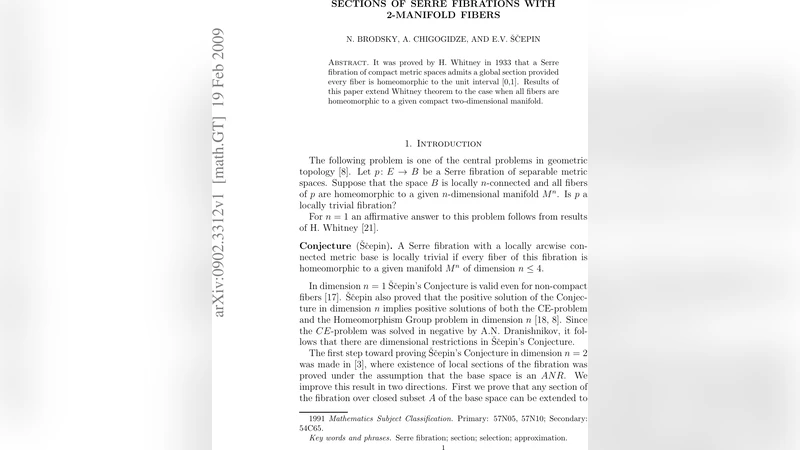
It was proved by H. Whitney in 1933 that a Serre fibration of compact metric spaces admits a global section provided every fiber is homeomorphic to the unit interval [0,1]. Results of this paper extend Whitney theorem to the case when all fibers are homeomorphic to a given compact two-dimensional manifold.
💡 Research Summary
The paper investigates the existence of local sections for Serre fibrations whose fibers are compact two‑dimensional manifolds. Building on H. Whitney’s 1933 theorem— which guarantees a global section when every fiber is homeomorphic to the unit interval— the author seeks to extend this result to the case where each fiber is homeomorphic to a fixed compact surface (M). The setting is a Serre fibration (p:E\to B) between compact metric spaces, which ensures that both the base (B) and total space (E) are complete and admit a compatible metric structure.
The first technical step is to reinterpret the fibration as a multivalued map (F:B\Rightarrow E) that assigns to each point (b\in B) the fiber (p^{-1}(b)), which is homeomorphic to (M). Because (M) is compact, metrizable, and an absolute neighborhood retract (ANR), the values of (F) inherit strong topological regularity: they are closed, compact, and locally contractible. The author proves that (F) is upper semicontinuous and possesses a complete graph, conditions that allow the application of Michael’s selection theorem in a refined form.
A central contribution is the development of an “approximate selection” scheme tailored to two‑dimensional fibers. For any (\varepsilon>0) the author constructs a map (s_\varepsilon:U\to E) defined on a sufficiently small neighbourhood (U\subset B) of a given point, such that (s_\varepsilon(x)\in p^{-1}(x)) and the distance between (s_\varepsilon(x)) and a true section is less than (\varepsilon). Using the fact that surfaces have well‑understood homotopy groups ((\pi_1) is a finitely presented group, (\pi_2=0) for most closed surfaces) and the dimension‑two approximation theorem for ANR‑valued multivalued maps, the author shows that the sequence ({s_{1/n}}) converges uniformly to a continuous map (s:U\to E) which is an actual local section. The convergence argument relies on the ability to homotope small perturbations within each fiber without leaving the fiber, a property guaranteed by the local contractibility of surfaces.
Having established the existence of a continuous local section around every point of (B), the paper proves the main theorem: If (p:E\to B) is a Serre fibration between compact metric spaces and every fiber is homeomorphic to a fixed compact 2‑manifold (M), then for each (b\in B) there exists a neighbourhood (U) of (b) and a continuous map (s:U\to E) with (p\circ s=\operatorname{id}_U). This result mirrors Whitney’s original theorem but replaces the interval fiber with any compact surface, thereby significantly broadening the class of fibrations for which local sections are guaranteed.
The author also discusses consequences for global sections. Under additional hypotheses—such as simple connectivity of the base, triviality of the monodromy action on (\pi_1(M)), or the existence of a global selection for the multivalued map— the local sections can be patched together to yield a global section, reproducing Whitney’s conclusion in the higher‑dimensional setting. Moreover, the paper outlines potential extensions: non‑compact fibers, higher‑dimensional ANR fibers, and fibrations with varying fiber types. The techniques introduced—particularly the refined approximate selection for 2‑dimensional ANR values— are likely to be useful in other problems involving fiberwise topology, selection theory, and the homotopy classification of fibrations.
In summary, the work provides a rigorous and elegant generalization of Whitney’s classical section theorem, demonstrating that the interplay between selection theory, ANR properties, and low‑dimensional topology suffices to secure local sections for Serre fibrations with surface fibers. This advances our understanding of the structure of fibrations beyond the one‑dimensional case and opens avenues for further research on global section problems in higher dimensions.
Comments & Academic Discussion
Loading comments...
Leave a Comment