On Deformations of Pasting Diagrams
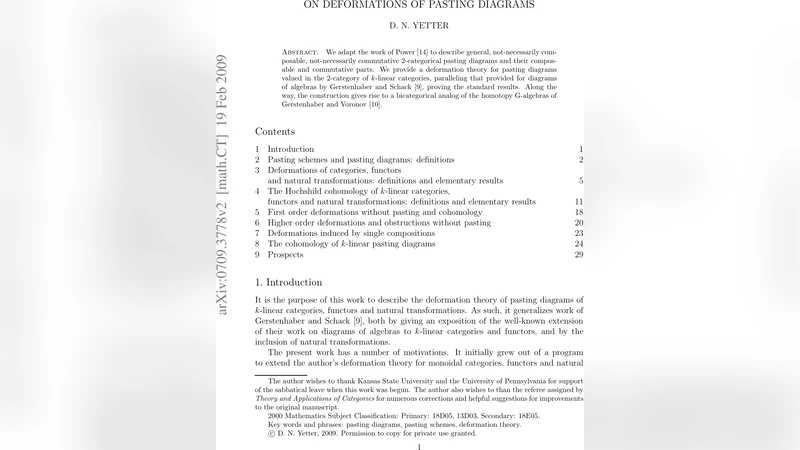
We adapt the work of Power to describe general, not-necessarily composable, not-necessarily commutative 2-categorical pasting diagrams and their composable and commutative parts. We provide a deformation theory for pasting diagrams valued in $k$-linear categories, paralleling that provided for diagrams of algebras by Gerstenhaber and Schack, proving the standard results. Along the way, the construction gives rise to a bicategorical analog of the homotopy G-algebras of Gerstenhaber and Voronov.
💡 Research Summary
The paper develops a deformation theory for arbitrary 2‑categorical pasting diagrams, extending Power’s framework beyond the usual assumptions of composability and commutativity. After a concise review of Power’s strictification and coherence results, the authors introduce a new definition of a “general pasting diagram” as a labeled graph whose vertices encode objects and 1‑cells and whose edges encode 2‑cells. Crucially, any such diagram can be decomposed into a composable part and a commutative part, each admitting its own pasting composition; compatibility conditions guarantee that these two structures interact coherently.
With this combinatorial foundation, the authors construct a deformation complex 𝔇(P) for a diagram P valued in a k‑linear category. For each 1‑cell they attach the Hochschild cochain complex of the corresponding hom‑category, and for each 2‑cell they introduce a cochain complex that records vertical and horizontal insertion operations. The total complex is the direct sum over all degrees, and its differential is the sum of horizontal and vertical insertion maps, mirroring the brace operations in the Gerstenhaber‑Schack theory of algebra diagrams. The authors prove that d²=0 by exploiting Power’s coherence diagrams together with the standard cup‑product identities, establishing that 𝔇(P) carries an L∞‑algebra structure.
The cohomology of 𝔇(P) controls deformations: H¹ classifies infinitesimal automorphisms, H² contains obstruction classes, and the vanishing of a 2‑cocycle guarantees the existence of higher‑order deformations, exactly as in the classical Gerstenhaber‑Schack setting. The paper further shows that the deformation complex naturally yields a bicategorical analogue of the homotopy G‑algebras introduced by Gerstenhaber and Voronov. By lifting the G‑operations to two dimensions, the authors define a family of higher operations m_{p,q} that simultaneously handle p horizontal and q vertical insertions. These operations satisfy both A∞‑type and L∞‑type relations, with m_{1,1} reducing to the usual Hochschild differential, while m_{2,0} and m_{0,2} encode non‑commutative composition in the two directions. Consequently, 𝔇(P) becomes a bicategorical homotopy G‑algebra, providing a unified algebraic framework for handling both compositional and commutative deformations.
Several illustrative examples are presented. For a linear chain of 2‑cells the deformation complex coincides with the classical Gerstenhaber‑Schack complex, confirming consistency. When applied to module categories over a quantum group where the R‑matrix introduces non‑commutative 2‑cell interchange, the obstruction classes correspond to deformations of the braiding. Finally, the authors discuss how their construction can be regarded as a stepping stone toward deformation theory for (∞,2)‑categories and derived bicategories.
In conclusion, the work not only generalizes the deformation theory of algebraic diagrams to the full breadth of 2‑categorical pasting diagrams but also uncovers a rich higher‑algebraic structure—bicategorical homotopy G‑algebras—that promises applications in higher‑dimensional quantum field theory, categorified deformation quantization, and the study of derived bicategorical moduli. Future directions include extending the theory to stacks of diagrams, integrating derived enrichment, and exploring connections with operadic models of higher categories.
Comments & Academic Discussion
Loading comments...
Leave a Comment