A Census of Exoplanets in Orbits Beyond 0.5 AU via Space-based Microlensing
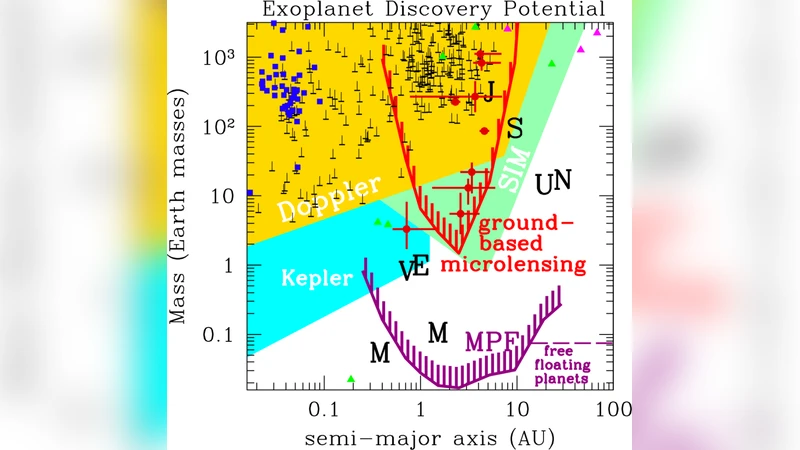
A space-based gravitational microlensing exoplanet survey will provide a statistical census of exoplanets with masses greater than 0.1 Earth-masses and orbital separations ranging from 0.5AU to infinity. This includes analogs to all the Solar System’s planets except for Mercury, as well as most types of planets predicted by planet formation theories. Such a survey will provide results on the frequency of planets around all types of stars except those with short lifetimes. Close-in planets with separations < 0.5 AU are invisible to a space-based microlensing survey, but these can be found by Kepler. Other methods, including ground-based microlensing, cannot approach the comprehensive statistics on the mass and semi-major axis distribution of extrasolar planets that a space-based microlensing survey will provide. The terrestrial planet sensitivity of a ground-based microlensing survey is limited to the vicinity of the Einstein radius at 2-3 AU, and space-based imaging is needed to identify and determine the mass of the planetary host stars for the vast majority of planets discovered by microlensing. Thus, a space-based microlensing survey is likely to be the only way to gain a comprehensive understanding of the architecture of planetary systems, which is needed to understand planet formation and habitability. The proposed Microlensing Planet Finder (MPF) mission is an example of a space-based microlensing survey that can accomplish these objectives with proven technology and a cost of under $300 million (excluding launch vehicle).
💡 Research Summary
The paper makes a compelling case that a space‑based gravitational microlensing survey is the only realistic way to obtain a complete statistical census of exoplanets with masses down to 0.1 Earth‑mass and orbital separations from 0.5 AU out to arbitrarily large distances. Current detection techniques each cover only a slice of this parameter space. Transit missions such as Kepler and TESS are exquisitely sensitive to planets interior to roughly 0.5 AU, while radial‑velocity surveys preferentially detect massive planets on relatively short periods. Direct‑imaging efforts are limited to wide‑separation, massive giants, and ground‑based microlensing, although capable of detecting planets near the Einstein radius (≈2–3 AU), suffers from atmospheric seeing, weather interruptions, and, crucially, cannot routinely resolve the host stars of the events. Without host‑star identification, the planet mass and distance remain ambiguous for the majority of ground‑based detections.
Microlensing, by contrast, measures the mass ratio between planet and host directly from the shape of the light‑curve perturbation. When the host star can be imaged, its luminosity and color give a precise mass and distance, allowing the planet’s absolute mass and orbital radius to be derived. A space platform provides the angular resolution (<0.1″) and continuous, high‑cadence monitoring needed to resolve the host in essentially all cases, even for faint, distant bulge stars. Consequently, a space‑based survey can map the full distribution of planets as a function of host‑star type, metallicity, and age, delivering the empirical foundation required to test core‑accretion, pebble‑accretion, and migration theories across the entire range of planetary architectures.
The authors present the Microlensing Planet Finder (MPF) as a concrete, low‑cost mission concept. MPF would employ a modest 1.5‑meter telescope equipped with a wide‑field (≈2 deg²) infrared‑optimized detector array. The design relies on proven CCD technology, low‑power electronics, and a simple pointing architecture, keeping the total hardware cost under US $300 million (excluding launch). Over a nominal four‑year mission, MPF would monitor the Galactic bulge and adjacent disk fields continuously, detecting several thousand microlensing events and, from them, thousands of planetary signals spanning Earth‑mass to Jupiter‑mass objects at separations from 0.5 AU to beyond 10 AU.
The scientific payoff is multi‑fold. First, MPF would deliver the first comprehensive inventory of planetary systems that includes analogues of all Solar‑System planets except Mercury, thereby quantifying how typical our system truly is. Second, by measuring the frequency of planets in the habitable zone (the “Goldilocks” region) for a wide variety of stellar hosts, the mission would directly inform estimates of η⊕ (the occurrence rate of potentially habitable worlds). Third, the survey would determine the prevalence of free‑floating planets and wide‑orbit giants, key diagnostics of dynamical evolution and planet‑planet scattering. Fourth, the combination of MPF’s long‑period planet statistics with the short‑period census from Kepler/TESS creates a full three‑dimensional (mass–radius–semi‑major axis) map of planetary populations, a dataset that will be indispensable for interpreting future atmospheric spectroscopy with missions such as JWST, LUVOIR, or HabEx.
In summary, the paper argues that only a space‑based microlensing mission can close the current observational gap in planetary demographics, providing the missing piece needed to understand planet formation, migration, and habitability on a Galactic scale. The MPF concept demonstrates that this capability can be achieved with mature technology and a modest budget, making it a highly attractive and scientifically essential addition to the exoplanet exploration portfolio.
Comments & Academic Discussion
Loading comments...
Leave a Comment