On the protection of extrasolar Earth-like planets around K/M stars against galactic cosmic rays
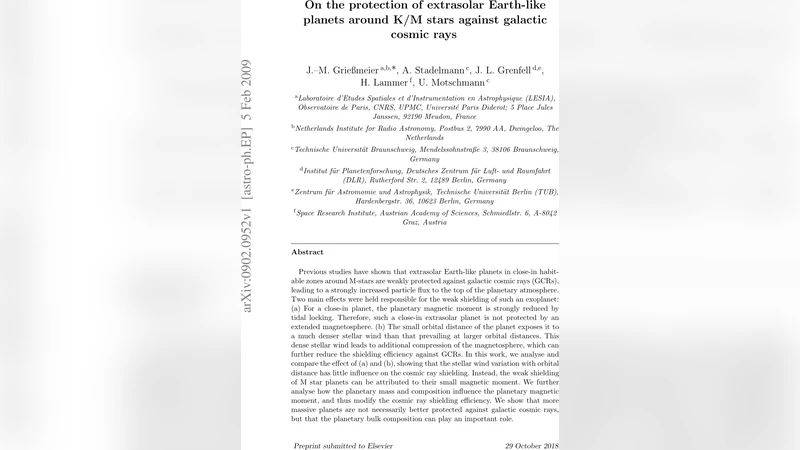
Previous studies have shown that extrasolar Earth-like planets in close-in habitable zones around M-stars are weakly protected against galactic cosmic rays (GCRs), leading to a strongly increased particle flux to the top of the planetary atmosphere. Two main effects were held responsible for the weak shielding of such an exoplanet: (a) For a close-in planet, the planetary magnetic moment is strongly reduced by tidal locking. Therefore, such a close-in extrasolar planet is not protected by an extended magnetosphere. (b) The small orbital distance of the planet exposes it to a much denser stellar wind than that prevailing at larger orbital distances. This dense stellar wind leads to additional compression of the magnetosphere, which can further reduce the shielding efficiency against GCRs. In this work, we analyse and compare the effect of (a) and (b), showing that the stellar wind variation with orbital distance has little influence on the cosmic ray shielding. Instead, the weak shielding of M star planets can be attributed to their small magnetic moment. We further analyse how the planetary mass and composition influence the planetary magnetic moment, and thus modify the cosmic ray shielding efficiency. We show that more massive planets are not necessarily better protected against galactic cosmic rays, but that the planetary bulk composition can play an important role.
💡 Research Summary
The paper investigates how Earth‑like exoplanets orbiting close to K‑ and especially M‑type stars are shielded from galactic cosmic rays (GCRs). Two mechanisms have previously been invoked to explain the weak shielding observed for such planets: (a) tidal locking, which dramatically reduces the planetary magnetic dipole moment, and (b) the high density of the stellar wind at small orbital radii, which compresses the magnetosphere. Using a combination of analytical magnetic‑dynamo scaling laws and magnetohydrodynamic simulations of stellar wind–magnetosphere interaction, the authors quantify the relative importance of these effects.
First, the study models the impact of tidal locking on the planetary dynamo. When a planet’s rotation period synchronises with its orbital period, the rotation rate drops from a few days (as for Earth) to tens or hundreds of days. Dynamo theory predicts that the magnetic dipole moment scales roughly with the rotation rate to the power of 0.5–1, so the moment can fall to 5–15 % of Earth’s value for a typical M‑star habitable‑zone planet. This reduction shrinks the magnetopause distance to only a few planetary radii, allowing high‑energy GCRs to reach the upper atmosphere with little attenuation.
Second, the authors evaluate the compression caused by the dense stellar wind. M‑type stars exhibit strong, often supersonic winds; at orbital distances of 0.05–0.2 AU the wind dynamic pressure can be 5–20 times higher than at Earth’s orbit. Magnetohydrodynamic simulations show that this pressure compresses the magnetosphere by 10–30 % relative to a solar‑wind case. However, because the magnetic moment is already severely weakened by tidal locking, the additional compression contributes only a modest further reduction in shielding efficiency.
Third, the paper explores how planetary mass and bulk composition affect the magnetic moment. Increasing planetary mass raises core pressure and temperature, potentially enlarging the liquid‑metal core and enhancing dynamo action. Yet the composition of the core is decisive: a high iron fraction dramatically raises electrical conductivity and can boost the dipole moment by a factor of two or more, whereas a core dominated by silicates or water yields a thinner, less conductive region and a weaker field. The authors demonstrate that a 5 M⊕ planet with an iron‑rich core can have a magnetic moment comparable to or larger than Earth’s, while a similarly massive planet with a low‑iron core may be even less protected than a 1 M⊕ Earth‑analog.
The key conclusion is that the primary cause of poor GCR shielding for close‑in M‑star planets is the reduction of the magnetic dipole moment due to tidal locking, not the stellar‑wind compression. Stellar wind effects are secondary and only modestly exacerbate the problem. Moreover, planetary mass alone does not guarantee stronger protection; bulk composition, especially core iron content, plays a critical role. These findings have direct implications for assessing the radiation environment of potentially habitable exoplanets, guiding future observational strategies, and informing models of atmospheric chemistry and surface habitability under high‑energy particle fluxes.
Comments & Academic Discussion
Loading comments...
Leave a Comment