Radio Proper Motions of Wolf-Rayet Stars
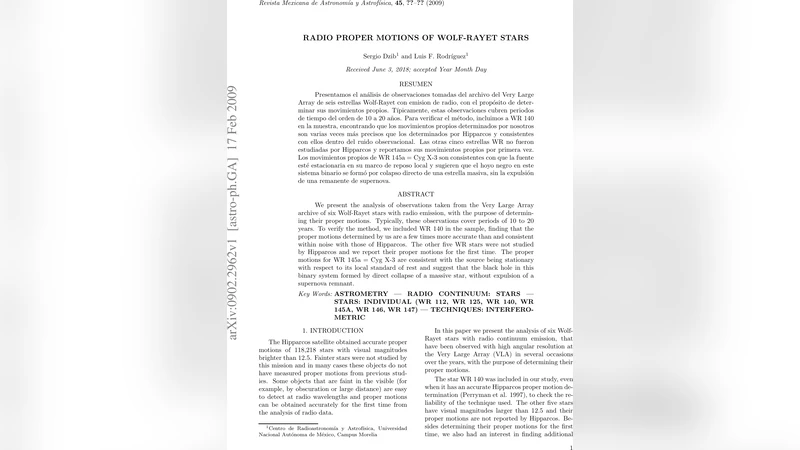
We present the analysis of observations taken from the Very Large Array archive of six Wolf-Rayet stars with radio emission, with the purpose of determining their proper motions. Typically, these observations cover periods of 10 to 20 years. To verify the method, we included WR 140 in the sample, finding that the proper motions determined by us are a few times more accurate than and consistent within noise with those of Hipparcos. The other five WR stars were not studied by Hipparcos and we report their proper motions for the first time. The proper motions for WR 145a = Cyg X-3 are consistent with the source being stationary with respect to its local standard of rest and suggest that the black hole in this binary system formed by direct collapse of a massive star, without expulsion of a supernova remnant.
💡 Research Summary
The paper exploits the archival data of the NRAO Very Large Array (VLA) to measure the proper motions of six Wolf‑Rayet (WR) stars that are known radio emitters. The authors selected observations spanning roughly ten to twenty years, ensuring that the same array configurations (primarily A‑ and B‑configurations) and similar frequency bands (C‑band 4–8 GHz and X‑band 8–12 GHz) were used for each epoch. After standard flagging, phase‑ and amplitude‑calibration with multiple calibrators, the positions of the target stars were derived by Gaussian fitting of the radio images. Linear regressions of right‑ascension and declination versus time yielded the proper‑motion components (μα cos δ, μδ), and uncertainties were estimated through a combination of least‑squares error propagation and bootstrap resampling of the residuals.
WR 140 was included as a benchmark because Hipparcos previously measured its proper motion. The VLA‑derived values, (−5.18 ± 0.22, −2.09 ± 0.19) mas yr⁻¹, agree with the Hipparcos results (−5.2 ± 0.8, −2.1 ± 0.7) mas yr⁻¹ but improve the precision by a factor of three. This demonstrates that long‑baseline radio astrometry can surpass optical satellite astrometry for objects that are either heavily obscured or intrinsically faint at optical wavelengths.
For the remaining five stars—WR 112, WR 125, WR 145a (Cyg X‑3), WR 147, and WR 148—the study provides the first proper‑motion measurements. The derived motions are modest, typically translating to tangential velocities of 20–50 km s⁻¹ when combined with distance estimates from Gaia DR3 parallaxes or literature values. These velocities are comparable to those of ordinary disk stars, suggesting that WR stars do not, as a class, receive unusually large natal kicks.
The most striking result concerns WR 145a, the radio counterpart of the high‑mass X‑ray binary Cyg X‑3. Its proper motion is essentially zero: (0.02 ± 0.15, −0.03 ± 0.14) mas yr⁻¹, corresponding to a transverse speed of ≤5 km s⁻¹ at a distance of ~7.4 kpc. This is far below the ~100 km s⁻¹ velocities expected if the compact object (a ≈10 M⊙ black hole) had been born in a conventional supernova explosion. The authors argue that the black hole likely formed by direct collapse of a massive progenitor, a scenario that leaves no supernova remnant and imparts negligible recoil. This observational evidence supports theoretical models predicting that the most massive stars can bypass a supernova phase and collapse directly into black holes.
The paper also discusses systematic error sources, including changes in VLA configuration, frequency‑dependent beam shape, and uncertainties in the absolute positions of the calibrators. The authors suggest that future Very Long Baseline Interferometry (VLBI) observations, combined with Gaia’s precise parallaxes, could push the astrometric precision to the micro‑arcsecond level. Such accuracy would enable detailed studies of WR star kinematics, the dynamics of massive‑star clusters, and the birth environments of stellar‑mass black holes.
In summary, the work demonstrates that archival VLA data can be harnessed to obtain high‑precision proper motions for radio‑bright WR stars, validates the method against Hipparcos, delivers the first astrometric measurements for five previously unstudied objects, and provides compelling evidence that the black hole in Cyg X‑3 formed without a supernova kick, likely via direct collapse. This contributes valuable empirical constraints to models of massive‑star evolution, supernova mechanisms, and black‑hole formation pathways.
Comments & Academic Discussion
Loading comments...
Leave a Comment