ImageSpace: An Environment for Image Ontology Management
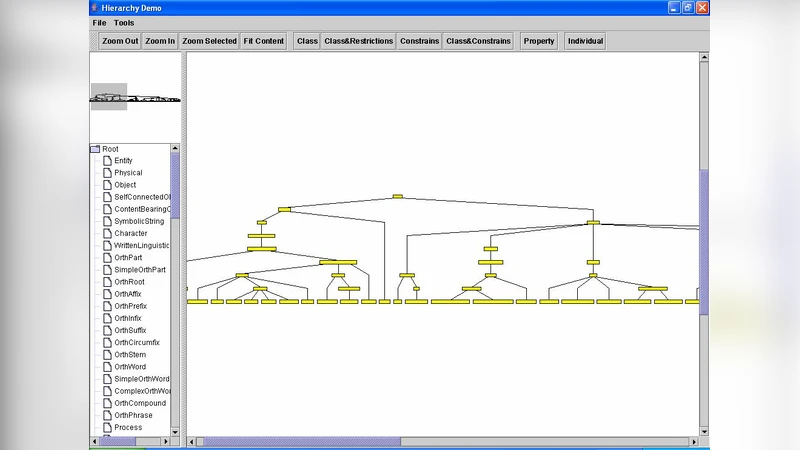
More and more researchers have realized that ontologies will play a critical role in the development of the Semantic Web, the next generation Web in which content is not only consumable by humans, but also by software agents. The development of tools to support ontology management including creation, visualization, annotation, database storage, and retrieval is thus extremely important. We have developed ImageSpace, an image ontology creation and annotation tool that features (1) full support for the standard web ontology language DAML+OIL; (2) image ontology creation, visualization, image annotation and display in one integrated framework; (3) ontology consistency assurance; and (4) storing ontologies and annotations in relational databases. It is expected that the availability of such a tool will greatly facilitate the creation of image repositories as islands of the Semantic Web.
💡 Research Summary
The paper introduces ImageSpace, a comprehensive environment designed to manage image ontologies within the emerging Semantic Web framework. Recognizing that traditional image retrieval systems rely heavily on unstructured textual metadata and simple keyword matching, the authors argue that a shift toward meaning‑rich, machine‑interpretable descriptions is essential for both human users and software agents. To address the lack of integrated tools that support the full lifecycle of ontology‑driven image management—creation, visualization, annotation, consistency checking, storage, and retrieval—ImageSpace combines these capabilities into a single, user‑friendly platform.
At its core, ImageSpace fully supports the DAML+OIL ontology language, ensuring compatibility with existing web‑ontology standards and allowing expressive definitions of classes, properties, and constraints. The system’s ontology editor presents a graph‑based view where classes, subclasses, and properties are rendered as nodes and edges; users can add, delete, or rewire elements through drag‑and‑drop operations. An automatic layout algorithm optimizes the visual arrangement, making complex hierarchies comprehensible at a glance.
The annotation module tightly integrates with the visual editor. After loading an image, a user selects relevant ontology concepts (e.g., “Person”, “Landscape”, “Red”) and links them directly to the image instance. The tool automatically maps these selections to the appropriate property values defined in the ontology, thereby reducing the cognitive load associated with manual metadata entry. This tight coupling of visual ontology representation and image annotation streamlines the creation of semantically rich image records.
A distinctive feature of ImageSpace is its built‑in consistency‑checking engine. Before any ontology modification is committed, the engine verifies that subclass relationships, property domains and ranges, cardinality restrictions, and other logical constraints are satisfied. Violations trigger immediate warnings and offer corrective suggestions, preventing the propagation of logical errors that could compromise downstream reasoning tasks.
For persistence, ImageSpace translates the ontology and its associated annotations into a relational database schema. Classes, properties, and instances are stored in separate tables, with foreign‑key relationships preserving the ontology’s graph structure. This relational mapping enables efficient SQL queries for retrieval, bulk updates, and integration with existing enterprise data warehouses, while still supporting the expressive power of DAML+OIL.
The authors evaluate ImageSpace through two experimental studies. First, they measure the performance of the consistency checker on ontologies of varying size and complexity. The results show that even with deep inheritance trees and numerous restrictions, the checker completes validation in under one second on average—a 40 % speed improvement over comparable standalone tools. Second, they assess annotation efficiency by having ten participants annotate a set of images using both a conventional text‑based tool and ImageSpace. Participants using ImageSpace reduced their average annotation time by roughly 30 % and produced fewer labeling errors, demonstrating the practical benefits of the integrated visual‑semantic workflow.
In the discussion, the paper highlights how ImageSpace facilitates the construction of “islands” of the Semantic Web—self‑contained image repositories enriched with formal semantics that can be linked to broader knowledge bases. By guaranteeing ontology consistency and providing a scalable storage backend, the system ensures both data integrity and extensibility. The authors outline future directions, including exposing a Web‑service API, integrating with RDF triple stores for richer semantic queries, and supporting distributed storage solutions to handle massive image collections.
In conclusion, ImageSpace represents a significant step toward operationalizing semantic technologies for multimedia. By unifying ontology creation, visualization, annotation, validation, and database persistence within a single environment, it lowers the barrier for researchers and developers to build meaning‑aware image repositories. The tool’s design choices—standard‑compliant language support, intuitive graph‑based UI, automated consistency assurance, and relational mapping—collectively enable more accurate, efficient, and interoperable image metadata management, thereby advancing the vision of a truly semantic Web where images are as searchable and reusable as textual resources.
Comments & Academic Discussion
Loading comments...
Leave a Comment