Solutions of nonlinear PDEs in the completion of uniform convergence spaces
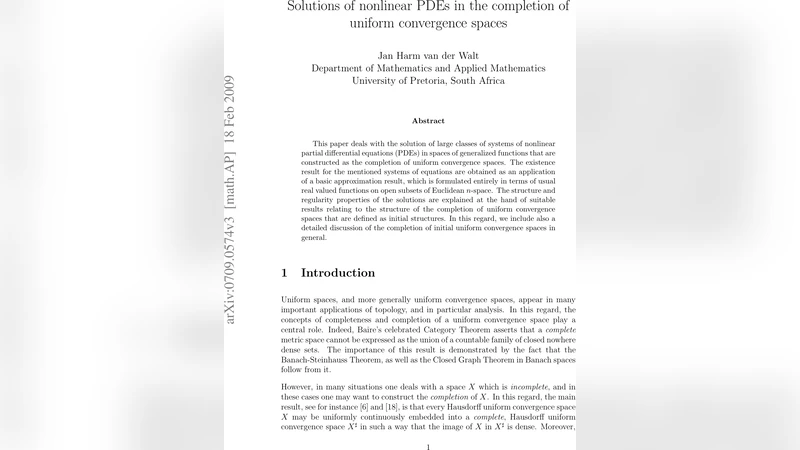
This paper deals with the solution of large classes of systems of nonlinear partial differential equations (PDEs) in spaces of generalized functions that are constructed as the completion of uniform convergence spaces. The existence result for the mentioned systems of equations are obtained as an application of a basic approximation result, which is formulated entirely in terms of usual real valued functions on open subsets of Euclidean n-space. The structure and regularity properties of the solutions are explained at the hand of suitable results relating to the structure of the completion of uniform convergence spaces that are defined as initial structures. In this regard, we include also a detailed discussion of the completion of initial uniform convergence spaces in general.
💡 Research Summary
The paper develops a novel framework for solving large classes of nonlinear partial differential equation (PDE) systems by working in spaces of generalized functions that arise as the completion of uniform convergence spaces. The authors begin by recalling the notion of a uniform convergence space, which refines the usual topological notion of convergence by requiring that a sequence of functions converge uniformly on the whole domain rather than merely pointwise or in some weaker sense. They then introduce the concept of an initial structure: given a family of real‑valued functions on an open set Ω⊂ℝⁿ, the initial uniform convergence structure is the strongest uniform convergence that makes all functions in the family continuous. This initial structure plays a central role because it is preserved under the completion process, ensuring that the completed space retains the same convergence characteristics as the original one.
The core technical contribution is an approximation theorem formulated entirely in terms of ordinary real‑valued functions. For any continuous target function g on Ω and any ε>0, the theorem guarantees the existence of a function f in the original space such that the nonlinear operator F (assumed to be continuous with respect to the initial uniform convergence structure) satisfies ‖F(f)−g‖∞<ε. The proof adapts classical approximation ideas (e.g., Stone–Weierstrass) to the uniform convergence setting, constructing a Cauchy sequence whose limit lies in the completion. Consequently, the nonlinear operator F extends uniquely to a continuous map ̂F on the completed space 𝔘̂.
Armed with this extension, the authors address the existence problem for the abstract nonlinear PDE F(u)(x) = g(x), x∈Ω. Because ̂F is continuous on the complete uniform convergence space, the equation ̂F(u)=g has a solution u∈𝔘̂. The solution u is not a classical function but an equivalence class of Cauchy sequences; nevertheless, each representative of the class converges uniformly to a genuine continuous function on Ω. Hence the generalized solution inherits a strong regularity property: it coincides with a continuous function at every point except possibly on a set that is topologically negligible (first category or measure zero). If additional smoothness assumptions are imposed on F, the authors show that the solution can be interpreted as a weak derivative in the distributional sense, thereby linking their construction to more familiar Sobolev‑type frameworks.
A substantial portion of the paper is devoted to the structural analysis of the completion of initial uniform convergence spaces. The authors prove that the completion can be described as the set of all uniform limits of Cauchy nets from the original space, equipped with the same initial uniform convergence structure. This result guarantees that no new convergence phenomena are introduced during completion, which is crucial for preserving the continuity of the nonlinear operator and for interpreting the generalized solutions as limits of ordinary functions.
Finally, the paper situates its contributions within the broader landscape of generalized function theories, such as Colombeau algebras, ultradistributions, and Sobolev space methods. Compared with these approaches, the uniform‑convergence‑space completion requires only the minimal continuity of the operator with respect to the initial structure, avoiding the heavy algebraic machinery or the need for strong differentiability hypotheses. The framework thus extends the existence theory for nonlinear PDEs to settings where traditional methods may fail, while still providing solutions that are “almost everywhere” continuous and, under mild extra conditions, possess weak derivatives.
In summary, the article offers a rigorous and conceptually clear pathway from elementary real‑valued approximations to the existence of generalized solutions of nonlinear PDEs, leveraging the preservation properties of initial uniform convergence structures under completion. This contributes a valuable tool to the analyst’s repertoire, especially for tackling equations whose nonlinearities preclude the direct application of classical functional‑analytic techniques.
Comments & Academic Discussion
Loading comments...
Leave a Comment