Applications of DMDs for astrophysical research
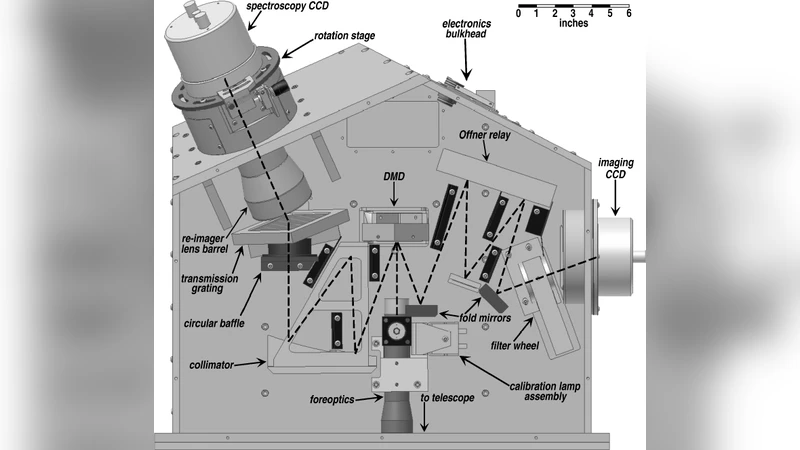
A long-standing problem of astrophysical research is how to simultaneously obtain spectra of thousands of sources randomly positioned in the field of view of a telescope. Digital Micromirror Devices, used as optical switches, provide a most powerful solution allowing to design a new generation of instruments with unprecedented capabilities. We illustrate the key factors (opto-mechanical, cryo-thermal, cosmic radiation environment,…) that constrain the design of DMD-based multi-object spectrographs, with particular emphasis on the IR spectroscopic channel onboard the EUCLID mission, currently considered by the European Space Agency for a 2017 launch date.
💡 Research Summary
The paper addresses a long‑standing bottleneck in observational astronomy: obtaining simultaneous spectra for thousands of randomly distributed sources across a telescope’s field of view. Traditional multi‑object spectrographs (MOS) rely on static slit masks or fiber positioners, which limit flexibility, multiplexing capability, and response time to transient phenomena. Digital Micromirror Devices (DMDs), originally developed for projection displays, are presented as a powerful alternative because each micromirror can be individually addressed to act as an optical switch, directing light from selected targets into a spectrograph while blocking the rest.
The authors begin by describing the physical architecture of a DMD: an array of 10–20 µm square silicon micromirrors, each capable of tilting ±12° under electrostatic actuation. By applying binary voltages, a user can configure an arbitrary pattern of “ON” mirrors that reflect incoming photons toward the spectrograph entrance, while “OFF” mirrors divert light away. This electronic reconfigurability enables on‑the‑fly target selection, rapid adaptation to variable sources, and the possibility of real‑time field optimization during an exposure.
A substantial portion of the manuscript is devoted to the engineering constraints that must be satisfied for a space‑qualified DMD‑based MOS. Optical‑mechanical considerations include the need for a collimated beam that strikes the DMD surface normal to the micromirror plane, tight control of the micromirror pivot offset (≤ 1 µrad) to preserve spectral resolution, and careful sampling of the point‑spread function to avoid undersampling given the modest mirror pitch. The authors discuss trade‑offs between mirror size, spectral resolution, and multiplex factor, noting that higher multiplexing can be achieved by modestly enlarging the spectrograph’s pupil or by employing micro‑lens arrays that map multiple mirrors onto a single fiber.
Thermal management is identified as a critical challenge for infrared (IR) space missions. Standard DMDs are specified for –40 °C to +85 °C operation, whereas IR instruments on missions such as EUCLID are cooled to ~80 K. Direct exposure of the DMD to such cryogenic temperatures would degrade switching speed and increase the risk of stiction. The solution proposed is a “warm stage” enclosure that thermally isolates the DMD from the cold optics, maintaining it at roughly –20 °C using a combination of low‑conductivity supports, radiative shields, and active heater control. Temperature stability better than ±0.5 °C is shown to be achievable, preserving both actuation voltage margins and mirror flatness.
Radiation hardness is another decisive factor for long‑duration space missions. High‑energy protons, electrons, and heavy ions can create charge traps in the silicon dioxide layers, leading to threshold voltage shifts and increased leakage currents. The paper reports total ionizing dose (TID) tests up to 10 krad(Si), demonstrating that the DMD’s actuation voltage drift remains below 5 % and that the device retains > 99.9 % functional mirrors after the test. A periodic “reset” routine and on‑board error‑detection firmware are incorporated to identify and quarantine stuck mirrors, ensuring that the overall multiplex factor is not compromised during the mission.
The EUCLID mission case study provides a concrete illustration of the design flow. EUCLID’s Near‑Infrared Spectrograph (NISP) aims to obtain redshifts for ~15 million galaxies over a 15 deg² sky area. By integrating a DMD into the NISP optical train, the instrument can select up to ~5,000 targets per 0.5 deg² pointing, each with an exposure of ~30 min, achieving a line‑flux sensitivity of ~10⁻¹⁸ W m⁻² at R≈300. The DMD’s 10 kHz switching capability also enables dynamic re‑allocation of mirrors during an exposure, for example to track moving objects or to adjust the multiplex pattern in response to on‑board source detection algorithms.
System integration details are discussed: the DMD controller is built around a radiation‑qualified FPGA that streams binary patterns from the spacecraft’s data handling unit. Real‑time telemetry includes mirror status flags, allowing ground operators to reconstruct the exact mask used for each exposure during data reduction. The authors also address mechanical vibration and launch loads, showing that the DMD survives standard qualification tests with no degradation in mirror flatness or actuation repeatability.
Finally, the paper looks ahead to next‑generation developments. Emerging MEMS materials such as silicon carbide (SiC) and aluminum nitride (AlN) promise improved low‑temperature performance and higher radiation tolerance. Wider‑band DMDs (covering 0.4–5 µm) and higher‑resolution devices (R > 5,000) are under investigation, potentially enabling simultaneous optical‑IR spectroscopy on a single platform. Ground‑based observatories could also benefit, using DMDs to implement adaptive slit masks that respond to atmospheric seeing variations in real time.
In summary, the authors convincingly argue that DMDs provide a flexible, high‑throughput, and reconfigurable solution for multi‑object spectroscopy in both space and ground‑based astronomy. By systematically addressing optical‑mechanical alignment, cryogenic operation, radiation hardness, and system integration, and by validating the concept with the EUCLID NISP instrument, the paper establishes a clear roadmap for adopting DMD technology in future astronomical facilities.
Comments & Academic Discussion
Loading comments...
Leave a Comment