Kinematic Evidence for Halo Substructure in Spiral Galaxies
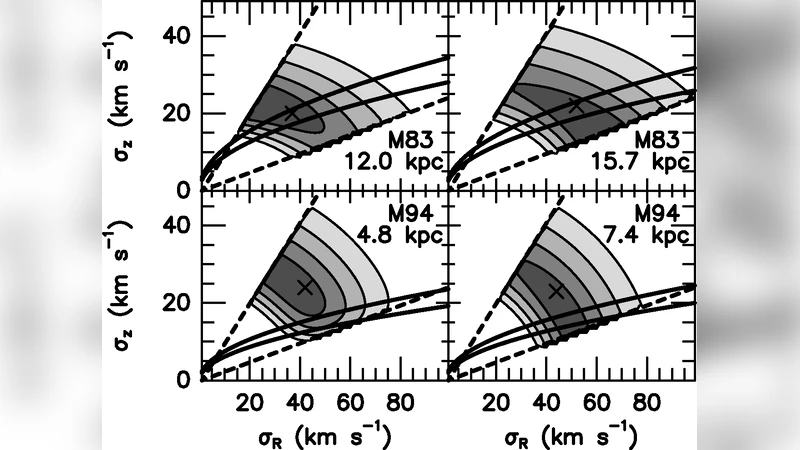
We present the results of a kinematic study of planetary nebulae in the extreme outskirts of two spiral galaxies, M83 (NGC 5236) and M94 (NGC 4736). We find that in the inner regions of the galaxies, the vertical velocity dispersion (sigma_z) falls off exponentially with the light, as expected for a constant mass-to-light ratio, constant thickness disk. However, starting at four optical scale lengths, sigma_z asymptotes out at roughly 20 km/s. Our analysis finds evidence for significant flaring in the outer regions as well, especially in M94. These observations are in excellent agreement with predictions derived from models of disk heating by halo substructure, and demonstrate how kinematic surveys in the outer disks of spirals can be used to test hierarchical models of galaxy formation.
💡 Research Summary
The paper presents a detailed kinematic study of planetary nebulae (PNe) located in the far‑outer disks of two nearby spiral galaxies, M83 (NGC 5236) and M94 (NGC 4736). Using multi‑object spectroscopy on 8‑meter class telescopes, the authors measured the line‑of‑sight velocities of roughly 150 PNe (≈70–80 per galaxy) via the strong
Comments & Academic Discussion
Loading comments...
Leave a Comment