The direct limit of electric dipole moment (EDM) and direct search for dark matter by EDM interaction are considered as including the electromagnetic nuclear form factor, in case that the dark matter candidate is a Dirac particle. The WIMP electric dipole moment constrained by direct searches must be lower than 7*10^(-22)e cm for WIMP mass of 100 GeV to satisfy the current experimental exclusion limits at XENON10 and CDMS II. We also consider the CP violation of EDM and the WIMP discovery by EDM intereaction in the future.
Deep Dive into Electric Dipole Moment of Dirac Fermionic Dark Matter.
The direct limit of electric dipole moment (EDM) and direct search for dark matter by EDM interaction are considered as including the electromagnetic nuclear form factor, in case that the dark matter candidate is a Dirac particle. The WIMP electric dipole moment constrained by direct searches must be lower than 7*10^(-22)e cm for WIMP mass of 100 GeV to satisfy the current experimental exclusion limits at XENON10 and CDMS II. We also consider the CP violation of EDM and the WIMP discovery by EDM intereaction in the future.
Dark matter (DM) has been postulated to explain various observations from gravitational effects on visible matter and plays an important role to explain structure formation and galaxy evolution. In recent years observations and the high precision analysis of the cosmic microwave background radiation have provided spectacular confirmation of the astrophysical evidence for DM, that is to say about quarter of the energy density of the universe is dark matter. Dark matter appears to be consisting of nonrelativistic particles that only interact gravitationally and perhaps by weak interaction. Mostly the coupling to photons is assumed to be nonexistent or very weak, so the electromagnetic interactions have not been considered seriously. A possible scenario for electromagnetic interaction of Dirac fermionic dark matter with nonzero magnetic dipole moment [1] has been considered in the standard model context.
No additional particles are assumed except for the DM candidate near electroweak scale (10 ∼ 1000 GeV). The various experimental bounds was investigated [2,3,4] in the past and a new experimental technique [5] for DM detection by electromagnetic interaction has been suggested for nonzero dipoles. There is a DM scenario for the electromagnetic interaction by the fractional or millie charged particles [7,8], but the DM scenario is for the case that another massless U(1) gauge boson, called paraphoton, exists beyond the standard model.
In this letter we consider electric dipole moment effect of Dirac fermionic dark matter.
The electric dipole moment (EDM) constrained by direct searches is investigated as considering the electromagnetic form factor of the nucleus. The WIMP-nucleus elastic scattering is due to spin independent interaction, that gives the WIMP electric dipole moment very strict bound since the WIMP-nucleus elastic scattering cross sections are enhanced by the square of nuclear charge (number of protons in the nucleus), Z 2 . The WIMP electric dipole moment constrained by direct searches must be lower than 7 ×10 -22 e cm for WIMP mass of 100 GeV to satisfy the current experimental exclusion limits. WIMP electric dipole moment is scaled as considering the current experimental exclusion limit of electric dipole moment (EDM) [6] for the known Dirac particles and the scenario that presented in Ref. [1] to investigate the WIMP detectability. A simple model (Lagrangian) with the complex dipole coupling is also introduced. Although we consider that the interaction of EDM is suppressed by CP violation, the suppression could be compensated by the enhancement of spin independent interaction. WIMP could thus be detected by the EDM interaction in near future if the suppression is not seriously small.
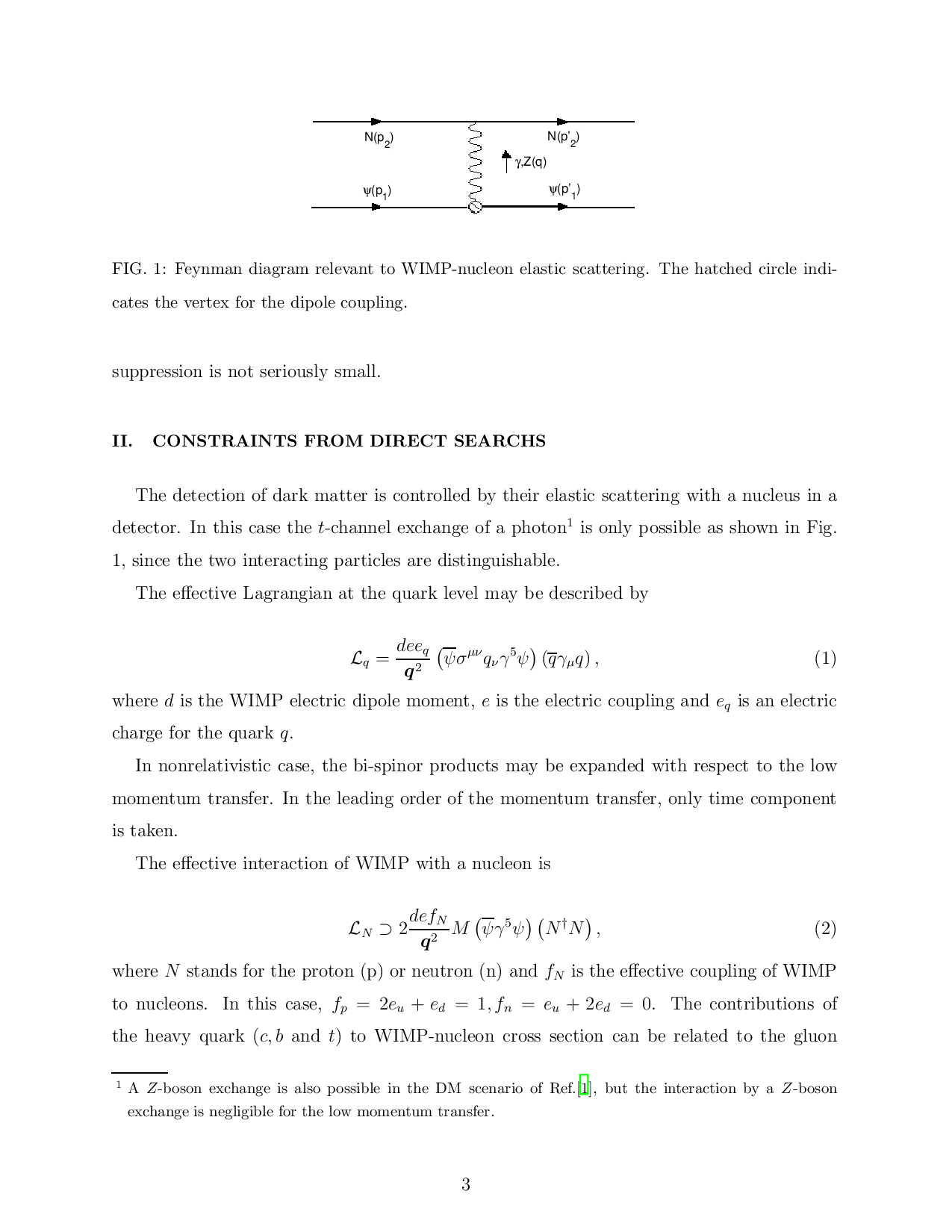
The detection of dark matter is controlled by their elastic scattering with a nucleus in a detector. In this case the t-channel exchange of a photon 1 is only possible as shown in Fig. 1, since the two interacting particles are distinguishable.
The effective Lagrangian at the quark level may be described by
where d is the WIMP electric dipole moment, e is the electric coupling and e q is an electric charge for the quark q.
In nonrelativistic case, the bi-spinor products may be expanded with respect to the low momentum transfer. In the leading order of the momentum transfer, only time component is taken.
The effective interaction of WIMP with a nucleon is
where N stands for the proton (p) or neutron (n) and f N is the effective coupling of WIMP to nucleons. In this case, f p = 2e u + e d = 1, f n = e u + 2e d = 0. The contributions of the heavy quark (c, b and t) to WIMP-nucleon cross section can be related to the gluon 1 A Z-boson exchange is also possible in the DM scenario of Ref. [1], but the interaction by a Z-boson exchange is negligible for the low momentum transfer.
contribution by QCD, but those appear in quark-antiquark pairs. So three valance quarks give the nucleon its global electric charge and the contributions of each valance quark in the nucleon add coherently.
The similar argument can be applied to the nuclei. The constructive coherent interactions give the squared scattering amplitude of the nucleus
where S = 1 2 is the WIMP spin, Z is the nuclear electric charge (the number of protons in the nucleus) and F 2 (|q|) is the electromagnetic form factor that is related to the electric charge distribution in a nucleus. For the low momentum transfer, we cannot consider the large nuclei as a point particle. We need consider the charge distribution of the nucleons in a nucleus. We take the Helm form factor [10] that was introduced as a modification of the form factor for an uniform sphere multiplied by a gaussian to account for the soft edge of the nucleus.
where
x is a spherical Bessel function of the first kind, and where s ≃ 1 fm is the nuclear skin thickness and R 1 = √ R 2 -5s 2 is an effective nuclear radius for nuclear radius R ≃ 1.2 fm A 1/3 for an atomic nucleus of atomic number A. Th
…(Full text truncated)…
This content is AI-processed based on ArXiv data.