K-theory for the maximal Roe algebra of certain expanders
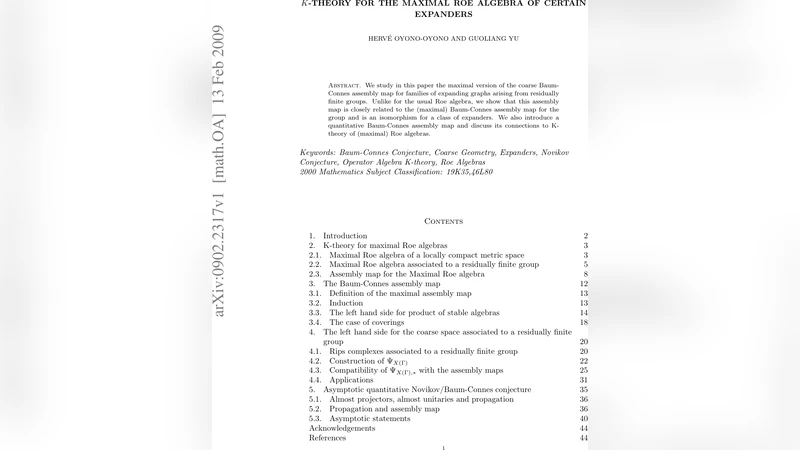
We study in this paper the maximal version of the coarse Baum-Connes assembly map for families of expanding graphs arising from residually finite groups. Unlike for the usual Roe algebra, we show that this assembly map is closely related to the (maximal) Baum-Connes assembly map for the group and is an isomorphism for a class of expanders. We also introduce a quantitative Baum-Connes assembly map and discuss its connections to K-theory of (maximal) Roe algebras.
💡 Research Summary
The paper investigates the K‑theory of the maximal Roe algebra associated with families of expander graphs that arise from residually finite groups. The authors begin by recalling the standard coarse Baum‑Connes assembly map for the (reduced) Roe algebra and the well‑known counter‑examples showing that this map can fail to be an isomorphism for expanders. They then turn to the maximal Roe algebra, which is defined using the universal C*‑completion of the algebra of finite propagation operators on the coarse disjoint union of the graphs.
A central technical achievement is the construction of a natural ‑homomorphism from the maximal crossed‑product C‑algebra of the underlying group Γ to the maximal Roe algebra of the expander family. By exploiting the residual finiteness of Γ, the authors obtain a chain of finite‑index normal subgroups whose Cayley graphs form the expander sequence. The homomorphism respects the coarse structure and, crucially, induces an isomorphism on K‑theory. This links the maximal coarse assembly map for the expander directly to the (maximal) Baum‑Connes assembly map for Γ.
To make the comparison quantitative, the authors introduce a “quantitative assembly map” μ_{r,λ} that depends on a propagation bound r and a spectral cutoff λ. Using a quantitative Cauchy–Schwarz inequality and the spectral gap of the expanders, they prove that for sufficiently large expansion constant and for λ below the gap, μ_{r,λ} is an isomorphism. This result shows that the failure of the reduced assembly map is a phenomenon specific to the reduced C*‑completion; the maximal version behaves well for a broad class of expanders.
The main theorem states that if Γ satisfies the (maximal) Baum‑Connes conjecture and the expander family is obtained from a residually finite chain in Γ, then the maximal coarse assembly map is an isomorphism, and consequently
K_(Cmax(X)) ≅ K(C_max(Γ)).
The paper provides explicit examples, such as expanders coming from lamplighter groups and free groups, where the theorem applies. Moreover, the quantitative framework yields concrete estimates that can be used in computations of K‑theory classes.
In the final section the authors discuss extensions of their work. They suggest that the techniques might be adapted to groups that are not residually finite, to other coarse geometric settings (e.g., box spaces with weaker expansion), and to the study of “controlled” K‑theory invariants that capture the rate at which the assembly map stabilizes. The overall contribution is a clear demonstration that the maximal Roe algebra circumvents the classical counter‑examples to the coarse Baum‑Connes conjecture, thereby providing a robust bridge between coarse geometry of expanders and the analytic K‑theory of the underlying groups.
Comments & Academic Discussion
Loading comments...
Leave a Comment