On Morphic Actions and Integrability of LA-Groupoids
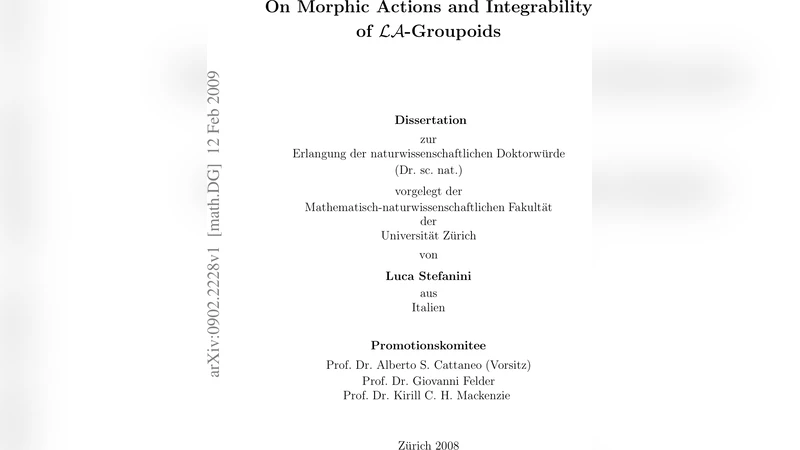
Lie theory for the integration of Lie algebroids to Lie groupoids, on the one hand, and of Poisson manifolds to symplectic groupoids, on the other, has undergone tremendous developements in the last decade, thanks to the work of Mackenzie-Xu, Moerdijk-Mrcun, Cattaneo-Felder and Crainic-Fernandes, among others. In this thesis we study - part of - the categorified version of this story, namely the integrability of LA-groupoids (groupoid objects in the category of Lie algebroids), to double Lie groupoids (groupoid objects in the category of Lie groupoids) providing a first set of sufficient conditions for the integration to be possible. Mackenzie’s double Lie structures arise naturally from lifting processes, such as the cotangent lift or the path prolongation, on ordinary Lie theoretic and Poisson geometric objects and we use them to study the integrability of quotient Poisson bivector fields, the relation between “local” and “global” duality of Poisson groupoids and Lie theory for Lie bialgebroids and Poisson groupoids.
💡 Research Summary
The thesis addresses the problem of integrating LA‑groupoids—groupoid objects living in the category of Lie algebroids—into double Lie groupoids, which are groupoid objects in the category of Lie groupoids. This can be viewed as a categorified version of the classical Lie theory that relates Lie algebroids to Lie groupoids and Poisson manifolds to symplectic groupoids. The work builds on the foundational contributions of Mackenzie‑Xu, Moerdijk‑Mrcun, Cattaneo‑Felder, and Crainic‑Fernandes, and it introduces the first systematic set of sufficient conditions guaranteeing that an LA‑groupoid admits an integration to a double Lie groupoid.
The first part of the thesis revisits Mackenzie’s double Lie structures and shows that they arise naturally from two elementary lifting procedures: the cotangent lift and the path prolongation. The cotangent lift takes a Lie groupoid (G) and equips its cotangent bundle (T^{*}G) with a canonical Poisson structure, thereby producing a Poisson double structure on the associated Lie algebroid (A). The path prolongation considers the space of (A)‑paths, endowing it with a groupoid multiplication that mirrors the Lie algebroid bracket and anchor. Both constructions provide candidate double Lie groupoid structures for a given LA‑groupoid and reveal a built‑in commutativity between the source and target groupoid maps.
The core technical contribution is a pair of sufficient integrability criteria. The first, commutativity, requires that the two groupoid structures on the LA‑groupoid interact in a way that their source‑target maps commute; this ensures compatibility between the Poisson brackets obtained from the cotangent lift and the multiplication coming from path prolongation. The second, completeness, demands that the space of (A)‑paths be homologically complete and that the Poisson flows generated by the cotangent lift be globally defined. When both conditions hold, the author constructs an explicit “integration ladder” that lifts the LA‑groupoid step by step to a genuine double Lie groupoid, providing a concrete model for the integration process.
Several significant applications are explored. First, the thesis tackles the integrability of quotient Poisson bivector fields. In many situations a Poisson structure is obtained by taking a quotient of a Poisson groupoid, which can introduce singularities that obstruct integration. By applying the combined cotangent‑and‑path lift, the author shows that the resulting quotient Poisson bivector can be integrated at the double Lie groupoid level, thereby resolving the usual obstruction. Second, the work clarifies the relationship between local and global duality for Poisson groupoids. Local duality refers to the Lie bialgebroid (infinitesimal) duality, while global duality concerns the duality of the integrated double Lie groupoid. The thesis proves that, under the completeness hypothesis, the infinitesimal dual structure lifts uniquely to a global dual double groupoid, establishing a precise bridge between the two notions.
Finally, the thesis extends Lie theory for Lie bialgebroids and Poisson groupoids. By interpreting a Lie bialgebroid as the infinitesimal data of a Poisson groupoid, the integration procedure shows how the bialgebroid’s co‑bracket becomes the Poisson structure on the integrated groupoid, and how the double Lie groupoid encodes both the original and the dual groupoid simultaneously. This yields a unified categorical picture in which the cotangent and path lifts are compatible, and the resulting double Lie groupoid serves as a “categorified symplectic groupoid” for the original Poisson geometry.
In summary, the thesis delivers a robust framework for integrating LA‑groupoids, supplies concrete sufficient conditions, and demonstrates the power of this framework through applications to quotient Poisson structures, duality theory, and the Lie theory of bialgebroids. The results open new avenues for exploring higher‑categorical structures in Poisson geometry and for addressing integrability problems that were previously out of reach.
Comments & Academic Discussion
Loading comments...
Leave a Comment