Proof Search Specifications of Bisimulation and Modal Logics for the pi-Calculus
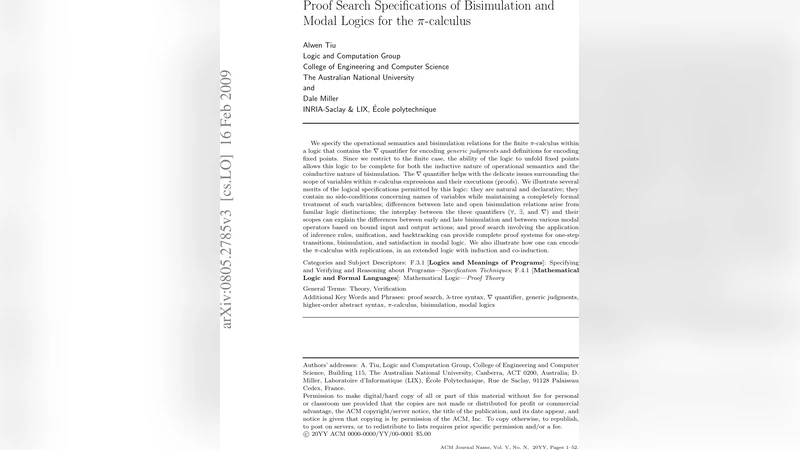
We specify the operational semantics and bisimulation relations for the finite pi-calculus within a logic that contains the nabla quantifier for encoding generic judgments and definitions for encoding fixed points. Since we restrict to the finite case, the ability of the logic to unfold fixed points allows this logic to be complete for both the inductive nature of operational semantics and the coinductive nature of bisimulation. The nabla quantifier helps with the delicate issues surrounding the scope of variables within pi-calculus expressions and their executions (proofs). We illustrate several merits of the logical specifications permitted by this logic: they are natural and declarative; they contain no side-conditions concerning names of variables while maintaining a completely formal treatment of such variables; differences between late and open bisimulation relations arise from familar logic distinctions; the interplay between the three quantifiers (for all, exists, and nabla) and their scopes can explain the differences between early and late bisimulation and between various modal operators based on bound input and output actions; and proof search involving the application of inference rules, unification, and backtracking can provide complete proof systems for one-step transitions, bisimulation, and satisfaction in modal logic. We also illustrate how one can encode the pi-calculus with replications, in an extended logic with induction and co-induction.
💡 Research Summary
The paper presents a uniform logical framework for specifying and reasoning about the finite π‑calculus, its operational semantics, bisimulation equivalences, and associated modal logics. The authors employ the logic FOλΔ∇, an extension of intuitionistic first‑order logic with simply‑typed λ‑terms, definition clauses for fixed points, and a novel ∇‑quantifier that captures generic judgments. The ∇‑quantifier introduces locally scoped variables that behave like “fresh names” and therefore solves the delicate problem of name capture and scope management that is intrinsic to the π‑calculus.
The syntax of π‑calculus processes is encoded using λ‑tree syntax (a form of higher‑order abstract syntax) where object‑level binders are represented by meta‑level λ‑abstractions. Because the underlying meta‑language is a weakly typed λ‑calculus, equality of λ‑terms remains decidable, allowing the logic to serve as a practical specification language rather than a purely semantic model.
Operational semantics are given as a set of inference rules for one‑step transitions. These rules are expressed as definitions (using the △= notation) within FOλΔ∇, so that the transition relation becomes a fixed‑point predicate. Since the calculus is finite, the fixed‑point can be unfolded completely, guaranteeing that proof search over the definitions yields a complete decision procedure for the transition relation.
Bisimulation is treated in two classic variants: open bisimulation and late bisimulation. The key insight is that the two notions differ only in the ordering of quantifiers over names. Open bisimulation is captured by a pattern of universal (∀) quantification over existing names followed by ∇‑quantification over freshly generated names; late bisimulation reverses this order, placing ∇ first and ∀ later. Consequently, the logical distinction between ∀ and ∇ directly mirrors the semantic distinction between the two bisimulations, and no side‑conditions on name freshness are required. The paper proves that the specifications derived from these quantifier patterns are sound and complete with respect to the standard definitions of open and late bisimulation.
The authors also encode a family of modal logics for mobility, extending the classic Hennessy‑Milner logic with modalities that can bind names (e.g., ⟨a(x)⟩φ and
Comments & Academic Discussion
Loading comments...
Leave a Comment