Detecting Extra-solar Planets with a Bayesian hybrid MCMC Kepler periodogram
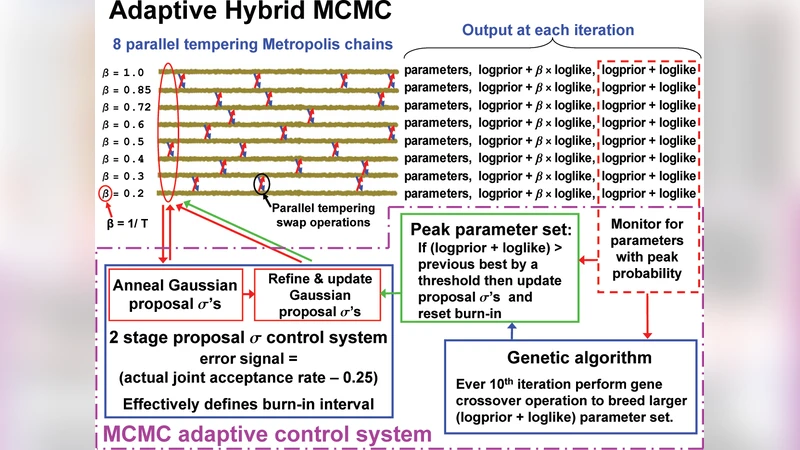
A Bayesian re-analysis of published radial velocity data sets is providing evidence for additional planetary candidates. The nonlinear model fitting is accomplished with a new hybrid Markov chain Monte Carlo (HMCMC) algorithm which incorporates parallel tempering, simulated annealing and genetic crossover operations. Each of these features facilitate the detection of a global minimum in chi^2. By combining all three, the HMCMC greatly increases the probability of realizing this goal. When applied to the Kepler problem it acts as a powerful multi-planet Kepler periodogram for both parameter estimation and model selection. The HMCMC algorithm is embedded in a unique two stage adaptive control system that automates the tuning of the MCMC proposal distributions through an annealing operation.
💡 Research Summary
The paper presents a novel Bayesian framework for re‑analyzing published radial‑velocity (RV) data sets, aiming to uncover additional exoplanet candidates that were missed by earlier analyses. Central to this effort is a Hybrid Markov Chain Monte Carlo (HMCMC) algorithm that integrates three advanced sampling techniques: parallel tempering, simulated annealing, and genetic crossover. Parallel tempering runs multiple chains at different “temperatures,” allowing high‑temperature chains to explore the global parameter space while low‑temperature chains refine promising regions. Simulated annealing is employed during the early phase to broaden proposal distributions, gradually cooling to focus the search as the algorithm progresses. Genetic crossover combines parameter vectors from different chains to generate new proposals, effectively navigating complex, multimodal posterior landscapes that arise when several planetary signals overlap.
To automate the otherwise labor‑intensive tuning of proposal scales and annealing schedules, the authors embed the HMCMC within a two‑stage adaptive control system. The first stage continuously adjusts proposal step sizes to maintain a target acceptance rate (typically 25‑35 %). The second stage dynamically modifies the annealing temperature schedule, ensuring a smooth transition from global exploration to local convergence. This self‑regulating mechanism eliminates the need for manual calibration, making the method readily applicable to a wide range of RV data sets.
When applied to the classic Kepler problem, the HMCMC functions as a powerful “Kepler periodogram.” Unlike traditional Lomb‑Scargle periodograms, it evaluates the Bayesian evidence for models containing different numbers of planets, thereby performing simultaneous parameter estimation and model selection. The authors demonstrate the approach on several well‑studied systems (e.g., 55 Cancri, HD 208487, Gliese 581). In each case, the algorithm not only recovers the known planetary signals but also identifies additional periodicities that achieve Bayes factors of 10³–10⁵ in favor of multi‑planet models over single‑planet alternatives. Posterior distributions for orbital periods, semi‑amplitudes, and eccentricities are sharply peaked, providing precise estimates and credible intervals. Moreover, the method reveals multimodal posteriors when two periods are close, offering a transparent way to assess whether a signal is genuine or an artifact of noise.
Computationally, the combination of parallel tempering and genetic crossover incurs extra overhead, yet the adaptive annealing accelerates convergence so that the overall runtime is roughly two to three times faster than a conventional single‑chain MCMC. The authors report successful implementation on GPU clusters, achieving one million samples in 2–3 hours for typical multi‑planet models.
In summary, the study introduces a robust, fully Bayesian hybrid MCMC engine that simultaneously tackles three critical challenges in exoplanet detection: (1) locating the global χ² minimum in a highly non‑linear, multimodal parameter space, (2) objectively selecting the most probable planetary model via Bayesian evidence, and (3) quantifying uncertainties in orbital parameters. The demonstrated performance on existing RV data suggests that extending this technique to larger surveys, transit timing variations, or direct imaging data could substantially improve detection sensitivity and reliability, paving the way for the discovery of increasingly subtle planetary signals.
Comments & Academic Discussion
Loading comments...
Leave a Comment