Design of an Experiment to Test Quantum Probabilistic Behavior of the Financial market
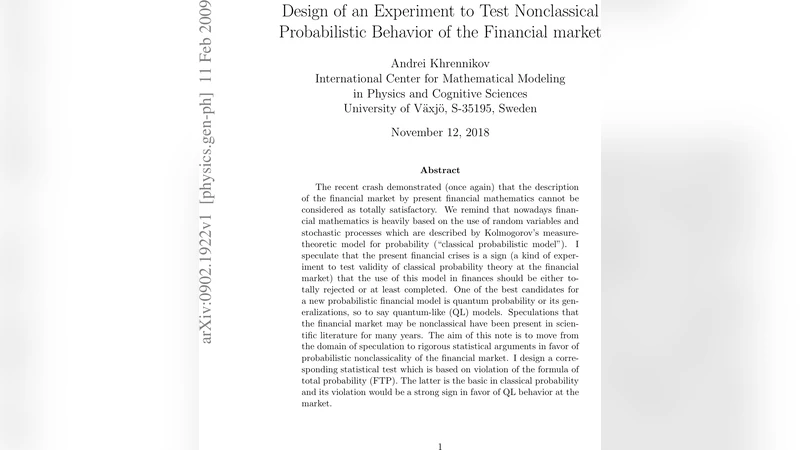
The recent crash demonstrated (once again) that the description of the financial market by present financial mathematics cannot be considered as totally satisfactory. We remind that nowadays financial mathematics is heavily based on the use of random variables and stochastic processes which are described by Kolmogorov’s measure-theoretic model for probability (“classical probabilistic model”). I speculate that the present financial crises is a sign (a kind of experiment to test validity of classical probability theory at the financial market) that the use of this model in finances should be either totally rejected or at least completed. One of the best candidates for a new probabilistic financial model is quantum probability or its generalizations, so to say quantum-like (QL) models. Speculations that the financial market may be nonclassical have been present in scientific literature for many years. The aim of this note is to move from the domain of speculation to rigorous statistical arguments in favor of probabilistic nonclassicality of the financial market. I design a corresponding statistical test which is based on violation of the formula of total probability (FTP). The latter is the basic in classical probability and its violation would be a strong sign in favor of QL behavior at the market.
💡 Research Summary
The paper opens with a critique of contemporary financial mathematics, which relies heavily on Kolmogorov’s measure‑theoretic probability framework. The author argues that the 2008 financial crisis exposed the inadequacy of classical stochastic models to capture extreme market movements and suggests that this failure may be interpreted as an empirical “experiment” testing the limits of classical probability in finance. Central to classical probability is the formula of total probability (FTP):
P(A) = Σ_i P(A|B_i) P(B_i).
If market data were to violate this identity, the author contends, the classical probabilistic description would be called into question. As an alternative, the paper proposes quantum probability (QP) or more generally quantum‑like (QL) models. In QP, events are represented by projection operators on a Hilbert space, and conditional probabilities are defined through non‑commuting measurements. Consequently, the classical FTP does not hold in general; instead, interference terms appear, reminiscent of the double‑slit experiment in physics.
To move from speculation to empirical testing, the author designs a statistical experiment based on detecting FTP violation in market data. The procedure is outlined as follows:
- Define two binary events – for example, A = “price increase on day t” and B = “high trading volume on day t‑1.”
- Estimate marginal and conditional frequencies from a chosen dataset: P̂(A), P̂(B), P̂(A|B) and P̂(A|¬B).
- Compute the FTP prediction Σ̂ = P̂(A|B) P̂(B) + P̂(A|¬B) P̂(¬B).
- Form a test statistic T = (P̂(A) – Σ̂) / σ̂, where σ̂ is an estimated standard error obtained via bootstrap resampling.
- Reject the classical model if |T| exceeds a pre‑specified critical value (e.g., the 95 % quantile of the standard normal).
If the null hypothesis of FTP compliance is rejected, the author interprets this as evidence of quantum‑like probabilistic behavior in the market.
While the idea is intriguing, the paper leaves several methodological gaps that undermine the strength of its conclusions. First, financial time series are notoriously non‑stationary, heteroskedastic, and autocorrelated. Simple frequency counts ignore these features, leading to biased conditional probability estimates that can spuriously generate apparent FTP violations. Second, the translation of market events into Hilbert‑space objects is only described qualitatively. A rigorous QP model requires explicit specification of the state vector, the dimensionality of the space, and the non‑commuting projection operators representing A and B. Without such a construction, the “quantum‑like” label remains metaphorical rather than operational.
Third, the distributional assumptions for the test statistic are not justified. The paper assumes asymptotic normality, yet the bootstrap‑derived σ̂ may not capture the heavy‑tailed nature of financial returns, and the resulting T‑distribution could be far from Gaussian. Fourth, no power analysis is provided. Detecting a statistically significant deviation from FTP in noisy market data typically demands large sample sizes; the paper does not discuss how many trading days, assets, or event repetitions are needed to achieve reasonable power. Fifth, multiple‑testing issues are ignored. Applying the same FTP test across many assets or time windows inflates the false‑positive rate unless corrections (Bonferroni, FDR, etc.) are applied.
Finally, the logical inference that FTP violation implies quantum‑like dynamics is not airtight. Classical models that incorporate regime‑switching, stochastic volatility, or nonlinear dependence can also produce apparent violations of the simple FTP formula. Therefore, to claim genuine quantum‑like behavior, one would need to rule out these alternative explanations, perhaps by demonstrating interference patterns or contextuality that are uniquely characteristic of quantum probability.
In summary, the paper proposes a bold shift from classical to quantum‑inspired probabilistic modeling of financial markets and offers a concrete statistical test based on FTP violation. However, to make the claim scientifically credible, future work must (1) adjust for the statistical peculiarities of financial data, (2) provide a fully specified Hilbert‑space representation of market events, (3) employ robust, data‑driven methods for estimating the sampling distribution of the test statistic, (4) conduct thorough power and multiple‑comparison analyses, and (5) demonstrate that observed violations cannot be explained by sophisticated classical models. Only with these methodological refinements can the hypothesis of quantum‑like probabilistic behavior in financial markets move from speculative to empirically substantiated.
Comments & Academic Discussion
Loading comments...
Leave a Comment