Loewners torus inequality with isosystolic defect
We show that Bonnesen's isoperimetic defect has a systolic analog for Loewner's torus inequality. The isosystolic defect is expressed in terms of the probabilistic variance of the conformal factor of the metric g with respect to the flat metric of un…
Authors: Charles Horowitz, Karin Usadi Katz, Mikhail G. Katz
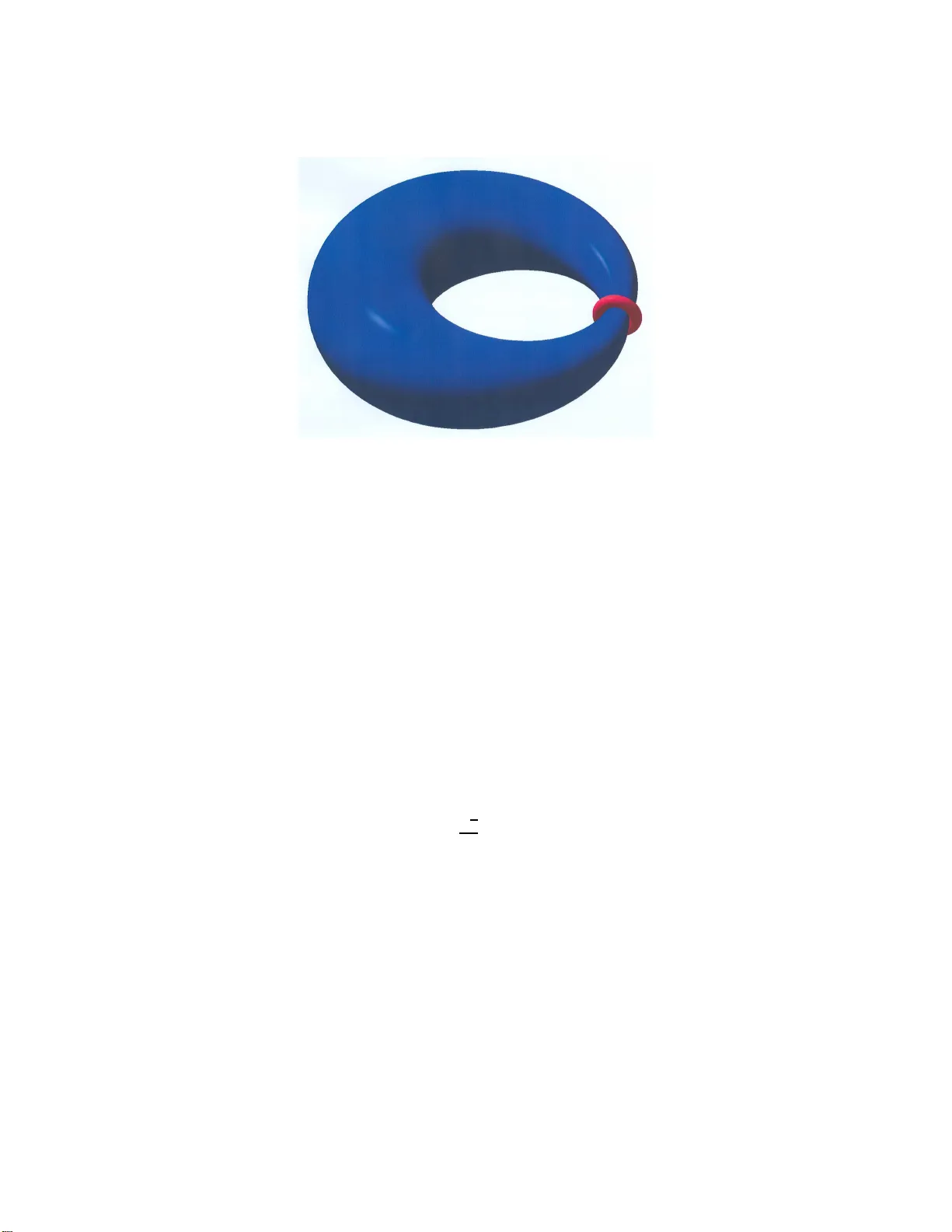
LOEWNER’S TOR US INEQUALITY WITH ISOSYSTOLIC DEFECT CHARLES HORO WITZ, KARIN USADI KA TZ, AND MIKHAIL G. K A TZ ∗ Abstract. W e s how that Bonnesen’s isop er imetric defect has a systolic analog fo r Lo ewner ’s tor us inequa lit y . The isosystolic de- fect is ex pressed in terms of the pro babilistic v ariance of the con- formal factor of the metric G with r esp ect to the flat metr ic of unit area in the conformal class o f G . Contents 1. Bonnesen defect and isosystolic defect 1 2. V ariance, Hermite constant, successiv e minima 5 3. Standard fundamen tal domain and Eisenstein in tegers 6 4. F undamen tal domain a nd Lo ewner’s torus inequalit y 7 5. First f undamen tal form and surfaces of revolution 9 6. A second isosystolic defect term 10 7. Biaxial pro jection and second defect 12 8. Ac kno wle dgmen ts 13 References 14 1. Bonnesen defect and isosystolic defect The systole of a compact metric space X is a metric in v aria n t of X , defined to b e the least length of a noncon tractible lo op in X . W e will denote it sys = sys( X ), cf. M. G romo v [Gr83, Gr96 , Gr99, Gr0 7]. When X is a graph, the in v aria nt is usually r eferred to as the girth , ev er since W. T utte’s article [T u47]. P ossibly inspired by the la tter, C. Lo ewner started thinking ab out systolic questions on surfaces in the Date : Oc tob er 24, 2018. 2000 Mathematics Subje ct Classific atio n. P rimary 53C23; Secondary 30F10, 35J60 , 58J60 . Key wor d s and phr ases. Bonnes en’s inequality , Liouville’s equation, L o ewner’s torus inequa lity , systole, systo lic defect, v ariance. ∗ Suppo rted b y the Isra el Science F oundation (grants no . 84 /03 a nd 1294/06 ) and the B SF (g r ant 2 00639 3). 1 2 CHARLES HOROWITZ, KARIN USADI KA T Z, AND M. KA TZ Figure 1.1. Wikiartist’s conce ption of a shortest lo op on a torus late forties, resulting in a ’5 0 thesis by his studen t P .M. Pu, published as [Pu52 ]. Lo ewner himself did not p ublish his torus ineq ualit y (1.1), apparently lea ving it to Pu to pursue this line of researc h. Mean while, the latt er w as recalled to the mainland after the comm unists ousted Chiang Kai- shek in ’49. Pu w as henceforth confined to researc h in fuzzy top olog y in the service of the p eople. Our guess is that Pu may hav e otherwise obtained a geometric inequalit y with isosys tolic defect, a lready ha lf a cen tury ago, placing it among the classics of the glo ba l geometry of surfaces. Similarly to t he isop erimetric inequalit y , Lo ewner’s torus inequality relates the total area, to a suitable 1-dimensional inv arian t, namely the systole, i.e. least length of a noncontractible lo op on the torus ( T 2 , G ): area( G ) − √ 3 2 sys( G ) 2 ≥ 0 , (1.1) cf. (4 .3) and [Pu52, Ka07]. The classical Bonnesen inequalit y [Bo2 1] is the strengthened isop eri- metric inequalit y L 2 − 4 π A ≥ π 2 ( R − r ) 2 , (1.2) see [BZ 8 8, p. 3]. Here A is the area of the r egio n b ounded by a closed Jordan curv e of length (p erimeter) L in the plane, R is the circumradius of the b ounded region, and r is its inradius. The error t erm π 2 ( R − r ) 2 on t he right hand side of (1.2) is traditio nally referred to as the isop erimetric defe ct . LOEWNER’S TORUS INEQUALI TY WITH I SOSYS TOLIC DEFECT 3 In the presen t text, we will strengthen Lo ewner’s torus inequalit y b y in tro ducing a “defect” term ` a la Bonnesen. There is no defect term in either [Pu52] or [Ka0 7]. The approach tha t has b een used in the literature is via an in tegral identit y expressing area in t erms of ener- gies of lo ops. Someho w researc hers in the field seem to ha ve ov erlo oke d the fact that the computational form ula for the v aria nce yields an im- pro veme n t , namely the defect term. There is thus a significan t change of fo cus, from the in tegral geometric identit y , to the application of the computational formula, elemen tary though it may b e. If w e use confo rmal r epresen tation to express the metric G on the torus a s f 2 ( dx 2 + dy 2 ) with r esp ect to a unit ar ea flat metric dx 2 + dy 2 on the torus view ed as a quotien t of the ( x, y ) plane by a lattice (see (1 .6)), then t he defect term in question is simply the v ariance of the conformal fa ctor f abov e. Then the inequality with the defect term can b e written as follo ws: area( G ) − √ 3 2 sys( G ) 2 ≥ V ar( f ) . (1.3) Here the error term, or isosystolic defe ct , is giv en b y the v a riance V ar( f ) = Z T 2 ( f − m ) 2 (1.4) of the confo r mal factor f of the metric G = f 2 ( dx 2 + d y 2 ) on t he torus, relative to the unit area flat metric G 0 = dx 2 + dy 2 in the same conformal class. Here m = Z T 2 f (1.5) is the mean of f . More concretely , if ( T 2 , G 0 ) = R 2 /L where L is a lattice of unit coarea, and D is a fundamental domain for the action of L on R 2 b y tra nslations, then the integral (1.5 ) can b e written as m = Z D f ( x , y ) dxdy where dxdy is the standard measure of R 2 . Ev ery flat to rus is isometric to a quotien t T 2 = R 2 /L where L is a la ttice, cf. [Lo7 1, Theorem 38.2]. Recall that the uniformisation theorem in the gen us 1 case can b e form ulated as follows . Theorem 1.1 (Uniformisation theorem) . F or every metric G on the 2 - torus T 2 , ther e exists a lattic e L ⊂ R 2 and a p ositive L -p erio dic func- tion f ( x, y ) on R 2 such that the torus ( T 2 , G ) is isome tric to R 2 /L, f 2 ds 2 , (1.6) 4 CHARLES HOROWITZ, KARIN USADI KA TZ, A ND M. KA TZ wher e d s 2 = d x 2 + dy 2 is the s tandar d flat metric of R 2 . When the flat metric is that o f the unit square torus, Lo ewner’s inequalit y can b e strengthened to the inequality area( G ) − sys( G ) 2 ≥ V ar( f ) , cf. (4 .4). In this case, if the confo rmal factor dep ends only on o ne v aria ble (as, for example, in the case of surfaces of rev olution), one can strengthen the inequalit y further by providing a second defect t erm as follo ws: area( G ) − sys( G ) 2 ≥ V ar( f ) + 1 4 | f 0 | 2 1 , (1.7) where f 0 = f − E ( f ), while E ( f ) is the exp ected v alue of f , a nd | | 1 is the L 1 -norm. See a lso inequalit y (6.2). More generally , w e obtain the follo wing theorem. W e first define a “biaxial” pro jection P BA ( f ) as follo ws. Giv en a doubly p erio dic function f ( x, y ), i.e . a function defined on R 2 / Z 2 , w e decomp ose f by setting f ( x , y ) = E ( f ) + g f ( x ) + h f ( y ) + k f ( x, y ) , where the single-v ariable functions g f and h f ha ve zero means, while k f has zero mean along ev ery v ertical and horizontal unit inte rv a l. W e ha ve g f ( x ) = R 1 0 f ( x , y ) dy , while h f ( y ) = R 1 0 f ( x , y ) dx . The pro jec- tion P BA ( f ) is then defined b y setting P BA ( f ) = g f ( x ) + h f ( y ) . In terms of t he double F ourier series of f , t he pro jection P BA amoun ts to extracting the ( m, n )-terms suc h that mn = 0 ( i.e. the terms lo cat ed along the pair of co ordinate axes), but ( m, n ) 6 = (0 , 0). Theorem 1.2. In the c onfo rm al class o f the unit squar e torus, the metric f 2 ds 2 define d by a gener al c onfo rmal factor f ( x, y ) > 0 , satis- fies the fo l lowing version of L o ewner’ s torus in e q uali ty with a se c ond systolic defe c t term: area( G ) − sys( G ) 2 ≥ V ar ( f ) + 1 16 P BA ( f ) 2 1 . (1.8) Theorem 1.2 is pro v ed in Section 7. Marcel Berger’s mo no graph [Be03, pp. 325- 353] con tains a detailed exp o sition of the state of systolic affair s up to ’03 . More recen t dev elop- men ts are cov ered in [Ka07]. Recen t publications in systolic geometry include [Be08, Br08 a , Br08b, Br0 8c, DKR08, Ka08, RS08, Sa08, BW09, AK09, KK09, KS09]. LOEWNER’S TORUS INEQUALI TY WITH I SOSYS TOLIC DEFECT 5 2. V ariance, Hermite const ant, success ive minima The pro of of inequalities with isosystolic defect r elies up on the fa- miliar computational formula for the v ariance o f a random v aria ble in terms of exp ected v a lues. Keeping our differen tial geometric applica- tion in mind, w e will denote t he r a ndom v ariable f . Namely , w e ha ve the form ula E µ ( f 2 ) − ( E µ ( f )) 2 = V ar( f ) , (2.1) where µ is a probabilit y measure. Here the v ariance is V ar( f ) = E µ ( f − m ) 2 , where m = E µ ( f ) is the exp ected v alue ( i.e. the mean). No w consider a flat metric G 0 of unit area on the 2-torus T 2 . D enote the asso ciat ed measure by µ . Since µ is a probabilit y measure, we can apply form ula (2.1) to it. Consider a metric G = f 2 G 0 conformal to the flat one, with conformal factor f ( x, y ) > 0 , and new measure f 2 µ . Then we hav e E µ ( f 2 ) = Z T 2 f 2 µ = area( G ) . Equation (2.1) therefore b ecomes area( G ) − ( E µ ( f )) 2 = V ar( f ) . (2.2) Next, w e will relate the expected v alue E µ ( f ) to the systole of the metric G . T o pro ceed further, w e need to deal with some com binatorial preliminaries. W e will then relate (2.1) to Lo ewner’s t o rus inequalit y . Let B b e a finite-dimensional Banac h space, i.e. a v ector space to- gether with a norm k k . Let L ⊂ ( B , k k ) b e a lattice of maximal rank, i.e. satisfying rank( L ) = dim( B ). W e define t he notion of successiv e minima of L as follow s. Definition 2.1. F or eac h k = 1 , 2 , . . . , rank( L ), define the k -th suc c es- sive m inimum of the lat t ice L b y λ k ( L, k k ) = inf λ ∈ R ∃ lin. indep. v 1 , . . . , v k ∈ L with k v i k ≤ λ fo r a ll i . (2.3) Th us the first successiv e minim um, λ 1 ( L, k k ) is the least length of a nonzero v ector in L . Definition 2.2. Let b ∈ N . The Hermite c onstant γ b is defined in one of the follo wing t w o equiv alen t wa ys: (1) γ b is the squar e of the biggest first successiv e minimum, cf. Defi- nition 2.1, among all lattices of unit co v olume; 6 CHARLES HOROWITZ, KARIN USADI KA TZ, A ND M. KA TZ (2) γ b is defined b y t he form ula √ γ b = sup λ 1 ( L ) v ol ( R b /L ) 1 /b L ⊆ ( R b , k k ) , (2.4) where the suprem um is extended ov er all lattices L in R b with a Euclidean norm k k . A lattice realizing the suprem um is called a critic al la t tice. A critical lattice may b e t hough t of as the one realizing the densest pac king in R b when we pla ce balls o f radius 1 2 λ 1 ( L ) at the p oints of L . 3. St and ard fundam ent al domain and Eisenstein integers Definition 3.1. The lattice of the Eis e n stein in te gers is t he lattice in C spanned b y the elemen ts 1 and the sixth ro ot o f unit y . T o visualize the lattice, start with an equilateral t riangle in C with v ertices 0, 1, and 1 2 + i √ 3 2 , and construct a tiling of the plane b y rep eat- edly reflecting in all sides. The Eisenstein in tegers are b y definition the set of v ertices of the resulting tiling. The following result is w ell-known. W e repro duce a pro of here since it is an essen tia l par t of the pro of of Lo ewner’s torus inequalit y with isosystolic defect. Lemma 3.2. When b = 2 , we have the fol lowing value for the Her- mite c onstant: γ 2 = 2 √ 3 = 1 . 154 7 . . . . The c orr esp onding critic al lattic e is homothetic to the Z -sp an of the cub e r o ots of unity in C , i.e . the Eisenstein inte gers. Pr o of. Consider a lattice L ⊂ C = R 2 . Clearly , m ultiplying L b y nonzero complex n um b ers do es not change the v alue of the quotient λ 1 ( L ) 2 area( C /L ) . Cho ose a “shortest” v ector z ∈ L , i.e. w e ha v e | z | = λ 1 ( L ). By re- placing L by the lattice z − 1 L , w e may a ssume that the complex n um- b er +1 ∈ C is a shortest elemen t in the lattice. W e will denote the new lattice b y the same letter L , so that now λ 1 ( L ) = 1 . Now complete the elemen t + 1 ∈ L to a Z -basis { τ , +1 } (3.1) for L . Th us | τ | ≥ λ 1 ( L ) = 1. Consider the r eal part ℜ ( τ ). Clearly , w e can adjust the basis b y a dding a suitable in teger to τ , so as to satisfy LOEWNER’S TORUS INEQUALI TY WITH I SOSYS TOLIC DEFECT 7 the condition − 1 2 ≤ ℜ ( τ ) ≤ 1 2 . Then the basis ve ctor τ lies in the closure o f the standard fundamen ta l domain D = z ∈ C | z | > 1 , |ℜ ( z ) | < 1 2 , ℑ ( z ) > 0 (3.2) for the a ction of the group PSL(2 , Z ) in the upp erhalf plane o f C . The imaginary part satisfies ℑ ( τ ) ≥ √ 3 2 , with equalit y p ossible in the follo wing tw o cases: τ = e i π 3 or τ = e i 2 π 3 . Finally , w e calculate the area of the parallelogram in C spanned by τ and + 1 , and write area( C /L ) λ 1 ( L ) 2 = ℑ ( τ ) ≥ √ 3 2 to conclude the pro of . 4. Fundament al domain and Loewner ’s torus inequality W e now return to the pro of of Lo ewner’s tor us inequalit y for the metric G = f 2 G 0 using the computational formula for the v ariance. Let us analyze the exp ected v alue term E µ ( f ) = R T 2 f µ in (2.2). By the pro of of Lemma 3.2, the lattice of dec k transforma t ions of the flat to r us G 0 admits a Z - basis similar to { τ , 1 } ⊂ C , whe re τ b elongs to the standard f undamen tal do ma in (3.2) . In other w ords, the la ttice is similar to Z τ + Z 1 ⊂ C . Consider the imaginary part ℑ ( τ ) a nd set σ 2 := ℑ ( τ ) > 0 . F rom the geometry of the fundamen tal doma in it follows that σ 2 ≥ √ 3 2 , with equalit y if and only if τ is the primitiv e cub e or sixth ro ot of unit y . Since G 0 is assumed to b e of unit area, the basis f or its g roup of dec k tranformations can therefore b e ta k en to b e { σ − 1 τ , σ − 1 } , where ℑ ( σ − 1 τ ) = σ . W e will pro v e t he following generalisation of Lo ewner’s b ound. Theorem 4.1. Every metric G on the torus satisfies the ine quality area( G ) − σ 2 sys( G ) 2 ≥ V ar( f ) , (4.1) wher e f is the c onform a l f a ctor of the metric G with r esp e ct to the unit ar e a flat metric G 0 . 8 CHARLES HOROWITZ, KARIN USADI KA TZ, A ND M. KA TZ Pr o of. With the normalisations describ ed ab ov e, we see that the flat torus is ruled by a p encil o f horizontal closed geo desics, denoted γ y = γ y ( x ), eac h of length σ − 1 , where the “width” of the p encil equals σ , i.e. the parameter y ranges thro ugh the in terv al [0 , σ ], with γ σ = γ 0 . By F ubini’s theorem, w e obtain the fo llo wing lo w er b ound fo r the exp ected v a lue: E µ ( f ) = Z σ 0 Z γ y f ( x ) dx ! dy = Z σ 0 length( γ y ) dy ≥ σ sys( G ) , Substituting in to (2.2), w e obtain the inequalit y area( G ) − σ 2 sys( G ) 2 ≥ V ar( f ) , (4.2) where f is the conformal factor of the metric G with resp ect to the unit area flat metric G 0 . Since σ 2 ≥ √ 3 2 , w e obta in in particular a strengthening of Lo ewner’s torus inequalit y , namely the follo wing inequality with isosystolic defect: area( G ) − √ 3 2 sys( G ) 2 ≥ V ar( f ) , (4.3) as discussed in the introduction. Corollary 4.2. A metric satisfying the b oundary c as e of e quality in L o ewn er’s torus ine quality (1.1 ) is ne c essarily flat and h omothetic to the quotient of R 2 by the lattic e of Eisenstein inte gers. Pr o of. If a metric f 2 ds 2 satisfies the b oundary case of equalit y in (1 .1), then the v ariance of t he conformal factor f m ust v anish b y (4.3). Hence f is a constan t function. The pro of is completed b y applying Lemma 3.2. No w supp o se τ is pure imaginary , i.e. the lattice L is a rectangular lattice of coarea 1. Note that this pro p ert y for a coarea 1 lattice is equiv alen t to the equality λ 1 ( L ) λ 2 ( L ) = 1. Corollary 4.3. If τ is pur e imaginary, then the metric G = f 2 G 0 satisfies the ine quality area( G ) − sys( G ) 2 ≥ V ar( f ) . (4.4) Pr o of. If τ is pure imag inary then σ ≥ 1, and the inequalit y follows from (4.2). In particular, ev ery surface of rev olution satisfies (4.4), since its lat- tice is rectangular, cf. Corollary 5.3. LOEWNER’S TORUS INEQUALI TY WITH I SOSYS TOLIC DEFECT 9 5. First fund ament al form and surf a ces of revolution This elemen tary section is concerned mainly with surfaces of rev olu- tion and a n explicit construction of isothermal co ordinates on suc h sur- faces. R ecall that the first fundamental form of a regular pa r a metrized surface x ( u 1 , u 2 ) in R 3 is the bilinear form on the ta ngen t plane defined b y the restriction of the ambien t inner pro duct h , i . With resp ect to the basis { x 1 , x 2 } , where x i = ∂ x ∂ u i , it is giv en b y the t w o b y t wo ma- trix ( g ij ), where g ij = h x i , x j i are the metric co efficien ts. In the sp ecial case o f a surface of rev olution, it is customary to use the notation u 1 = θ and u 2 = ϕ . The starting p oin t is a curv e C in the xz - plane, parametrized by a pair o f functions x = f ( ϕ ), z = g ( ϕ ). W e will a ssume that f ( ϕ ) > 0. The surface o f rev olution (around the z -a xis) defined by C is pa rametrized as follows : x ( θ , ϕ ) = ( f ( ϕ ) cos θ, f ( ϕ ) sin θ, g ( ϕ )). The condition f ( ϕ ) > 0 ensures that the resulting surface is an im b edded torus, provide d the original curv e C itself is a Jordan curv e. The pair of functions ( f , g ) gives an arclength parametrisation of the curv e if d f dϕ 2 + dg dϕ 2 = 1. F or example, setting f ( ϕ ) = sin ϕ and g ( ϕ ) = cos ϕ , w e obtain a parametrisa- tion of the sphere S 2 in spherical co o rdinates. T o calculate the first fundamen tal form of a surface of rev o lution, note t hat x 1 = ∂ x ∂ θ = ( − f sin θ , f cos θ , 0), while x 2 = ∂ x ∂ ϕ = d f dϕ cos θ, d f dϕ sin θ, dg dϕ , so that w e ha ve g 11 = f 2 sin 2 θ + f 2 cos 2 θ = f 2 , while g 22 = d f dϕ 2 (cos 2 θ + sin 2 θ ) + dg dϕ 2 = d f dϕ 2 + dg dϕ 2 and g 12 = − f d f dϕ sin θ cos θ + f d f dϕ cos θ sin θ = 0. Th us we obtain the first fundamen tal form ( g ij ) = f 2 0 0 d f dϕ 2 + dg dϕ 2 ! . (5.1 ) W e hav e the f o llo wing ob vious lemma. Lemma 5.1. F or a surfac e of r evo lution obtain e d fr om a unit sp e e d p a r am etrisation ( f ( ϕ ) , g ( ϕ )) of the gener ating curve, we ob tain the fol- lowing matrix of the c o efficie n ts of the first fundam ental form : ( g ij ) = f 2 0 0 1 . The following lemma expresses the metric of a surface o f rev olutio n in isothermal co ordina t es. Lemma 5.2. Supp ose ( f ( ϕ ) , g ( ϕ )) , wher e f ( ϕ ) > 0 , is an ar clength p a r am etrisation of the ge n er a ting curve of a surfac e of r ev olution. Then 10 CHARLES HOROWITZ, KARIN USADI KA TZ, A ND M. KA TZ the chan g e of variable ψ = Z dϕ f ( ϕ ) pr o duc es a new p ar am etrisation (in terms of variables θ , ψ ), w i th r esp e ct to which the fi rs t fundamental form is given by a s c al a r matrix ( g ij ) = ( f 2 δ ij ) . In other words, w e obtain an explicit conformal equiv alence b et w een the metric on the surface of rev olution and the standard flat metric on the quotien t of the ( θ , ψ ) plane. Suc h co ordinates are referred to as “isothermal co ordinates” in the literature. The existence of suc h a parametrisation is of course predicted by the uniformisation theorem (see Theorem 1.1) in the case of a general surface. Pr o of. Let ϕ = ϕ ( ψ ). By chain rule, d f dψ = d f dϕ dϕ dψ . Now consider again the first fundamen tal form (5.1 ). T o imp o se t he condition g 11 = g 22 , w e need t o solve the equation f 2 = d f dψ 2 + dg dψ 2 , or f 2 = d f dϕ 2 + dg dϕ 2 ! dϕ dψ 2 . In the case when t he generating curv e is parametrized b y arclength, w e are therefore reduced to t he equation f = dϕ dψ , or ψ = R dϕ f ( ϕ ) . Replac- ing ϕ b y ψ , w e o btain a parametrisation of the surface o f rev o lution in co ordinates ( θ , ψ ), suc h that t he matrix of metric co efficien ts is a scalar matrix. Corollary 5.3. Consider a torus of r evo lution in R 3 forme d by r otating a Jor dan curve with unit sp e e d p a r am e tisation ( f ( ϕ ) , g ( ϕ )) wher e ϕ ∈ [0 , L ] , and L is the total length of the c l o se d curve. Th e n the torus is c o n formal ly e quivalen t to a flat torus define d by a r e ctangular lattic e a Z ⊕ b Z , wher e a = 2 π and b = R L 0 dϕ f ( ϕ ) . 6. A second isosystolic defect term In the no t ation of Section 3 , assume for simplicit y that τ = i , i.e. the underlying flat metric is that of a unit square torus R 2 / Z 2 where w e think of R 2 as the ( x, y ) plane. F or metrics in this confo r ma l class, w e will obtain an a dditio nal defect term for Lo ewner’s torus inequal- it y . First, w e study a metric G = f 2 ds 2 , defined b y a conformal fac- tor f ( y ) > 0 , where ds 2 = dx 2 + dy 2 is the standard flat metric and t he conformal factor only depends on one of the v ariables, as in the case LOEWNER’S TORUS INEQUALI TY WITH I SOSYS TOLIC DEFECT 11 of a surface of rev olution, see Section 5 . O ur estimate is based on the follo wing lemma. Lemma 6.1. L et g b e a c ontinuous function with zer o me a n on the unit interval [0 , 1] . Then we have the fol low i n g b ound in terms of the L 1 norm: Z 1 0 ( g − min g ) ≥ 1 2 | g | 1 . Pr o of. Let S + ⊂ [0 , 1] b e the set where the function g is p o sitiv e, so that | g | 1 = R | g | = 2 R S + g . Since min g ≤ 0, w e obtain Z 1 0 ( g − min g ) ≥ Z S + ( g − min g ) ≥ Z S + g = 1 2 | g | 1 , completing the pro of of the lemma. Consider the unit square torus ( R 2 / Z 2 , ds 2 ), where ds 2 = d x 2 + dy 2 , co vere d by t he ( x, y ) plane. Theorem 6.2. If the c onfo rmal factor f of the metric G = f 2 ds 2 on R 2 / Z 2 only dep ends on one of the two variables, then G sa tisfi e s the ine quality area( G ) − V ar( f ) ≥ sys( G ) + 1 2 | f 0 | 1 2 , (6.1) wher e f 0 = f − m an d m is the exp e cte d v a lue of f . T o mak e inequalit y (6.1) r esem ble Lo ewner’s torus inequalit y , w e can rewrite it as follows : area( G ) − sys( G ) 2 ≥ V ar( f ) + sys( G ) | f 0 | 1 + 1 4 | f 0 | 2 1 , so that, in particular, we obtain a form of t he inequalit y whic h do es not in volv e the systole in the righ t hand side: area( G ) − sys( G ) 2 ≥ V ar( f ) + 1 4 | f 0 | 2 1 . (6.2) Pr o of of T he or e m 6.2. T o fix ideas, assume f only dep ends on y . Let y 0 b e the p oin t where the minimu m min f of f = f ( y ) is attained. The G - length of the horizon tal unit interv al at heigh t y 0 equals Z 1 0 f ( x, y 0 ) dx = Z 1 0 min f dx = min f . (6.3) Suc h an in terv al parametrizes a noncontractible lo op on the torus, and w e obtain sys( G ) = min f . 12 CHARLES HOROWITZ, KARIN USADI KA TZ, A ND M. KA TZ Applying Lemma 6.1 to f 0 = f − E ( f ) where f is the conformal factor, w e obtain E ( f ) − sys( G ) = Z 1 0 ( f − min f ) = Z 1 0 ( f 0 − min f 0 ) ≥ 1 2 | f 0 | 1 , (6.4) and the theorem follows from (2.2). 7. Biaxial projection and s econd defect No w consider an arbitra ry conformal factor f > 0 on R 2 / Z 2 . W e decomp ose f into a sum f ( x, y ) = E ( f ) + g f ( x ) + h f ( y ) + k f ( x, y ) , where functions g f and h f ha ve zero means, and k f has zero mean along ev ery vertical and horizontal unit interv al. The “biaxial” pro jec- tion P BA ( f ) is defined b y setting P BA ( f ) = g f ( x ) + h f ( y ) . (7.1) In terms of t he double F ourier series of f , t he pro jection P BA amoun ts to extracting the ( m, n )-terms suc h that mn = 0 ( i.e. the pair of axes), but ( m, n ) 6 = (0 , 0). Theorem 7.1. I n the c onformal c l a ss of the unit squar e torus, the metric f 2 ds 2 define d by a c on formal factor f ( x, y ) > 0 , satisfies the fol lowing version of L o ewn e r’s torus ine quality with a se c ond defe ct term: area( G ) − sys( G ) 2 ≥ V ar ( f ) + 1 16 P BA ( f ) 2 1 . (7.2) If f only de p e nds on one vari a b le then the c o efficient 1 16 in (7.2) c an b e r eplac e d by 1 4 . Pr o of. Applying the triangle inequality to (7.1), w e obtain P BA ( f ) 1 ≤ | g f ( x ) | 1 + | h f ( y ) | 1 . Due to the symmetry of the t wo co o rdinates, w e can assume without loss of generalit y that | h f ( y ) | 1 ≥ 1 2 P BA ( f ) 1 . (7.3) W e define a function ¯ f b y setting ¯ f ( y ) = E ( f ) + h f ( y ) = Z 1 0 f ( x, y ) dx. LOEWNER’S TORUS INEQUALI TY WITH I SOSYS TOLIC DEFECT 13 W e hav e ¯ f > 0 since it is an a verage of a positive f unction. Clearly , w e hav e ¯ f 0 = h f . By Lemma 6.1 applied to ¯ f 0 , w e o bta in Z ¯ f − min ¯ f ≥ 1 2 ¯ f 0 1 ≥ 1 4 P BA ( f ) in view o f (7.3). W e no w compare the t w o metrics ¯ f 2 ds 2 and f 2 ds 2 . Let y 0 b e the p oint where the function ¯ f attains its minimum . Then sys( ¯ f 2 ds 2 ) = min ¯ f = ¯ f ( y 0 ) = Z 1 0 f ( x, y 0 ) dx ≥ sys( f 2 ds 2 ) . (7.4) Mean while, E ( f ) = E ( ¯ f ) ≥ sys ( ¯ f 2 ds 2 ) + 1 2 ¯ f 0 1 (7.5) b y (6.4) applied t o the av eraged metric ¯ f 2 ds 2 . Thu s, area( f 2 ds 2 ) − V a r( f ) = E ( f ) 2 ≥ sys( ¯ f 2 ds 2 ) + 1 4 P BA ( f ) 2 ≥ sys( f 2 ds 2 ) + 1 4 P BA ( f ) 2 b y combining (7.4) and (7 .5 ). 8. A cknowledgments W e are grateful to M. Agranov sky , A. Rasin, and A. Reznik ov for helpful discussions . 14 CHARLES HOROWITZ, KARIN USADI KA TZ, A ND M. KA TZ Reference s [AK09] A mbrosio, L.; Katz, M.: Flat currents mo dulo p in metric spaces and filling r adius inequalities, preprint. [BW09] Bangert, V; Katz, M.; Shnider, S.; W einber g er, S.: E 7 , Wirtinger in- equalities, Cayley 4-form, and ho motopy . Duke Math. J. 146 (’09), no. 1, 35-70 . See arXiv:math.DG/06 0 8006 [Be03] Berger, M.: A panoramic view of Riema nnia n geometry . Springer -V erlag, Berlin, 2003. [Be08] Berger, M.: What is... a Systole? Notic es of the A MS 55 (2008), no. 3, 374-3 76. [Bo21] Bonnesen, T.: Sur une am´ elioration de l’in´ egalit´ e isop´ erimetr ique du cer- cle et la d´ emo nstration d’une in´ egalit´ e de Minko ws k i. C. R. A c ad. Sci. Paris 172 (192 1), 1087-1 089. [Br08a ] Brunnbauer, M.: Homologica l inv a riance for asy mptotic inv ariants and systolic inequalities. Ge ometric and F unctional Analysis (GAF A) , 18 (’08), no. 4 , 1 087- 1117. See arXiv:math.GT/07 0278 9 [Br08b] Brunnbauer, M.: Filling inequalities do not dep end on to po logy . J. R eine Angew. Math. 624 (2 008), 217–23 1. See a rXiv:070 6.2790 [Br08c] Brunnbauer M.: On manifolds sa tisfying stable s ystolic inequalities. Math. Annalen 342 (’08), no. 4, 951-9 68. See arXiv:070 8.258 9 [BZ80] Burago , Y u.; Zalg aller, V.: Geometric Inequalities, “Nauk a”(198 0), Rus- sian. [BZ88] Burago , Y u.; Zalgaller , V.: Geometric Inequalities, Springer (19 88). [DKR08] Dra nishniko v, A.; Ka tz, M.; Rudyak, Y.: Small v alues o f the Luster nik- Schn irelmann categor y for manifolds. Ge ometry and T op olo gy 12 (20 08), 1711- 1727. See arXiv:080 5.152 7 [Gr83] Gro mov, M.: Filling Riemannian manifolds. J. D iff. Ge om. 18 (1983 ), 1-147 . [Gr96] Gro mov, M.: Systoles and in tersystolic inequalities. Actes de la T a- ble Ro nde de G´ eom´ etrie Diff´ erentielle (Luminy , 199 2 ), 291 –362 , S´ emin. Congr. , 1 , So c. Math. F ra nce, Paris, 1996. www.emis.de/journals /SC/199 6/1/ ps/smf sem-cong 1 2 91-3 6 2.ps.gz [Gr99] Gro mov, M.: Metric structur es for Riemannian and non-Riema nnian spaces. Pr o gr. Math. 152 , Birkh¨ auser, Boston, 1999. [Gr07] Gro mov, M.: Metric structur es for Riemannian and non-Riema nnian spaces. Base d o n the 1981 F rench o riginal. With app endices b y M. Katz, P . Pansu and S. Semmes . T ranslated from the F rench by Sea n Michael Bates. Reprint of the 2 001 English edition. Mo dern Bir kh¨ auser Classics. Birkh¨ auser Boston, Inc., Bosto n, MA, 20 07. [KK09] Katz, Kar in Usadi; Katz, M.: Hyperellipticity a nd K lein b o ttle compa n- ionship in systolic geometry . See arXiv:081 1.171 7 [Ka07] Katz, M.: Systolic geometr y and top olo g y . With an appe ndix by Ja ke P . Solomon. Mathematic al Su rveys and Mono gr aphs , 137 . America n Math- ematical So ciety , P rovidence, RI, 2007 . [Ka08] Katz, M.: Systolic inequa lities and Ma s sey pr o ducts in simply-c o nnected manifolds. Isra el J. Math. 164 (20 08), 3 81-3 9 5. arXiv:math.DG/06040 12 [KS09] Katz, M.; Shnider, S.: Cayley 4-for m comass and tria lit y iso morphisms. Isr ael J. Math. (20 09), to app ear. See arXiv:080 1.028 3 LOEWNER’S TORUS INEQUALI TY WITH I SOSYS TOLIC DEFECT 15 [Lo71] Lo ewner, C.: Theo ry of contin uous groups. Notes b y H. Flander s a nd M. Protter. Mathematicians of Our Time 1 , The MIT Press, Ca mb ridge, Mass.-Londo n, 197 1. [Pu52] Pu, P .M.: Some inequa lities in c e rtain no no rientable Riema nnian mani- folds, Pacific J. Math. 2 (1952), 55– 7 1. [Ri1854] B. Riemann, Hyp oth` eses qui serven t de fondement ` a la g´ eom´ etrie. Oe u- vres ma th ´ ematiques de Riemann. J. Gabay , Sceaux, 199 0. [RS08] Rudy ak , Y.: Saboura u, S.: Systolic inv aria nts of gro ups and 2-complexe s via Grushk o deco mp o s ition. Ann. In s t. F ourier 58 (2008), no. 3, 7 77-80 0. See a rXiv:math.DG/060 9379 [Sa08] Sab ourau, S.: Asymptotic b ounds for separ ating systoles o n s ur faces. Comment. Math. Helv. 83 (200 8), no. 1, 35 –54. [T u4 7] T utte, W. T.: A family of cubical graphs . Pr o c. Cambridge Philos. So c. , 43 (1947), 4 59–47 4. [Us93] Usadi, Ka rin: A counterexample to the equiv a riant s imple lo op conjec- ture. Pr o c. Amer. Math. So c. 118 (1993), no . 1, 321–3 2 9. Dep ar tment of Ma thema tics, Bar Ilan Un iversity, Rama t Gan 52 900 Israel E-mail addr ess : { horo witz,k atzmik } @macs.biu.ac.il
Original Paper
Loading high-quality paper...
Comments & Academic Discussion
Loading comments...
Leave a Comment