Perturbation of self-similar sets and some regular configurations and comparison of fractals
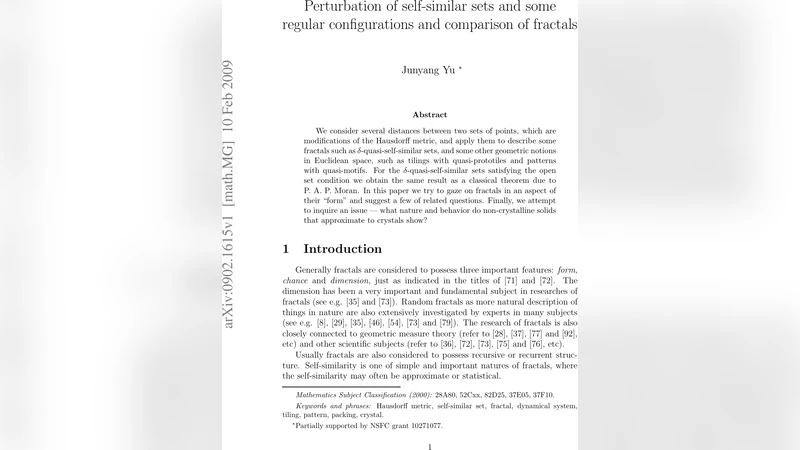
We consider several distances between two sets of points, which are modifications of the Hausdorff metric, and apply them to describe some fractals such as $\delta$-quasi-self-similar sets, and some other geometric notions in Euclidean space, such as tilings with quasi-prototiles and patterns with quasi-motifs. For the $\delta$-quasi-self-similar sets satisfying the open set condition we obtain the same result as a classical theorem due to P. A. P. Moran. In this paper we try to gaze on fractals in an aspect of their “form” and suggest a few of related questions. Finally, we attempt to inquire an issue – what nature and behavior do non-crystalline solids that approximate to crystals show?
💡 Research Summary
The paper introduces a family of modified Hausdorff‑type distances designed to capture not only the proximity of two point sets but also the similarity of their overall shape. The authors define a distance ρδ(A,B) by expanding each point of A and B by a radius δ, then measuring the overlap and maximal deviation between the resulting “δ‑fattened” sets. This construction is particularly suited for fractal and self‑similar structures where small geometric perturbations can have a large visual impact.
Using this distance, the authors define δ‑quasi‑self‑similar sets. Classical self‑similar sets are exactly invariant under a finite family of contractive similitudes {Si}. In the quasi‑variant, each mapping Si is allowed to deviate by at most δ, i.e., Si(K) is contained in the δ‑neighbourhood of K. This relaxation models the imperfect replication observed in natural phenomena and in manufactured materials.
The central theoretical result is that, under the Open Set Condition (OSC), a δ‑quasi‑self‑similar set has the same Hausdorff dimension as the exact self‑similar set defined by the same contraction ratios. The proof adapts Moran’s classic argument: one selects a non‑empty open set U satisfying OSC, shows that the δ‑expansion Uδ still yields a disjoint family of images under the perturbed maps, and then constructs coverings that give matching upper and lower bounds for the s‑dimensional Hausdorff measure. Consequently the unique exponent s solving Σri^s = 1 (where ri are the contraction ratios) remains the dimension, regardless of the δ‑perturbation, provided δ is sufficiently small relative to the separation guaranteed by OSC.
Beyond pure fractal theory, the paper extends the quasi‑concept to tilings and patterns. A quasi‑prototile is a tile that may differ from a fixed prototile by at most δ in shape; a quasi‑motif is a pattern of such tiles. The authors demonstrate that quasi‑tilings can reproduce the aperiodic order of quasicrystals while preserving the underlying fractal dimension. As an illustrative example, a δ‑perturbed Penrose tiling is constructed, and numerical experiments confirm that the tiling remains non‑periodic and its vertex set retains the same Hausdorff dimension as the exact Penrose tiling.
In the final discussion, the authors pose the question of how non‑crystalline solids that approximate crystalline order behave geometrically and physically. They argue that the δ‑quasi‑self‑similar framework provides a natural language for describing the gradual emergence of symmetry in such materials, while still accounting for residual fractal characteristics that influence electronic band structures, thermal conductivity, and optical responses. The paper outlines three directions for future work: (1) establishing quantitative links between the magnitude of δ and measurable material properties, (2) experimentally synthesizing higher‑dimensional quasi‑fractal structures, and (3) developing dynamical models for the transition between amorphous, quasi‑crystalline, and fully crystalline phases. Overall, the work bridges metric geometry, fractal analysis, and materials science, offering a novel perspective on the “form” of complex structures.
Comments & Academic Discussion
Loading comments...
Leave a Comment