Topological conjugacy classes of affine maps
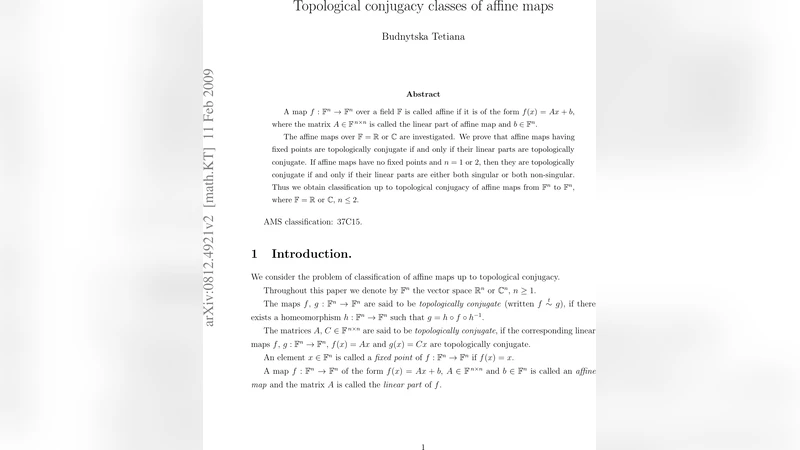
A map $f: \ff^n \to \ff^n$ over a field $\ff$ is called affine if it is of the form $f(x)=Ax+b$, where the matrix $A \in \ff^{n\times n}$ is called the linear part of affine map and $b \in \ff^n$. The affine maps over $\ff=\rr$ or $\cc$ are investigated. We prove that affine maps having fixed points are topologically conjugate if and only if their linear parts are topologically conjugate. If affine maps have no fixed points and $n=1$ or 2, then they are topologically conjugate if and only if their linear parts are either both singular or both non-singular. Thus we obtain classification up to topological conjugacy of affine maps from $\ff^n$ to $\ff^n$, where $\ff=\rr$ or $\cc$, $n\leq 2$.
💡 Research Summary
The paper investigates affine maps (f:\mathbb{F}^n\to\mathbb{F}^n) over the real or complex field, where an affine map is written as (f(x)=Ax+b) with a linear part (A\in\mathbb{F}^{n\times n}) and a translation vector (b\in\mathbb{F}^n). The central problem is to classify such maps up to topological conjugacy, i.e. to determine when there exists a homeomorphism (h) satisfying (h\circ f = g\circ h) for two affine maps (f) and (g). The authors split the analysis according to the existence of fixed points.
If a fixed point exists, a simple translation moves the fixed point to the origin, reducing the affine map to the pure linear map (x\mapsto Ax). Consequently, two affine maps with fixed points are topologically conjugate precisely when their linear parts are topologically conjugate as linear operators. The paper leverages classical results on the topological classification of linear maps: the conjugacy class is determined by the spectral data (real eigenvalues, complex conjugate pairs, and the presence or absence of the eigenvalue zero). In particular, the sign of non‑zero real eigenvalues, the modulus of complex eigenvalues, and whether the matrix is singular or not are the decisive invariants.
When no fixed point exists, the situation is more delicate. The authors treat the low‑dimensional cases (n=1) and (n=2) in full detail. In dimension one, an affine map has the form (f(x)=ax+b). The absence of a fixed point forces either (a=1) with (b\neq0) or (a\neq1). The key observation is that the determinant (here simply the scalar (a)) being zero or non‑zero completely governs topological conjugacy: two such maps are conjugate if and only if both are singular ((a=0)) or both are nonsingular ((a\neq0)).
In dimension two, the authors analyse all possible Jordan or diagonal forms of the linear part (A). The condition “no fixed point” translates into the linear system ((I-A)p=b) having no solution, which is equivalent to (\det(I-A)=0) while (b) does not lie in the image of (I-A). By a careful case‑by‑case study (real eigenvalues, complex conjugate pairs, nilpotent parts), they prove that the only topological invariant needed is again the singularity of (A). Specifically, two affine maps without fixed points in (\mathbb{R}^2) or (\mathbb{C}^2) are topologically conjugate exactly when either both linear parts are singular ((\det A=0)) or both are nonsingular ((\det A\neq0)). No finer spectral information is required in this setting.
Putting the two parts together, the paper delivers a complete classification of affine maps over (\mathbb{R}) and (\mathbb{C}) for dimensions (n\le2):
- If both maps have fixed points, conjugacy reduces to the topological conjugacy of their linear parts.
- If neither map has a fixed point and (n=1) or (2), conjugacy holds precisely when the determinants of the linear parts share the same zero/non‑zero status.
The authors illustrate the classification with explicit examples and provide concise proofs based on constructing appropriate homeomorphisms (often simple translations combined with linear homeomorphisms). The work highlights how a global dynamical equivalence—topological conjugacy—can be completely captured by elementary algebraic invariants in low dimensions. It also suggests natural extensions: investigating higher dimensions, exploring affine maps with mixed fixed‑point behavior, and applying the methodology to more general nonlinear maps. Overall, the paper offers a clear, rigorous, and accessible treatment of affine map classification from a topological dynamics perspective.
Comments & Academic Discussion
Loading comments...
Leave a Comment