Isometry groups of proper CAT(0)-spaces
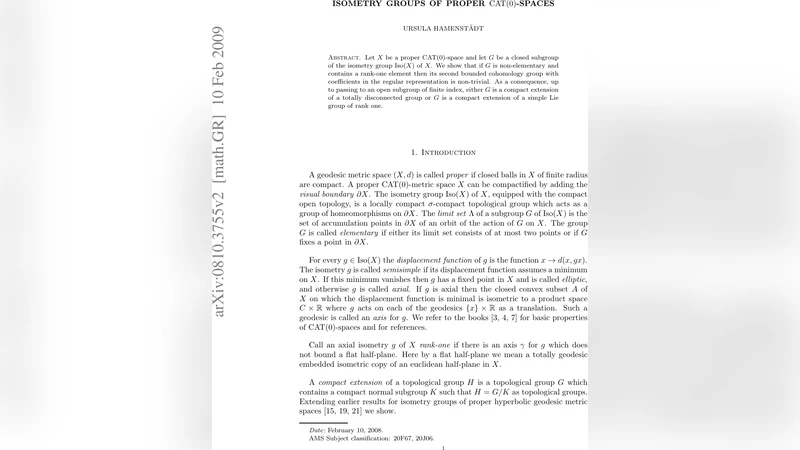
Let G be a closed subgroup of the isometry group of a proper CAT(0)-space X. We show that if G is non-elementary and contains a rank-one element then its second bounded cohomology group with coefficients in the regular representation is non-trivial. As a consequence, up to passing to an open subgroup of finite index, either G is a compact extension of a totally disconnected group or G is a compact extension of a simple Lie group of rank one.
💡 Research Summary
The paper studies closed subgroups G of the isometry group of a proper CAT(0) space X and shows that the presence of a rank‑one element forces a rich bounded cohomology structure. After recalling the basic geometry of proper CAT(0) spaces, the visual boundary ∂X, and the dynamics of isometries, the author defines a non‑elementary subgroup as one whose action on ∂X has infinitely many limit points and contains hyperbolic‑type elements. A rank‑one isometry is an element whose axis does not bound a flat half‑plane; such elements exhibit north‑south dynamics on ∂X and generate Morse quasi‑geodesics.
The core technical achievement is the construction of non‑trivial quasi‑morphisms on G using the axis of a rank‑one element. For a chosen rank‑one element g with axis γ, a counting function φ_g: G → ℝ is defined by measuring how many translates of γ a group element moves across. This function is a quasi‑morphism: it is additive up to a uniformly bounded error. By passing to the regular representation ℓ²(G) and applying the Burger‑Monod correspondence between quasi‑morphisms and bounded 2‑cohomology with ℓ²‑coefficients, the author proves that the class
Comments & Academic Discussion
Loading comments...
Leave a Comment