Compatibility of (co)actions and localizations
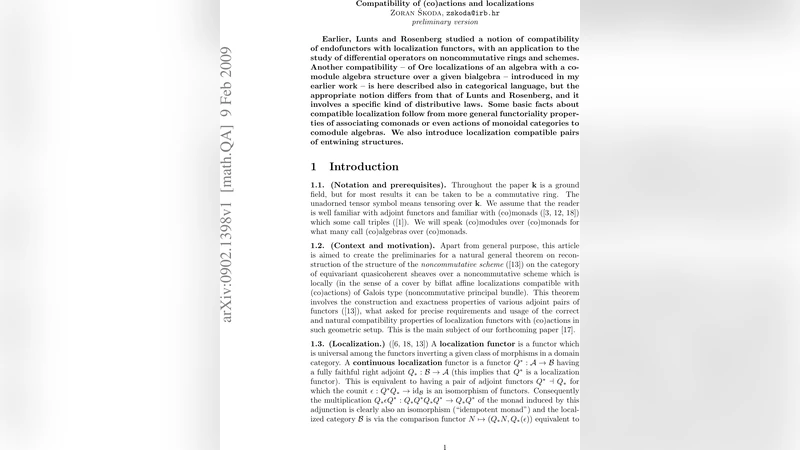
Earlier, Lunts and Rosenberg studied a notion of compatibility of endofunctors with localization functors, with an application to the study of differential operators on noncommutative rings and schemes. Another compatibility – of Ore localizations of an algebra with a comodule algebra structure over a given bialgebra – introduced in my earlier work – is here described also in categorical language, but the appropriate notion differs from that of Lunts and Rosenberg, and it involves a specific kind of distributive laws. Some basic facts about compatible localization follow from more general functoriality properties of associating comonads or even actions of monoidal categories to comodule algebras. We also introduce localization compatible pairs of entwining structures.
💡 Research Summary
The paper revisits the compatibility notion introduced by Lunts and Rosenberg, which requires a natural transformation η: L ∘ F ⇒ F ∘ L between a localization functor L and an endofunctor F. While effective for studying differential operators on non‑commutative rings, this framework does not directly accommodate comodule algebra structures.
The author therefore focuses on a bialgebra B and a B‑comodule algebra A equipped with an Ore localization S⁻¹A. The central question is when the localization respects the B‑coaction on A. The answer is expressed via a distributive law λ: L_S ∘ Γ_A ⇒ Γ_{S⁻¹A} ∘ L_S, where Γ_A(–)=A⊗_B(–) is the comonad induced by the coaction and L_S is the localization functor.
Two precise conditions guarantee the existence of λ: (1) the multiplicative set S must be stable under the coaction, i.e. the image of the coaction ρ(A)⊂A⊗B is closed under inversion by elements of S; (2) L_S must be a strong monoidal functor on the category of B‑modules, preserving tensor products and the unit object. When these hold, λ can be constructed explicitly, and the localized algebra S⁻¹A inherits a natural B‑coaction, making the diagram of functors commute up to λ. This compatibility is fundamentally different from the Lunts‑Rosenberg notion because it relies on a distributive law rather than a mere commuting square.
The paper then extends the discussion to entwining structures (ψ: B⊗A→A⊗B). A pair (ψ, φ) is called localization‑compatible if both entwining maps are preserved by the same localization. Such pairs give rise to localized entwined modules and provide a unified language for treating both coactions and entwining in the presence of Ore localizations.
Finally, the author places these constructions in a 2‑categorical context. The assignment A↦Γ_A defines a comonad, while the B‑module action defines a monoidal 2‑functor. The localization L_S becomes a 2‑natural transformation between these 2‑functors, and the distributive law λ is a modification of this transformation. This higher‑categorical viewpoint clarifies functoriality properties, shows how comonads and monoidal actions transport across localizations, and suggests a pathway to generalize the theory to quantum groups, non‑commutative schemes, and other settings where both coactions and localizations play a central role.
In summary, the work provides a new categorical framework—based on distributive laws and comonad transport—for studying the compatibility of (co)actions with Ore localizations, and it introduces the notion of localization‑compatible entwining pairs, thereby enriching the toolkit available for non‑commutative geometry and quantum algebra.
Comments & Academic Discussion
Loading comments...
Leave a Comment