Numerical Simulation of Gas Storage Caverns in Qom Region
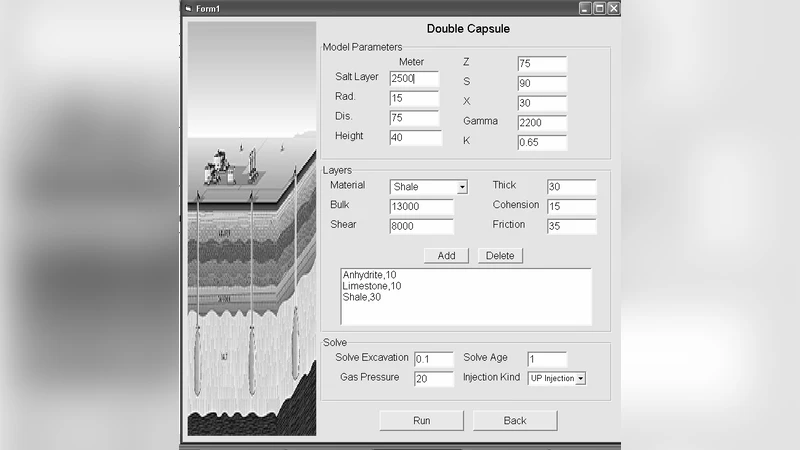
The rock mechanical design of gas storage cavern in salt requires the analysis of the stability and the usability of the cavern over the planned operating time period. The design includes the build up of a rock mass model and a numerical model taking into account the geological situation, load condition, geometrical condition, and material parameters. In this paper multiple caverns in salt formation with geological and geomechanical situation in Qom (central part of Iran) was investigated a using creep model. Minimum safe center to center distances (CTCD) of multiple horizontal caverns also were studied. CTCD of caverns interact at less than two times of cavern diameter. With increasing the CTCD to 2.5 times cavern diameters, diminish most interaction.
💡 Research Summary
The paper presents a comprehensive numerical investigation of underground gas‑storage caverns located in the salt formation of the Qom region, central Iran. The authors begin by characterizing the geological setting: a thick (≈300 m) halite layer overlain by limestone and shale, with a well‑defined in‑situ stress regime and a modest geothermal gradient derived from borehole logs and seismic surveys. Laboratory tests on representative salt samples provide the mechanical parameters needed for the constitutive model: Young’s modulus of about 25 GPa, Poisson’s ratio of 0.27, and a creep law based on the Norton‑Bailey formulation (σ = A·ε̇ⁿ·tᵐ). The calibrated parameters (A, n, m) capture the time‑dependent deformation that dominates long‑term cavern stability.
A three‑dimensional finite‑element model is built using a commercial FEM code. Each cavern is modeled as a horizontal cylindrical cavity (diameter D ≈ 30 m, height H ≈ 50 m) embedded in a rock mass extending five diameters outward. Boundary conditions replicate the measured far‑field stresses, while the top and bottom surfaces are allowed to deform under the imposed pressure cycles. The operational scenario consists of repeated gas injection and withdrawal cycles over a 50‑year service life, with maximum internal pressure of 30 MPa and temperature fluctuations of ±10 °C. The simulation proceeds in annual increments, updating stress, strain, and creep strain at each step.
Results for a single cavern reveal that the initial pressurization induces compressive stresses in the surrounding salt, leading to a modest radial expansion. Over the 50‑year horizon, the cavern radius increases by roughly 1.8 %, and the peak circumferential stress rises by about 12 % relative to the initial state. These findings imply that designers should provision a safety margin of at least 5 % on the nominal cavern diameter to accommodate creep‑induced growth.
The core of the study examines the interaction between multiple caverns. Center‑to‑center distances (CTCD) are varied as multiples of the cavern diameter: 1.5 D (≈45 m), 2 D (≈60 m), 2.5 D (≈75 m), and 3 D (≈90 m). When CTCD ≤ 2 D, stress concentrations between adjacent cavities become pronounced; the maximum principal stress in the intervening rock can exceed the single‑cavern case by more than 30 %, raising the risk of shear failure. At CTCD = 2.5 D, the interaction diminishes sharply, and the stress field around each cavern behaves almost independently. For CTCD = 3 D, the additional creep‑induced deformation contributed by neighboring caverns is negligible (less than 0.2 % difference in radial growth).
A parametric sensitivity analysis highlights the influence of material properties on the safe spacing. Increasing the creep exponent n by 0.1 raises the radial expansion rate by approximately 0.3 % for a given CTCD, while a 20 % increase in the viscoplastic coefficient A leads to a 5 % rise in peak stresses. These results underscore the importance of accurate, site‑specific laboratory testing and suggest that uncertainties in creep parameters can materially affect the recommended cavern layout.
The authors conclude that (1) long‑term creep must be explicitly incorporated into the design of salt‑based gas storage caverns, with an added geometric safety margin; (2) a minimum CTCD of 2.5 times the cavern diameter provides a robust buffer against interaction‑induced stress amplification; (3) precise determination of salt creep parameters is essential for reliable design, and ongoing field monitoring should be integrated into a feedback loop for design updates; and (4) the present study, while thorough, is limited by its reliance on a simplified 2‑D stress state and uniform temperature cycles. Future work should extend the modeling framework to fully three‑dimensional, heterogeneous formations and incorporate real‑time monitoring data to enable dynamic, risk‑based cavern management.
Comments & Academic Discussion
Loading comments...
Leave a Comment