📝 Original Info
- Title: Algorithms for Scheduling Weighted Packets with Deadlines in a Bounded Queue
- ArXiv ID: 0807.2694
- Date: 2009-02-09
- Authors: Researchers from original ArXiv paper
📝 Abstract
Motivated by the Quality-of-Service (QoS) buffer management problem, we consider online scheduling of packets with hard deadlines in a finite capacity queue. At any time, a queue can store at most $b \in \mathbb Z^+$ packets. Packets arrive over time. Each packet is associated with a non-negative value and an integer deadline. In each time step, only one packet is allowed to be sent. Our objective is to maximize the total value gained by the packets sent by their deadlines in an online manner. Due to the Internet traffic's chaotic characteristics, no stochastic assumptions are made on the packet input sequences. This model is called a {\em finite-queue model}. We use competitive analysis to measure an online algorithm's performance versus an unrealizable optimal offline algorithm who constructs the worst possible input based on the knowledge of the online algorithm. For the finite-queue model, we first present a deterministic 3-competitive memoryless online algorithm. Then, we give a randomized ($\phi^2 = ((1 + \sqrt{5}) / 2)^2 \approx 2.618$)-competitive memoryless online algorithm. The algorithmic framework and its theoretical analysis include several interesting features. First, our algorithms use (possibly) modified characteristics of packets; these characteristics may not be same as those specified in the input sequence. Second, our analysis method is different from the classical potential function approach.
💡 Deep Analysis
Deep Dive into Algorithms for Scheduling Weighted Packets with Deadlines in a Bounded Queue.
Motivated by the Quality-of-Service (QoS) buffer management problem, we consider online scheduling of packets with hard deadlines in a finite capacity queue. At any time, a queue can store at most $b \in \mathbb Z^+$ packets. Packets arrive over time. Each packet is associated with a non-negative value and an integer deadline. In each time step, only one packet is allowed to be sent. Our objective is to maximize the total value gained by the packets sent by their deadlines in an online manner. Due to the Internet traffic’s chaotic characteristics, no stochastic assumptions are made on the packet input sequences. This model is called a {\em finite-queue model}. We use competitive analysis to measure an online algorithm’s performance versus an unrealizable optimal offline algorithm who constructs the worst possible input based on the knowledge of the online algorithm. For the finite-queue model, we first present a deterministic 3-competitive memoryless online algorithm. Then, we give a
📄 Full Content
arXiv:0807.2694v4 [cs.DS] 7 Feb 2009
Algorithms for Scheduling Weighted Packets with Deadlines in a
Bounded Queue
Fei Li∗
November 2, 2018
Abstract
Motivated by the Quality-of-Service (QoS) buffer management problem, we consider online
scheduling of packets with hard deadlines in a finite capacity queue.
At any time, a queue can
store at most b ∈Z+ packets. Packets arrive over time.
Each packet is associated with a non-
negative value and an integer deadline. In each time step, only one packet is allowed to be sent. Our
objective is to maximize the total value gained by the packets sent by their deadlines in an online
manner. Due to the Internet traffic’s chaotic characteristics, no stochastic assumptions are made on
the packet input sequences. This model is called a finite-queue model.
We use competitive analysis to measure an online algorithm’s performance versus an unrealizable
optimal offline algorithm who constructs the worst possible input based on the knowledge of the online
algorithm. For the finite-queue model, we first present a deterministic 3-competitive memoryless
online algorithm. Then, we give a randomized (φ2 = ((1 +
√
5)/2)2 ≈2.618)-competitive memoryless
online algorithm.
The algorithmic framework and its theoretical analysis include several interesting features. First,
our algorithms use (possibly) modified characteristics of packets; these characteristics may not be
same as those specified in the input sequence. Second, our analysis method is different from the
classical potential function approach. We use a simple charging scheme, which depends on a clever
modification (during the course of the algorithm) on the packets in the queue of the optimal offline
algorithm. We then prove that a set of invariants holds at the end of each time step. Finally, we
analyze the two proposed algorithm in a relaxed model, in which packets have no hard deadlines but
an order. We conclude that both algorithms have the same competitive ratios in the relaxed model.
1
Introduction
In the last three decades, routers in the Internet continue supporting more and more applications.
Currently, most routers forward packets in a First-In-First-Out (FIFO) manner and treat all packets
equally. However, the diversity of applications has resulted in heterogeneity and unpredictable network
traffic. Thus, it is more reasonable to consider differentiation among packets from different types of
applications (see [23, 1, 17, 2] and the references therein). For instance, we could specify values for
packets to represent their priorities. Also, we may like to assign hard deadlines to packets in time-
critical applications. These concerns have made buffer management at routers significant in providing
effective quality of service (QoS) to various applications.
∗Department of Computer Science, George Mason University. lifei@cs.gmu.edu. Part of this work appears in the Proceedings
of the 28th IEEE International Conference on Computer Communications (INFOCOM 2009) [19].
One kind theoretical research on QoS buffer management starts from three paper by Aiello et al. [1],
by Kesselman et al. [17] and by Hajak [15], where a model called a bounded-delay model is proposed. In
this model, time is discrete. Packets arrive over time, and they are buffered upon arrivals. The queue
capacity is unlimited. An arriving packet p has a non-negative value wp ∈R+ and an integer deadline
dp ∈Z+ by which it should be transmitted; after dp, p expires. In each time step, at most one packet
can be sent. The objective is to maximize the weighted throughput, which is defined as the total value
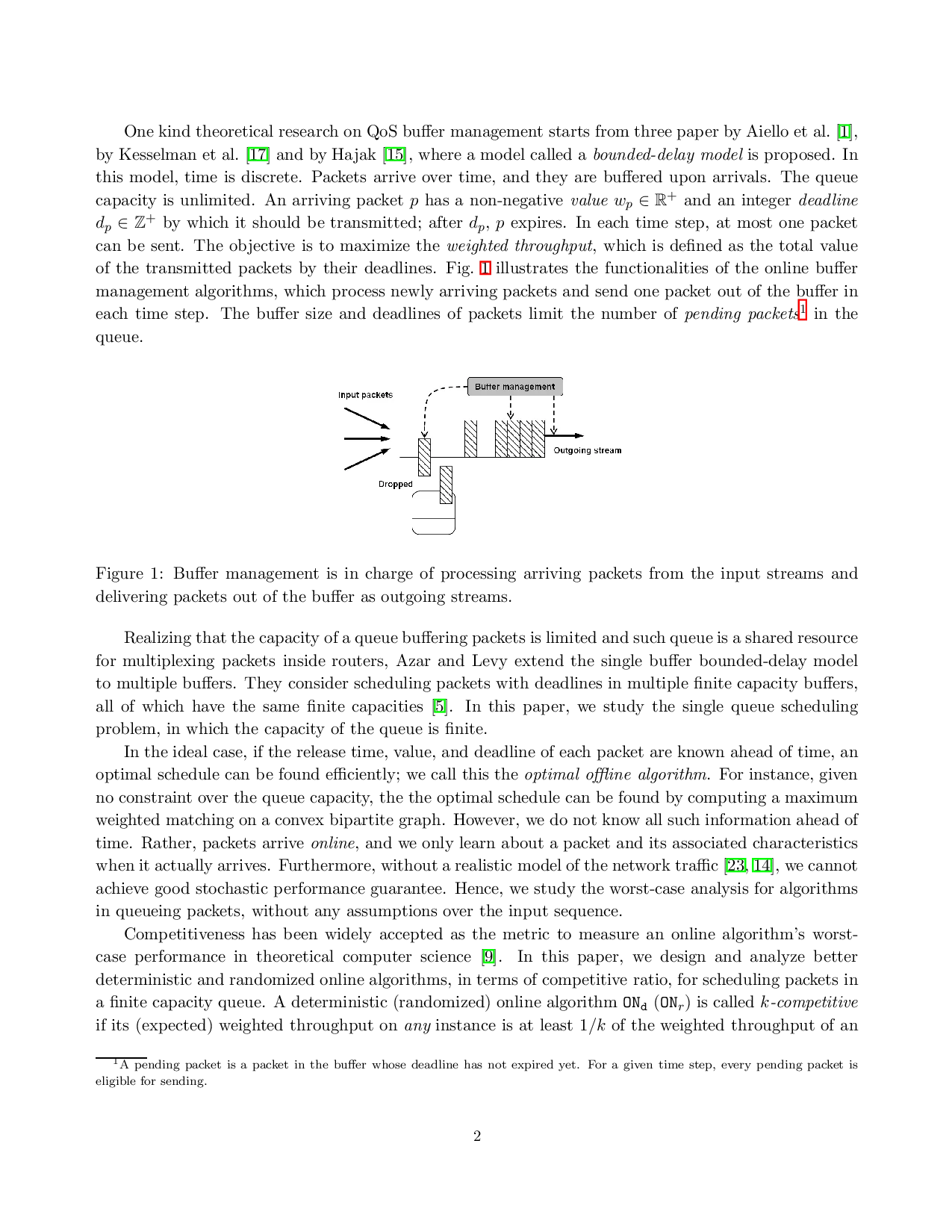
of the transmitted packets by their deadlines. Fig. 1 illustrates the functionalities of the online buffer
management algorithms, which process newly arriving packets and send one packet out of the buffer in
each time step. The buffer size and deadlines of packets limit the number of pending packets1 in the
queue.
Figure 1: Buffer management is in charge of processing arriving packets from the input streams and
delivering packets out of the buffer as outgoing streams.
Realizing that the capacity of a queue buffering packets is limited and such queue is a shared resource
for multiplexing packets inside routers, Azar and Levy extend the single buffer bounded-delay model
to multiple buffers. They consider scheduling packets with deadlines in multiple finite capacity buffers,
all of which have the same finite capacities [5]. In this paper, we study the single queue scheduling
problem, in which the capacity of the queue is finite.
In the ideal case, if the release time, value, and deadline of each packet are known ahead of time, an
optimal schedule can be found efficiently; we call this the optimal offline algorithm. For instance, given
no constraint over the queue capacity, the the optimal schedule can be found by computing a maximum
weighted matching on a convex bipartite graph. However, we do not know all such information ahead of
time. Rather, packets arrive online, and we only learn about a packet and its
…(Full text truncated)…
📸 Image Gallery
Reference
This content is AI-processed based on ArXiv data.