Pareto Optimality and Isoperimetry
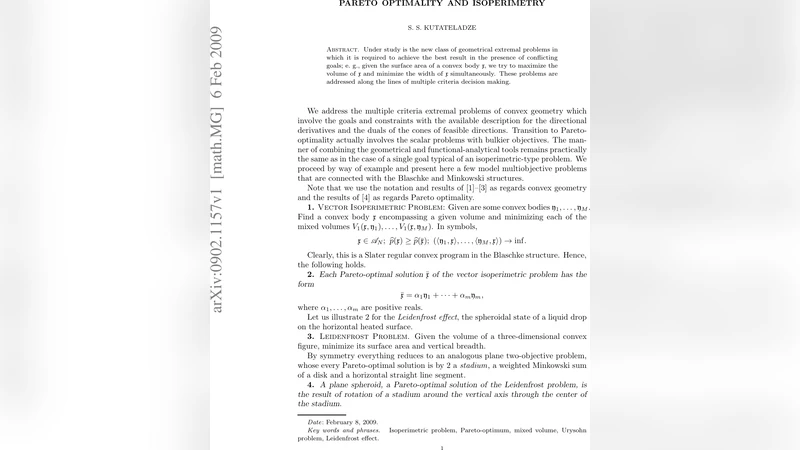
Under study is the new class of geometrical extremal problems in which it is required to achieve the best result in the presence of conflicting goals; e.g., given the surface area of a convex body $\mathfrak x$, we try to maximize the volume of $\mathfrak x$ and minimize the width of $\mathfrak x$ simultaneously. These problems are addressed along the lines of multiple criteria decision making.
💡 Research Summary
The paper introduces a novel class of geometric extremal problems in which several conflicting objectives must be optimized simultaneously. Classical isoperimetric problems—such as maximizing volume for a given surface area or minimizing surface area for a given volume—are extended to a multi‑criteria setting by invoking the concept of Pareto optimality from multiple‑criteria decision making (MCDM). The authors focus on convex bodies 𝔁 in Euclidean space and consider, for a fixed surface area S(𝔁)=S₀, the simultaneous maximization of volume V(𝔁) and minimization of minimal width w(𝔁). The set of feasible bodies under the surface‑area constraint forms a convex feasible region in the space of shape descriptors, and the pair (V(𝔁), w(𝔁)) defines a two‑dimensional objective vector.
A Pareto‑optimal body is defined as one for which no other feasible body can improve one objective without worsening the other. The collection of all such bodies constitutes the Pareto front (or Pareto frontier) in the (V,w)‑plane. The paper shows that this front can be characterized analytically by a multi‑objective Lagrangian
L(𝔁;λ,μ,ν)=λ V(𝔁)−μ w(𝔁)+ν (S(𝔁)−S₀),
where λ, μ≥0 are the weights associated with the two competing goals and ν is the multiplier for the surface‑area constraint. By applying the calculus of variations to the support function h_𝔁(u) of the convex body, the authors derive first‑order optimality conditions (the Karush‑Kuhn‑Tucker conditions) that read, for every direction u on the unit sphere,
λ ∂V/∂h(u)−μ ∂w/∂h(u)+ν ∂S/∂h(u)=0.
These conditions translate into a family of integral equations linking the support function to the curvature distribution of the body.
The analysis reveals that the shape of a Pareto‑optimal body depends continuously on the ratio λ/μ. In the limit λ≫μ the problem reduces to the classical isoperimetric problem, and the unique optimal shape is the sphere, which maximizes volume for a given surface area. Conversely, when μ≫λ the width becomes the dominant objective, and the optimal bodies tend toward shapes that minimize width while preserving surface area, such as thin cylinders or flat plates. For intermediate ratios, the optimal bodies exhibit axial symmetry: they are rotationally symmetric about a distinguished axis, with the support function linear in the axial direction and quadratic in the orthogonal directions. This symmetry result generalizes the well‑known “sphere maximizes volume” theorem to a multi‑objective context, showing that the sphere remains Pareto‑optimal for a whole segment of the Pareto front.
To illustrate the theory, the authors present numerical experiments in two and three dimensions. They discretize the support function, solve the optimality equations for various λ/μ values, and plot the resulting Pareto front. The computed shapes transition smoothly from near‑spherical bodies to elongated, thin bodies as the weight on width increases. The numerical Pareto front matches the analytical predictions and demonstrates the trade‑off curve between volume and width under a fixed surface area.
The paper concludes by discussing implications for design and engineering. In many practical situations—such as material‑efficient structural components, aerospace shells, or biomedical implants—designers must balance competing criteria like strength (related to volume), slenderness (related to width), and material usage (related to surface area). The Pareto‑optimal framework provides a systematic way to explore the entire spectrum of feasible compromises rather than committing to a single scalarized objective.
Finally, the authors outline future research directions. Extending the approach to non‑convex bodies, incorporating additional physical quantities (elastic energy, surface tension, thermal conductivity), and developing efficient computational algorithms for high‑dimensional shape spaces are identified as promising avenues. The work thus opens a bridge between classical geometric inequalities and modern multi‑objective optimization, offering both theoretical insight and practical tools for complex shape design.
Comments & Academic Discussion
Loading comments...
Leave a Comment