Recursive properties of Dirac and Metriplectic Dirac brackets with Applications
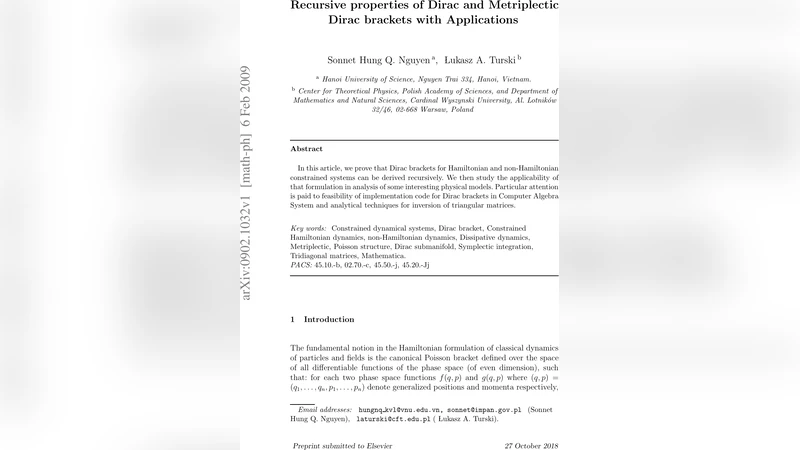
In this article, we prove that Dirac brackets for Hamiltonian and non-Hamiltonian constrained systems can be derived recursively. We then study the applicability of that formulation in analysis of some interesting physical models. Particular attention is paid to the feasibility of implementation code for Dirac brackets in Computer Algebra System and analytical techniques for inversion of triangular matrices.
💡 Research Summary
The paper addresses a long‑standing computational bottleneck in the treatment of constrained dynamical systems: the evaluation of Dirac brackets, which require the inversion of the constraint matrix. Traditional approaches compute the full inverse of the constraint matrix in one step, an operation whose cost grows cubically with the number of constraints and quickly becomes prohibitive for high‑dimensional systems. The authors propose a recursive construction of Dirac brackets that sidesteps the need for a single large matrix inversion.
The work begins with a concise review of Poisson brackets, Dirac brackets, and the extension to metriplectic (or GENERIC) structures that combine Hamiltonian dynamics with dissipative, entropy‑producing terms. The authors emphasize that both Hamiltonian and non‑Hamiltonian constrained systems can be described within a unified algebraic framework, provided an appropriate bracket is defined.
The central technical contribution is the derivation of a recursion formula for the inverse of an upper‑triangular constraint matrix (C). By performing a sequence of Schur complements, the authors show that the inverse of an (n\times n) matrix can be built from the inverse of an ((n-1)\times (n-1)) sub‑matrix together with a few scalar operations: \
Comments & Academic Discussion
Loading comments...
Leave a Comment