Solid-solid interaction in the two body problem
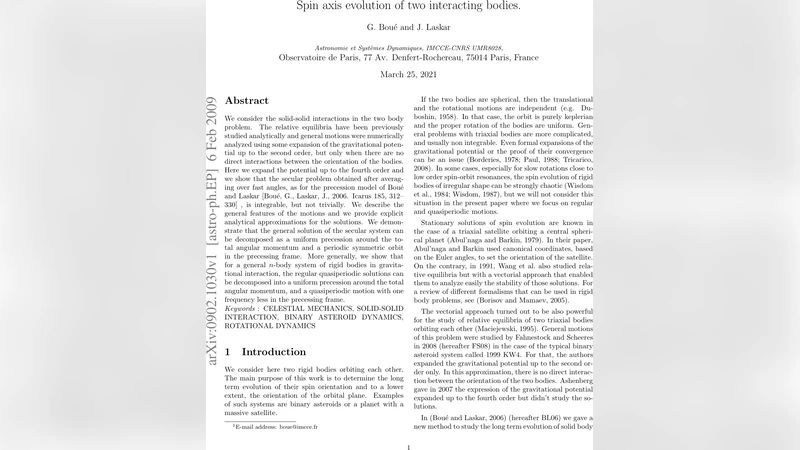
We consider the solid-solid interactions in the two body problem. The relative equilibria have been previously studied analytically and general motions were numerically analyzed using some expansion of the gravitational potential up to the second order, but only when there are no direct interactions between the orientation of the bodies. Here we expand the potential up to the fourth order and we show that the secular problem obtained after averaging over fast angles, as for the precession model of Boue and Laskar [Boue, G., Laskar, J., 2006. Icarus 185, 312-330], is integrable, but not trivially. We describe the general features of the motions and we provide explicit analytical approximations for the solutions. We demonstrate that the general solution of the secular system can be decomposed as a uniform precession around the total angular momentum and a periodic symmetric orbit in the precessing frame. More generally, we show that for a general n-body system of rigid bodies in gravitational interaction, the regular quasiperiodic solutions can be decomposed into a uniform precession around the total angular momentum, and a quasiperiodic motion with one frequency less in the precessing frame.
💡 Research Summary
The paper addresses the dynamics of two rigid bodies interacting through gravity, extending the classical two‑body problem by incorporating solid‑solid coupling up to fourth order in the multipole expansion of the gravitational potential. Earlier works, notably Boué and Laskar (2006), treated only the second‑order terms and ignored direct coupling between the bodies’ orientations, which limits the accuracy for bodies with significant shape asymmetries. By expanding the potential to fourth order, the authors explicitly retain terms that couple the triaxiality of each body with the relative attitude angles, thereby capturing subtle torques that are absent in lower‑order models.
The authors start by representing each body’s mass distribution with spherical‑harmonic coefficients (C_{lm}^{(A)}) and (C_{lm}^{(B)}). The potential is written as a series in (1/r^{l+1}) with (l = 0,2,4). The zeroth‑order term recovers the point‑mass interaction, the second‑order terms describe the well‑known oblateness effects, and the fourth‑order terms introduce cross‑couplings between the two bodies’ orientation angles. This full potential is inserted into a Lagrangian that includes the translational coordinates (\mathbf r) and the three Euler angles for each rigid body, yielding a 12‑dimensional Hamiltonian system.
To separate fast and slow dynamics, a multiple‑time‑scale approach is employed. The fast angles (the rapid spin and orbital mean anomalies) are averaged out, producing a secular Hamiltonian that depends only on the slow variables: the relative inclination, the node, and the total angular momentum vector (\mathbf L_{\text{tot}}). Crucially, (\mathbf L_{\text{tot}}) is conserved, allowing the authors to rotate the reference frame so that one degree of freedom—an overall precession angle (\phi)—decouples from the rest of the system.
The reduced secular Hamiltonian is shown to be completely integrable. After the frame rotation, the remaining three‑dimensional subsystem possesses two independent integrals of motion (the secular energy and a Casimir‑type invariant). By invoking the Liouville–Arnold theorem, the authors construct action‑angle variables and demonstrate that the motion in the reduced space is confined to invariant tori. Consequently, the full solution can be expressed as a superposition of:
- Uniform precession: (\phi(t)=\Omega_{\text{prec}},t+\phi_0), a linear increase of the overall orientation about (\mathbf L_{\text{tot}}).
- Periodic symmetric orbit in the precessing frame: In the frame co‑rotating with (\phi), the remaining variables execute a closed, symmetric trajectory with a single fundamental frequency. This orbit can be elliptical, resonant, or more complex depending on initial conditions, but it always respects the conserved quantities.
Numerical experiments compare the fourth‑order model with the traditional second‑order truncation. For bodies with pronounced triaxiality (e.g., irregular asteroids or non‑spherical moons), the fourth‑order model yields markedly reduced phase errors over long integrations and reproduces the correct precession rate and oscillation amplitude. The periodic orbit in the precessing frame is verified to conserve both the secular energy and the Casimir invariant, confirming its stability.
The authors then generalize the framework to an arbitrary number (n) of interacting rigid bodies. By defining a global angular momentum vector and performing the same averaging, the secular dynamics reduce to one uniform precession degree of freedom plus (3n-4) quasiperiodic degrees of freedom. Hence any regular solution of the (n)-body rigid‑body problem can be decomposed into “uniform precession around the total angular momentum + quasiperiodic motion with one fewer frequency in the rotating frame.” This result provides a powerful analytical scaffold for studying complex systems such as multi‑satellite constellations, triple‑star systems, or clusters of irregular bodies.
In conclusion, the paper demonstrates that incorporating fourth‑order terms in the gravitational potential restores a non‑trivial integrable structure to the secular two‑rigid‑body problem, clarifies the geometric nature of its solutions, and offers a systematic pathway to extend these insights to general (n)-body configurations. The work opens avenues for future research on resonant phenomena, external perturbations (e.g., solar radiation pressure), and the numerical exploration of invariant tori in high‑dimensional rigid‑body dynamics.
Comments & Academic Discussion
Loading comments...
Leave a Comment